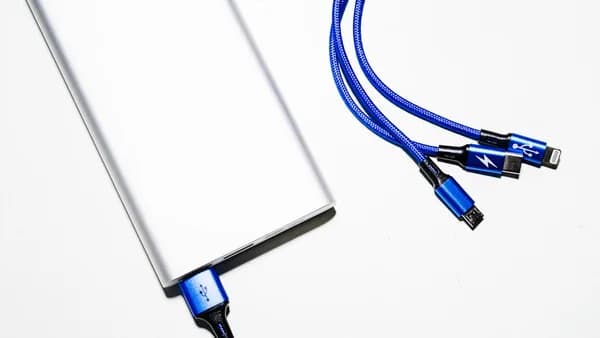
On May 30, 2026, Solly surfaced as a unusually dense charging pitch: a 300W power bank with a fold-down wall plug, built-in USB-C cable, solar backup, and planned August shipping — all inside a 3.1 x 2 x 1.4-inch device weighing 14.1 oz.
That timing matters because the product is not being sold as a finished retail item. It is part of a crowdfunding campaign, with early pricing starting at $89, according to Notebookcheck. The headline spec is aggressive, much like the 120 km e-bike bet. The delivery risk is part of the story.
Notebookcheck warns that the campaign “carries a considerable financial risk for backers” and says it “seems very ambitious,” making the crowdfunding risk “relatively high in this specific case.”
May 30: Solly’s pitch compresses a charger, cable, and solar backup into 14.1 oz
The most interesting part of Solly is not the solar panel. It is the attempt to make a high-output power bank behave more like a self-contained travel charger.
The device includes an integrated plug, with US, EU, and UK versions planned. That plug folds into the body, which should make the unit easier to pack and less awkward than a fixed-prong brick. It also includes a built-in USB-C cable that doubles as a lanyard and is said to transmit up to 100W.
That matters because most power banks still create a small accessory chain: battery, wall charger, USB-C cable, sometimes a regional adapter. Solly’s pitch cuts that stack down. For travelers or remote workers, fewer loose pieces is the real convenience claim.
MLXIO analysis: this is the same product-design logic behind compact charger stories like Pikachu Turns Anker Nano Charger Into 70W Fan Bait and niche setup hardware like Acer’s strip display. The power spec gets attention, but the hook is physical convenience — how the thing fits into a bag, a desk, or a travel routine.
The 300W label hides the real constraint: 74 Wh
The 300W figure sounds closer to a small power station than a conventional phone battery pack. But Notebookcheck notes a key caveat: that figure refers to combined output across all ports, not necessarily one device drawing 300W from a single connector.
The listed port mix is still serious:
| Solly spec | Source-supported detail |
|---|---|
| Capacity | 74 Wh |
| Total output | Up to 300W combined |
| USB-C ports | Two ports, up to 140W each |
| Built-in USB-C cable | Up to 100W |
| USB-A | Up to 20W |
| Recharge input | Integrated plug or USB-C up to 140W |
| Plug versions | US, EU, UK |
| Weight | 14.1 oz |
| Dimensions | 3.1 x 2 x 1.4 inches |
The distinction between output and capacity is the buyer filter here. 300W describes how quickly the device can push power out across ports. 74 Wh describes how much energy it stores. A high output rating can make laptop charging possible, but it does not make the battery large.
That is why Solly sits in a narrow middle lane. It is more ambitious than a basic phone top-up pack. It is not presented as a full-size portable power station with a large battery reserve. The product’s usefulness depends on whether buyers need short bursts of high-output charging rather than long-duration backup.
The built-in solar panel should also be read cautiously. The source says it is supposed to provide “a certain amount of charge” in an emergency. That framing is important. This is not described as a primary recharge method. It is a fallback.
August shipping turns the built-in plug into the credibility test
Solly’s integrated wall charging could become its strongest feature if it works well. The power bank can recharge through the foldable plug or through USB-C at up to 140W, which gives users two paths back to full power.
That also concentrates risk. A separate charger can be replaced. A built-in plug and charger circuit are part of the product. If the folding mechanism, plug assembly, or internal charging system fails, the convenience advantage shrinks fast.
For European buyers, the EU plug option is a practical detail, not just a localization note. A power bank with an integrated plug only works cleanly if the plug matches the wall. Regional versions reduce adapter clutter, but they also make buyers think harder about where they will use the device most.
MLXIO analysis: Solly’s foldable body and plug design put it closer to the broader hardware push toward compact, hinge-driven devices — a theme we also see in phone hardware coverage like Case Leak Exposes Foldable iPhone Ultra Before Apple. Different category, same pressure: moving parts make devices easier to carry, but they also create durability questions that specs alone cannot settle.
Solid-state safety claims need proof beyond the spec sheet
Notebookcheck says Solly is described as a solid-state power bank, and that it “should not go into thermal runaway even under severe physical stress.”
That is a meaningful claim because high-output charging raises the stakes for heat management. But the source does not provide independent test data, certification details, or long-term durability results. So the right reading is cautious: the manufacturer is positioning battery chemistry as a safety advantage, but backers do not yet have the evidence a finished retail review would provide.
The same applies to sustained output. The source supports the headline ratings: 300W combined, 140W per USB-C port, 20W over USB-A. It does not establish how long Solly can maintain high draw, how hot it gets, or whether output drops under load.
That gap matters more than usual because the campaign’s promise is not just “charge a phone.” It is “carry one compact device that can handle multiple higher-power jobs.” That claim lives or dies in testing.
The buyer split is clear: less cable clutter or more power density
Solly’s strongest audience is not every power bank buyer. It is the person who hates carrying a charger, cable, and battery as separate items.
For that buyer, the appeal is direct:
- Travel simplicity: Fold-down plug, built-in cable, regional plug options.
- Laptop relevance: Two USB-C ports are said to deliver up to 140W each.
- Fallback charging: Solar is framed as emergency support, not daily fuel.
- Compactness: The device is listed at 3.1 x 2 x 1.4 inches and 14.1 oz.
- Recharge flexibility: Wall plug or USB-C input up to 140W.
For creators, campers, and remote workers, the questions get sharper. Is 74 Wh enough for the intended workload? Are the ports available in the right mix? Does the solar panel add meaningful emergency value? Can the unit manage heat when several devices draw power at once?
Notebookcheck’s risk warning should sit at the center of any buying decision. A $89 early crowdfunding price is attractive only if the final product lands near the promised spec, ships on schedule, and performs safely.
The next proof point is not another wattage claim
The next decision point is August, when shipping is scheduled. Until then, Solly is best treated as an ambitious crowdfunding device with a compelling spec sheet and unresolved execution risk.
The evidence that would strengthen the case is straightforward: independent testing of sustained output, recharge time through the wall plug and USB-C, heat behavior under multi-port load, solar recovery in real conditions, and confirmation of safety certifications and shipping terms.
The evidence that would weaken it is just as clear: delays, reduced output ratings, vague safety documentation, poor thermal performance, or a solar feature that adds little beyond marketing.
Solly’s headline is 300W. The real test is whether a compact, foldable, self-charging power bank can deliver that promise without turning convenience into compromise.
The Bottom Line
- Solly promises an unusually compact all-in-one charger for travelers who want fewer accessories.
- The 300W headline spec and 100W built-in cable make the device ambitious for its 14.1 oz size.
- Because it is crowdfunding-based with early pricing at $89, buyers face delivery and execution risk.