Power banks were supposed to compete on bigger batteries; EcoFlow is making the cable the product.
The company has launched three compact 45 W models — the Rapid power bank (10K), Rapid power bank (20K), and Rapid 3-in-1 power bank (10K) — each built around a pocket-sized body, an integrated cable, and an LED display, according to Notebookcheck. That signals a sharper bet: for daily-carry charging, the winning feature may not be raw capacity. It may be whether the charger is ready when the user’s bag is not.
EcoFlow turns cable clutter into the real battleground
The expected move for a portable power brand is simple: raise capacity, raise wattage, raise the price. EcoFlow did some of that, but the more revealing decision is physical. Every new Rapid model includes a built-in USB-C cable.
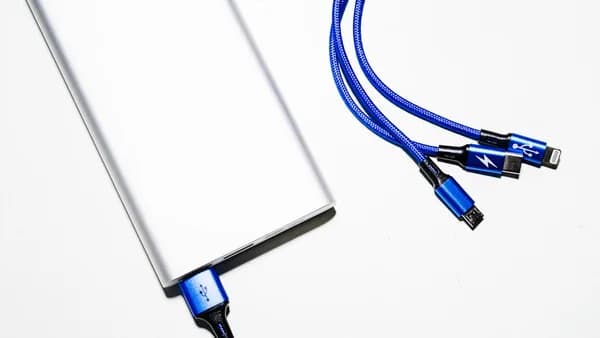
That matters because the failure point in mobile charging is often mundane. The battery is charged, but the cable is missing. The phone supports fast charging, but the loose cable is wrong. The power bank is in the bag, but the charging setup becomes three separate objects.
EcoFlow’s answer is to collapse the kit.
- Before: power bank, cable, possibly wall adapter, and guesswork.
- After: battery, cable, display, and in one model, a folding wall plug.
The company frames the lineup as designed for “modern and mobile lifestyles,” per the source material. MLXIO analysis: that phrase is marketing-heavy, but the hardware choices are concrete. EcoFlow is trying to move its power identity from larger energy products into the smaller, more habitual space of phones, tablets, earbuds, and travel bags.
For readers comparing portability claims across device categories, MLXIO’s related coverage includes 300W Power Bank Bets $89 on Risky Solar Travel Pitch, portable battery-powered fan, and $5,766 HP EliteBook X Flip G2i Bets on Tiny Laptop Power. The shared question is not just “how much power?” It is “how much compromise fits in a bag?”
Rapid 10K, Rapid 20K, and Rapid 3-in-1 10K split the convenience trade-off
EcoFlow’s three models share the same headline ceiling: 45 W maximum output. They also share the same basic promise: compact charging with fewer loose parts.
| Model | Capacity | Max output | Built-in cable | Extra design point | Price |
|---|---|---|---|---|---|
| Rapid power bank (10K, 45 W) | 10,000 mAh | 45 W | 70 cm retractable USB-C | Three outputs; pocket-sized body | $42 |
| Rapid power bank (20K, 45 W) | 20,000 mAh | 45 W | 24 cm USB-C cable | Cable doubles as carry strap; aluminum alloy shell | $46 |
| Rapid 3-in-1 power bank (10K, 45 W) | 10,000 mAh | 45 W | USB-C cable | Folding wall plug | $70 |
The Rapid 10K is the most straightforward daily-carry unit. Notebookcheck lists its dimensions at 90 x 49.9 x 39.17 mm and weight at about 230 grams. It has a 70 cm retractable USB-C cable, plus USB-C and USB-A outputs. EcoFlow says the retractable cable is durable enough for over 10,000 bends.
The Rapid 20K doubles the stated capacity to 20,000 mAh and weighs about 360 grams. Its cable is shorter at 24 cm, but it also works as a carry strap. That is a different convenience argument: less cable reach, more grab-and-go utility.
The Rapid 3-in-1 is the most aggressive version of the “fewer accessories” pitch. It combines a power bank, built-in USB-C cable, and folding wall plug. Specs-wise, it stays close to the 10K model: 10,000 mAh, 45 W, LED display, USB-A, and USB-C.
The 45 W number is useful, but it is not the whole performance story
EcoFlow claims the Rapid 10K can charge the iPhone 17 Pro Max to 50% in just 20 minutes when using single-port mode. That is the strongest real-world performance claim in the supplied material.
The important qualifier is “single-port mode.” The 10K model offers three outputs, but the maximum figure does not mean every connected device gets 45 W at once. EcoFlow says it offers a maximum of 45 W output across three ports. For buyers, that distinction matters more than the badge on the box.
Capacity has its own caveat. 10,000 mAh and 20,000 mAh are useful shorthand, but real delivered energy is lower after conversion losses and heat. That does not undermine the products. It just means the 20K model is not merely “twice as convenient.” It is heavier, larger in practical carry terms, and still bound by the same 45 W output ceiling.
The LED display is a small but meaningful usability upgrade. Simple indicator dots often force users to guess whether a battery is at one-third or nearly empty. A display makes the device easier to trust during travel, commuting, or a long workday away from outlets.
EcoFlow also gives the 20K model a durable aluminum alloy shell and X-Guard protection, including intelligent temperature control and multiple safety features. That is the model where the company appears most focused on endurance rather than pure pocketability.
EcoFlow shrinks its portable-power pitch without proving a market shift
EcoFlow’s own broader positioning supports the logic of this launch. In an August 25, 2025 announcement, the company described the RAPID Pro Series, RAPID Series, and RAPID Mag Series as on-the-go charging lines for work, travel, and daily life, via PRNewswire.
“By integrating advanced technologies from our larger portable power stations, RAPID can offer pro-grade fast charging, safe operation and smart customization in an ultra-convenient form factor. It's more than a power bank— it's a versatile, personal energy companion for every moment of the day,” Essenmacher said.
That quote is doing a lot of brand work. The three new 45 W models are not the high-output end of EcoFlow’s Rapid family. The same PR material describes a RAPID Pro Power Bank (27650mAh, 300W, 140W Built-in Cable) priced at $179.99, and a RAPID Pro X Power Bank (27650mAh, 300W) priced at $249.99.
The pocket-sized 45 W units sit below that. They are not trying to replace higher-output mobile power gear. They are trying to make everyday charging less annoying.
MLXIO analysis: that is the right lens for these models. The $42 and $46 prices make the 10K and 20K units look like practical add-ons, while the $70 3-in-1 asks users to pay more for integration. The question is whether the folding plug saves enough friction to justify the jump.
Travelers and remote workers will judge the same specs differently
A commuter may see the Rapid 10K as enough: small body, retractable cable, quick phone top-up, three-device support when needed. A heavier traveler may look at the Rapid 20K and accept the extra weight because the stated capacity buys more margin.
Remote workers and students sit somewhere between those use cases. Phones, earbuds, tablets, and occasional emergency charging all benefit from a power bank that does not require a cable hunt. But power users may still be skeptical. Built-in cables are convenient until they are damaged, too short, or the wrong connector for a future device.
EcoFlow tries to answer part of that concern with the over 10,000 bends claim on the Rapid 10K retractable cable. Still, durability claims are not the same as long-term field data. That is where reviews will matter.
The next test is not launch volume — it is cable durability and charging consistency
EcoFlow’s three new Rapid power banks point to a convenience-first buying logic. Capacity still matters. Wattage still matters. But the more interesting shift is that the cable, display, and wall-plug design are now central selling points rather than afterthoughts.
The thesis will strengthen if independent testing confirms three things: the built-in cables hold up, the 45 W output behaves reliably across supported devices, and the LED display accurately reflects remaining charge under real use.
It weakens if users find the integrated cables limiting, the 3-in-1 plug design too bulky, or the multi-device charging behavior less useful than the headline spec suggests. EcoFlow has made pocket power simpler on paper. The next evidence will come from pockets, bags, airports, desks, and the failure point every built-in cable eventually has to face: daily use.
The Bottom Line
- EcoFlow is shifting attention from bigger batteries to everyday charging convenience.
- Built-in USB-C cables reduce the common problem of carrying a power bank without the right cable.
- The lineup pushes EcoFlow further into daily mobile accessories beyond its larger power products.