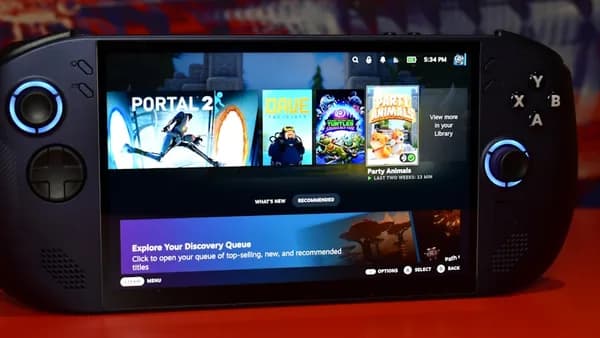
Acer is putting the Nitro Blaze name on a Linux handheld with 1GB of RAM and 8GB of eMMC storage — specs that make no sense for native PC gaming and perfect sense if the device is really a couch-streaming terminal for people who already own a stronger machine.
The Acer Nitro Blaze Link, announced for release in Q4 2026, is built around PC game streaming rather than Steam Deck-style local play, according to Notebookcheck. That puts it closest to the Logitech G Cloud, not Acer’s heavier Windows handheld ambitions.
For buyers, the pitch is narrow but clear: if your gaming PC or laptop already does the rendering, the handheld only needs to decode the stream, hold a stable Wi-Fi connection, feel good in the hands, and avoid costing too much. The risk is just as clear. A dedicated streaming handheld must justify itself against phones, tablets, controller grips, and full handheld PCs.
Acer’s Nitro Blaze Link Bets That Cloud Handhelds Can Still Win Without Premium Silicon
Acer’s most interesting decision is not the screen, the controls, or the weight. It is the refusal to chase Steam Deck-class hardware here.
The Nitro Blaze Link sits inside Acer’s gaming handheld brand, but it does not run Windows like prior Nitro Blaze devices. It runs Linux, and its reported memory and storage land closer to cheap Android handhelds than to native PC gaming machines. That is not a spec-sheet accident. It is the product thesis.
Acer appears to be asking a different question: why pay for local gaming silicon if the actual game is running on a laptop or desktop nearby?
The buyer Acer seems to be targeting
This is not aimed at the person who wants to install a huge Steam library directly onto a handheld. It is aimed at someone who already has a capable PC and wants a lighter device for another room.
That matters because the cost structure changes. A native handheld needs the processor, graphics horsepower, storage, memory, cooling, battery capacity, operating system support, and thermals to run games locally. A streaming handheld can strip that down. The hard work happens elsewhere.
MLXIO analysis: Acer is using the Nitro brand to test whether handheld gaming can split into clearer tiers: premium portable PCs at one end, streaming-first companion devices at the other. The Nitro Blaze Link is not trying to win benchmarks. It is trying to avoid needing them.
The embedded question for Acer is blunt: can a gaming brand sell a handheld that is intentionally underpowered if the use case is focused enough?
Nitro Blaze Link Specs Signal a Streaming Device, Not a Steam Deck Rival
The spec list makes Acer’s intent hard to miss.
The Nitro Blaze Link has a 7-inch touch display with 1920 × 1200 resolution and a 16:10 aspect ratio. Notebookcheck notes that this matches the Logitech G Cloud on screen size but gives Acer’s device a higher resolution. Acer has not listed a high refresh rate, and Notebookcheck presumes the display refreshes at 60Hz.
The reported internals are far more revealing:
- Memory: 1GB of LPDDR4 RAM, per Videocardz reporting cited in the source material.
- Storage: 8GB of eMMC storage.
- Battery: single-cell 18Wh battery.
- Charging: 15W over USB-C.
- Wireless: Wi-Fi 6 for low-latency streaming from a laptop or PC.
- Software: reported support for Sunshine and Moonlight, a local game-streaming setup where the PC renders the game and the handheld receives the stream.
Those numbers would be disqualifying for a conventional PC handheld. They are not enough for a broad local gaming library. The Verge put the gap sharply: the Blaze Link is “technically not even enough RAM to run Stardew Valley,” because it is not meant for local play.
The performance target shifts from frame rates to latency
For a streaming-first device, raw CPU and GPU power matter less than the chain between host PC, router, handheld, display, decoder, and controls.
That makes the real product questions different:
- Wi-Fi reliability: Can Wi-Fi 6 hold a low-latency stream in typical homes?
- Display quality: Does the 1920 × 1200 panel look sharp enough at 7 inches?
- Battery life: Does the 18Wh pack hold up when the device is decoding video and powering a bright screen?
- Controls: Do the joysticks, D-pad, triggers, and buttons feel good enough for long sessions?
- Software support: Do Sunshine and Moonlight work cleanly out of the box?
Acer’s design covers the expected control layout: two thumbsticks, a D-pad, ABXY buttons, Home, Back, Start, a mute button, stacked shoulder and trigger buttons, power and volume buttons on top, USB-C, and a bottom audio jack. It also includes dual front-facing 2W speakers.
The question for users is whether “good enough to stream” feels like a purpose-built product or a compromise.
The Numbers That Will Decide Whether Acer Can Undercut Logitech G Cloud
The price is the missing number that decides the whole story.
Acer has not revealed pricing for the Nitro Blaze Link. That omission matters because every known spec points toward a product that must undercut stronger handhelds and likely undercut the Logitech G Cloud to avoid immediate skepticism.
The G Cloud gives Acer a clean comparison point. Logitech’s handheld launched at $350, with 4GB of RAM, 64GB of storage, and Android, according to additional reporting from The Verge. Acer’s device reportedly carries only 1GB of RAM and 8GB of storage, but it also has a sharper 1920 × 1200 display and is aimed at PC streaming.
| Device / category | Screen | RAM | Storage | OS | Known price | Core use case |
|---|---|---|---|---|---|---|
| Acer Nitro Blaze Link | 7-inch, 1920 × 1200, 16:10 | 1GB | 8GB eMMC | Linux | Not announced | PC game streaming |
| Logitech G Cloud | 7-inch | 4GB | 64GB | Android | $350 | Cloud and remote play |
| Notebookcheck’s sub-$150 spec comparison | Varies | Varies | Varies | Varies | Under $150 reference in coverage | Hardware-price comparison point |
The 464-gram weight is another important number. Acer says that weight makes the handheld easy to carry and comfortable for long gaming sessions. That is the kind of claim reviewers will test immediately because comfort is one of the few areas where a dedicated device can beat a phone-and-controller setup.
Price is not just a sticker problem
If Acer prices the Nitro Blaze Link too close to full Windows handhelds, the spec sheet becomes a liability. Buyers will ask why they should accept 1GB of RAM, 8GB of storage, and no native PC gaming capability when more capable devices exist.
If Acer prices it closer to the low-cost hardware comparison referenced in early coverage, the calculation changes. Then the product becomes less about replacing a Steam Deck and more about buying a fixed-purpose screen-and-controller for local PC streaming.
There is also a hidden cost question. A streaming-first handheld may rely on a gaming PC, a laptop, or a paid cloud gaming subscription. Acer’s hardware price is only one line in the buyer’s actual budget.
That is why this device sits closer to the logic behind cheap media and streaming hardware than to premium gaming hardware. We saw a similar cost-versus-purpose tension in consumer tech with the $150 Roku TV projector that ditches the streaming stick: if the device is narrowly built around one job, the price has to make that narrowness feel efficient.
The question for Acer is simple: does the final price make the missing horsepower look intentional rather than cheap?
Logitech G Cloud Showed the Promise—and the Pricing Problem—Acer Now Faces
The Logitech G Cloud already proved that dedicated cloud handhelds can exist. It also showed how quickly pricing can poison the pitch.
At $350, the G Cloud had to defend itself against stronger handheld hardware and against smartphones with controller attachments. Its value depended heavily on internet quality and cloud or remote-play services. Acer is entering the same category with an even leaner hardware profile, but a clearer PC-streaming identity.
That difference matters. The Nitro Blaze Link is not positioned as an Android gaming tablet with controls. It runs Linux and is tied to PC streaming software. Videocardz reports it ships with Sunshine and Moonlight, which points toward local game streaming rather than trying to be a broad mobile gaming device.
Acer’s strategy looks narrower than Logitech’s
The G Cloud was a general cloud handheld. Acer’s device looks more like a PC companion.
That could help messaging. A narrower promise is easier to meet: stream games from your PC or laptop over Wi-Fi 6. But it also limits the audience. If someone wants broad Android app support, Acer has not provided that claim. If someone wants native PC play, the reported specs rule that out.
Acer also has to contend with expectations set by more powerful handhelds. The market has already seen devices that try to put PC-grade performance in portable form. MLXIO recently covered how the May 28 Intel Arc G3 leak threw another chip into the handheld race, a reminder that one side of the category keeps moving toward more powerful local hardware.
MLXIO analysis: Acer is choosing not to fight that battle with the Blaze Link. Instead of chasing silicon, it is betting that enough players want the handheld form factor without paying for a second gaming PC.
The question is whether timing has improved since the G Cloud: are buyers now more willing to accept a dedicated streaming device because premium handhelds are more expensive and local streaming tools are more familiar?
Gamers, Acer, Cloud Platforms, and Retailers All Want Different Things From Nitro Blaze Link
Different groups will judge the Nitro Blaze Link by different standards, and that is where Acer’s launch messaging becomes critical.
For casual players, the device has to feel simple. Turn it on, connect to the PC, play. The 7-inch touchscreen, front-facing speakers, standard controls, and ergonomic grips all serve that goal.
For PC gamers, the test is harsher. They will care about input latency, bitrate stability, controller mapping, sleep/wake behavior, and whether Moonlight works cleanly with their existing gaming machine. They will also notice any limitations in Acer’s compatibility claims.
The key unresolved support question is how broadly Acer will validate host systems beyond its own gaming PCs and laptops. If Acer markets the Nitro Blaze Link mainly as a companion for Predator and Nitro laptops, it may reduce support headaches but narrow the addressable audience.
Retailers need a cleaner shelf story
A low-cost streaming handheld can be easy to explain if the box is honest: this is for streaming PC games, not running them locally. If the messaging blurs that line, returns and bad reviews become more likely.
Cloud gaming services and remote-play software could benefit from more dedicated hardware, but the Nitro Blaze Link will not automatically help every service. The supplied material supports a PC-streaming focus more clearly than broad cloud-service compatibility, which remains an important caveat for buyers who think “cloud handheld” means every cloud service is ready.
The skeptic’s question remains strong: why buy this instead of using a smartphone, tablet, controller grip, or a more capable Windows handheld?
Acer’s answer has to be comfort, screen fit, dedicated controls, lower cost, and less friction. None of that is guaranteed by the spec sheet. It has to show up in use.
What Nitro Blaze Link Means for Handheld Buyers and the Portable PC Gaming Market
For the right buyer, the Nitro Blaze Link could make sense.
That buyer already owns a gaming PC or compatible Acer gaming laptop. They play at home. They want a dedicated handheld for couch, bed, or another room. They do not need local AAA gaming on the handheld itself. They care more about comfort and stream quality than benchmarks.
For the wrong buyer, the device could disappoint immediately.
- Travelers: Unreliable Wi-Fi weakens the whole product.
- Steam Deck shoppers: The Nitro Blaze Link is not built for local PC gaming.
- Storage-focused users: 8GB eMMC is tiny by gaming handheld standards.
- Cloud-service buyers: App compatibility is not fully established in the supplied material.
- Subscription-averse players: If they depend on paid cloud services instead of local PC streaming, the total cost rises beyond Acer’s hardware.
The category split is becoming harder to ignore
Acer’s move suggests handheld gaming is not one market. It is several product types sharing a shape.
There are portable PCs that run games locally. There are console-tethered devices. There are Android-style cloud and emulation handhelds. Now Acer is pushing a Linux PC-streaming companion under a mainstream gaming brand.
That could pressure rivals to be more explicit. Is the device a portable PC, a cloud terminal, an Android gaming screen with controls, or a budget emulation machine? The answer determines the specs that matter.
The question for buyers is not “How powerful is it?” The better question is “Where does the game actually run?”
For the Nitro Blaze Link, the answer is elsewhere. That is either the whole appeal or the whole problem.
Acer’s Cloud Handheld Gamble Will Live or Die by Price, Latency, and Launch Messaging
Acer has three jobs before Q4 2026: set the price low enough, prove the streaming experience is smooth enough, and describe the device clearly enough that buyers do not mistake it for a native gaming handheld.
If the Nitro Blaze Link lands at an aggressive price, it could become a credible Logitech G Cloud alternative for PC owners who want a dedicated streaming handheld. If it lands too close to stronger handhelds, the 1GB RAM and 8GB storage figures will dominate every review.
Early reviews should focus less on synthetic performance and more on:
- Latency: Does input feel immediate over Wi-Fi 6?
- Setup: How easy are Sunshine and Moonlight to configure?
- Compatibility: Does it work well beyond Acer’s own Nitro and Predator laptops?
- Battery: How far does the 18Wh pack go in real streaming sessions?
- Controls: Do the sticks, triggers, and D-pad feel precise enough for PC games?
MLXIO analysis: The Nitro Blaze Link is Acer’s attempt to sell specialization as value. That can work only if the product feels purpose-built, not stripped down.
The evidence that would confirm Acer’s thesis: low launch pricing, clean local streaming, broad PC compatibility, and reviewers praising comfort over raw specs. The evidence that would weaken it: service compatibility gaps, noticeable latency, vague support boundaries, or a price that invites direct comparison with handhelds that can actually run games locally.
Key Takeaways
- Acer is signaling that streaming-first handhelds may still have a place despite the rise of full PC handhelds.
- The Nitro Blaze Link’s low-end specs make sense only if users already have a stronger gaming machine doing the rendering.
- Its success will depend on price, comfort, Wi-Fi reliability, and whether buyers prefer it over phones, tablets, or controller grips.