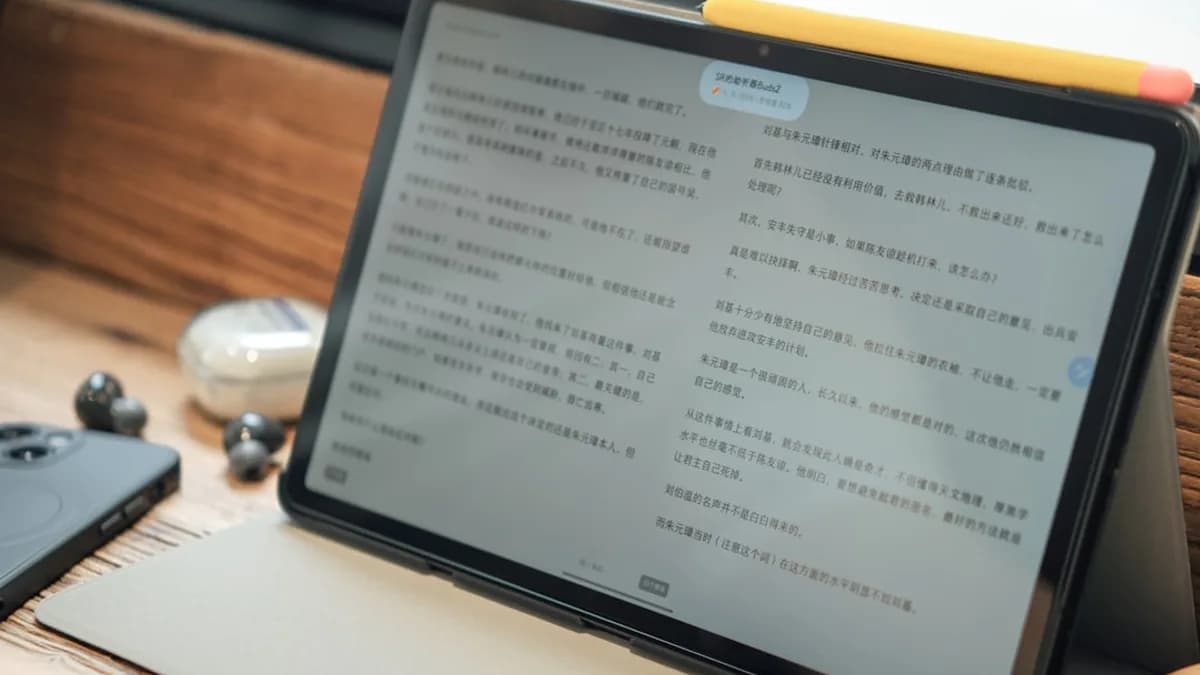
AOC’s new 13.3-inch portable monitor pairs a 3200 x 2400 color E Ink panel with a 30Hz refresh rate — a combination aimed less at Netflix and spreadsheets-in-motion than at people who stare at dense documents all day.
The device, called the AOC 13T5S, has debuted in China for CNY 4,599, or around $679, according to Notebookcheck. It uses E Ink’s Kaleido 3 color panel, adds adjustable front lighting, and includes AI-assisted ghosting reduction. The catch: global availability is still pending.
The 13T5S targets professionals who spend long hours reading or editing documents, with a paper-like viewing experience and reduced eye strain as the central pitch.
That positioning matters. This is not a conventional portable display trying to beat LCD or OLED on brightness, refresh rate, or color punch. It is a productivity-first screen for a narrower job: keeping text, PDFs, notes, code references, and marked-up documents visible without turning every second screen into another glowing slab.
Why document-heavy professionals should care about AOC’s 13.3-inch color E Ink monitor
The strongest argument for the AOC 13T5S is not that it has color. It is that AOC has put color E Ink into a portable external monitor format with enough resolution and refresh capability to make real desk work plausible.
The monitor has a 13.3-inch display, 3K resolution, 300ppi for monochrome content, and 150ppi for color. That matters for people reading dense PDFs, reviewing contracts, editing long documents, or keeping reference material beside a laptop for hours.
The 30Hz refresh rate is also central to the pitch. On a normal monitor, 30Hz would feel limited. On E Ink, it signals a push toward smoother scrolling and cursor movement than older e-paper screens, helped by an IGZO oxide TFT backplane, according to the supplied source material.
Still, the trade-off is clear. The 13T5S is not trying to replace a high-refresh portable gaming monitor like the hardware we covered in TCL’s $338 4K Gaming Monitor Hits 320Hz — in China. AOC is aiming at a different use case: fewer distractions, more reading, less visual fatigue.
What AOC’s 13T5S is built to do
In practical terms, the AOC 13T5S is a portable second screen that swaps the usual LCD or OLED panel for color E Ink. It is meant to sit next to a laptop and hold material that does not need constant animation.
The known specs are unusually specific for this category:
| Feature | AOC 13T5S detail |
|---|---|
| Display size | 13.3 inches |
| Panel type | E Ink Kaleido 3 color display |
| Resolution | 3200 x 2400 |
| Pixel density | 300ppi monochrome, 150ppi color |
| Refresh rate | 30Hz |
| Lighting | ComfortGaze front lighting with brightness and color temperature adjustment |
| Build | 8mm thick, around 700g, anodized aluminum |
| Ports | Two full-function USB-C ports for power and data |
| Stand | Folding cover with portrait and landscape support |
| China price | CNY 4,599, around $679 |
The likely audience is obvious from the design. Legal researchers, analysts, editors, programmers, students, and executives could use it as a static or semi-static work surface for documents, notes, code documentation, or reports.
But buyers outside China do not yet have a clear path. The source says information on global availability is still pending, which leaves open the bigger questions: timing, regional pricing, support, and warranty coverage.
How color E Ink, 3K resolution, and 30Hz differ from a laptop screen
A normal laptop screen is built around fast redraws, bright color, video, and interactive motion. The 13T5S is built around readability.
The panel uses E Ink Kaleido 3, which means monochrome text and color elements do not render with the same sharpness. Black-and-white content reaches 300ppi, while color drops to 150ppi. That is a meaningful distinction for anyone expecting LCD-like color precision.
The 3200 x 2400 resolution still gives AOC room to make text look sharp on a compact screen. That should help with PDFs, long-form notes, small-font documents, and reference windows where clarity matters more than motion.
The lighting system is also different from a typical backlit panel. AOC uses ComfortGaze front lighting, with adjustable brightness and color temperature. That is closer to an e-reader-style experience than a laptop display shining light directly through a panel.
The 30Hz refresh rate is the most important compromise. It should make scrolling and cursor movement smoother than older E Ink experiences, according to the product claims cited in the source material. But it remains far below what users expect for video, fast dashboards, animation-heavy interfaces, gaming, or image work.
That is why this product sits apart from conventional display upgrades, including the kind of panel decisions MLXIO has tracked in Key Display Bet Gets Cut From Cheaper Apple Vision Pro. The 13T5S is not chasing spectacle. It is chasing endurance.
How AI-assisted ghosting reduction could make the monitor more usable
Ghosting is the persistent shadow of E Ink. After a page turn, scroll, or interface change, faint traces of old content can remain on screen. For casual reading, that may be tolerable. For dense work, it can get irritating fast.
AOC’s answer is a dual-controller system with AI-assisted ghosting reduction. The source material says it is designed to reduce image retention by refreshing specified screen areas instead of forcing a full-screen refresh.
That matters because full-screen E Ink refreshes can interrupt flow. Localized refreshes, if implemented well, could clear artifacts from the parts of the screen that changed while leaving the rest alone.
The productivity case is straightforward:
- Text: Cleaner refreshes could keep dense paragraphs readable after scrolling.
- Code: Fewer residual traces could make syntax and indentation easier to track.
- Charts: Local cleanup could reduce confusion when chart lines or labels shift.
- Spreadsheets: Static tables may benefit, though rapid navigation remains a weak fit.
The caution is just as important. Notebookcheck reports the feature as a claimed capability. Real-world performance will depend on software modes, operating system behavior, connection quality, and independent testing once the monitor is more widely available.
What a workday with AOC’s portable color E Ink monitor could look like
Consider a financial analyst using a laptop as the main machine and the 13.3-inch 13T5S as a second screen. The laptop handles email, spreadsheets, web apps, and live communication. The E Ink monitor holds an annual report, research PDF, or notes window.
That is the ideal split. The main screen does the active work. The E Ink screen keeps reference material visible without competing for attention in the same way a bright second LCD might.
Color helps in narrow but useful ways. It can distinguish chart lines, annotations, headings, tracked changes, spreadsheet categories, or presentation notes. Because color content displays at 150ppi, buyers should not expect it to behave like a color-accurate design monitor.
A legal researcher could use the same setup with contracts and case materials. A programmer could park documentation or issue notes on the E Ink panel while writing code on the laptop. In both cases, the value comes from persistent readability, not speed.
The limits show up quickly. Video calls, rapid spreadsheet movement, high-refresh dashboards, multimedia review, gaming, and image editing are better suited to conventional displays. The 13T5S is a work surface, not an all-purpose screen.
Should buyers wait for AOC’s color E Ink monitor or choose a regular portable display now?
The decision comes down to what hurts more: eye fatigue from long reading sessions, or the limitations of E Ink motion and color.
Choose the AOC 13T5S approach if the priority is document review, reading comfort, portability, and a calmer second-screen workflow. Its 8mm thickness, roughly 700g weight, folding cover stand, and dual USB-C ports make it credible as a travel monitor on paper.
Choose a conventional portable LCD or OLED if the job needs brighter color, faster motion, wider software certainty, or immediate availability. AOC’s monitor is currently available in China, while global launch details remain unresolved.
The practical watch list is short but critical: international release timing, final regional pricing, macOS support details, warranty terms, and hands-on testing of the AI-assisted ghosting reduction. Until those are clear, the 13T5S is best viewed as a promising specialist device — one that could make long document work easier, but only for buyers comfortable with E Ink’s trade-offs.
Key Takeaways
- The 13T5S brings color E Ink into a portable monitor format aimed at professionals who read dense documents for long periods.
- Its 3200 x 2400 resolution, 30Hz refresh rate, and front lighting make E Ink more practical for desk productivity.
- At CNY 4,599, or about $679, it remains a niche device with global availability still uncertain.