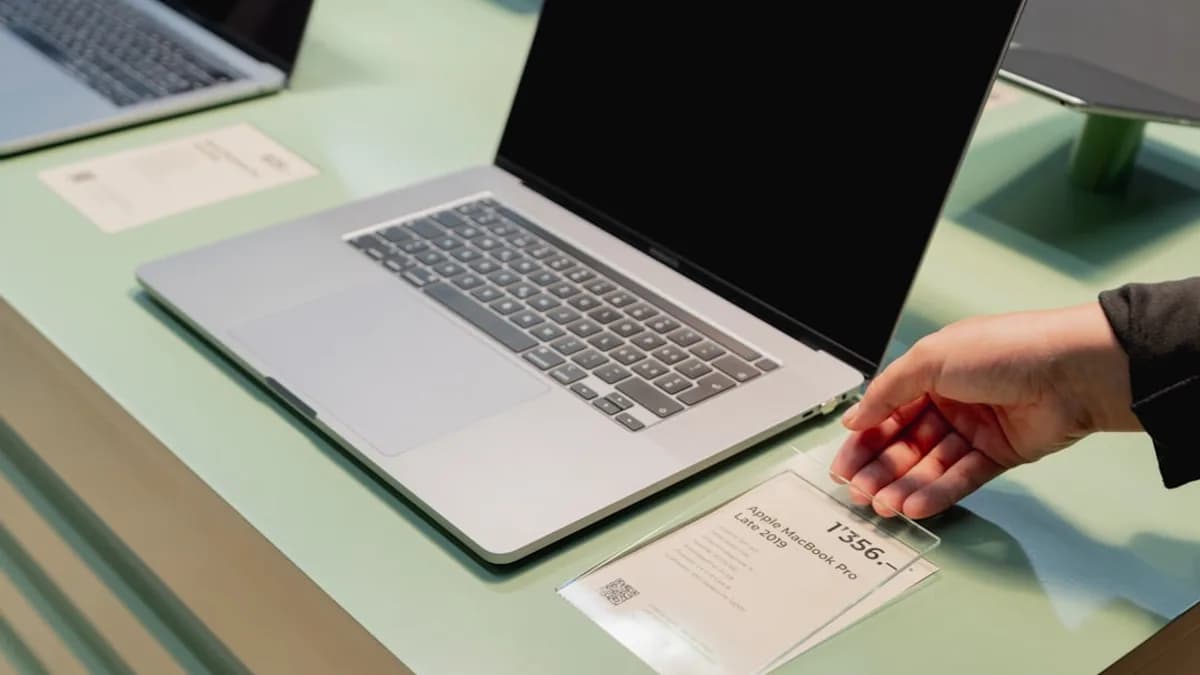
A fully loaded 16-inch MacBook Pro now reaches $10,149, turning Apple’s upgrade page into the real pricing story.
That figure, reported by 9to5Mac , is not about the average Mac buyer. It is about Apple’s confidence that the top end of the MacBook Pro market can absorb far steeper configuration costs than the base-model headline suggests.
Apple’s $10,149 MacBook Pro Is Really an Upgrade Pricing Story
The key point is not that Apple sells an expensive laptop. Apple has done that for years. The sharper signal is where the increase lands.
John Gruber’s pricing work, cited by 9to5Mac, shows base prices for the M5 Pro and M5 Max MacBook Pro models rose by 13–15%. That is material, but not shocking for a premium machine. The real jump sits in the build-to-order tiers: RAM and SSD upgrades rose in most configurations by 50–67%, while the 64GB and 128GB RAM upgrades for the M5 Max doubled.
“The base model prices for these M5 Pro and M5 Max MacBook Pros only went up 13–15%. But RAM and SSD upgrades increased, in most configurations, by a whopping 50–67%. The 64 and 128 GB RAM upgrades for the M5 Max doubled in price.”
That pushes the fully configured 16-inch MacBook Pro to $10,149 with:
| Component | Maxed-out configuration cited by 9to5Mac |
|---|---|
| Chip | M5 Max with 18-core CPU |
| GPU | 40-core GPU |
| Memory | 128GB memory |
| Storage | 8TB SSD |
| Display | Nano-texture display |
| Total | $10,149 |
This is an “exceedingly niche spec,” as 9to5Mac puts it. But niche pricing still matters. It reveals how Apple monetizes professional demand: not mainly through the entry price, but through the choices buyers make after they have already committed to the platform.
Base Models Rose Modestly; Memory and Storage Did the Damage
A 13–15% base increase can be framed as a premium-product adjustment. A doubled high-end memory upgrade is harder to ignore.
Apple’s build-to-order model magnifies that gap. A buyer who only needs the base configuration sees one kind of price move. A buyer who needs maximum unified memory and internal storage sees another. The latter is the customer Apple is now charging far more aggressively.
The psychological break matters too. A four-figure MacBook Pro can still sit inside the mental category of “expensive laptop.” A five-figure laptop moves closer to “mobile workstation purchase,” even if the machine has the same MacBook Pro badge on the lid.
There is also a source discrepancy readers should treat carefully. The related AppleInsider material supplied for this analysis lists a top M5 Max 16-inch MacBook Pro configuration at $7,349, with 128GB unified memory, 8TB SSD, and the nano-texture display. 9to5Mac’s article, citing Gruber’s math, gives $10,149. That gap means buyers should verify live Apple configuration pricing directly before making purchasing decisions.
Still, both figures point in the same direction: the upper end of Apple’s pro laptop pricing is no longer just expensive. It is moving into workstation territory.
Why Apple’s Upgrade Pricing Carries More Weight Than Commodity RAM Prices
The easy critique is that RAM and SSD components do not cost anywhere near Apple’s upgrade premiums. That critique is not new. What changed here is the scale of the reported increases.
Apple’s architecture gives the company more pricing power than a standard modular PC vendor. With Apple Silicon, memory is part of the unified system design. Buyers cannot treat memory as a later fix. If they need 128GB, they have to choose it at checkout.
That makes the upgrade page more consequential. It is not a convenience menu. It is the point at which the buyer locks in the machine’s practical ceiling.
MLXIO analysis: this structure lets Apple price professional optionality. A buyer may not need 128GB memory every day, but if their work occasionally hits memory limits — local AI models, advanced video production, large-scale code compilation, or other heavy workflows cited in the related material — the cost of underbuying can feel higher than the cost of overbuying.
The counterargument is just as clear. When upgrade pricing rises by 50–67%, and some RAM tiers double, the move looks less like simple cost pass-through and more like Apple testing how much margin the top of the MacBook Pro line can carry.
The Pro Mac Has Become Less Modular and More Front-Loaded
The available source material does not provide older PowerBook or Mac Pro pricing comparisons, so the stronger historical point is narrower: Apple’s current pro laptop strategy concentrates decisions upfront.
In older workstation thinking, buyers often separated the initial purchase from later expansion. In this MacBook Pro model, that flexibility is limited. The customer chooses the chip, memory, storage, and display configuration at purchase, then lives with it.
That is the real shift. Apple is selling sealed, high-performance pro machines where the most consequential choices happen before the device ships.
The related AppleInsider material frames the fully configured model as a top-tier mobile workstation, and that is the right category for understanding the price. A $10,149 MacBook Pro is not aimed at the average buyer browsing for a laptop. It targets users who want the maximum Mac configuration in a portable form and are willing to pay for the headroom.
For broader Apple hardware context, MLXIO has also tracked how Apple’s M-series roadmap may shape future Mac demand in Apple’s Touchscreen MacBook Bets on M5 — Not M6 Chips. The pricing pressure also sits alongside the discount cycle we covered in Apple Deals Slash AirPods 4 to $99, M5 iPad Pro $350 Off, though those deal dynamics apply to different product categories.
Pros, Finance Teams, and Investors Will Read the Same Price Differently
For creative professionals and developers, the question is not whether $10,149 sounds high. It does. The question is whether the maxed-out machine removes enough friction from paid work to justify the spend.
The strongest candidates are users whose workloads are genuinely memory-bound or storage-heavy. The related material names developers compiling large codebases, video editors cutting 8K timelines, audio professionals with extensive sample libraries, and researchers running local AI models.
For finance teams, the label changes. This is no longer just a premium laptop request. It becomes a mobile workstation request, and that changes how the purchase is compared internally.
For Apple investors, the reported pricing split is the more interesting part. MLXIO analysis: keeping base increases to 13–15% while pushing far harder on upgrades can protect the visible entry price while extracting more revenue from the buyers least likely to compromise on specs.
That strategy has a risk. A five-figure MacBook Pro gives critics a clean number to attack, even if almost nobody needs that exact build.
The New Ceiling Forces Buyers to Be More Ruthless About Specs
The practical takeaway is simple: MacBook Pro buyers should separate real workflow needs from future-proofing anxiety.
Memory is the hardest decision because it cannot be upgraded later. If the work needs 128GB, the buyer has little room to maneuver. Storage is more flexible in practice because external drives and cloud workflows can offset some internal SSD needs, though not for every workflow.
Apple’s pricing suggests the company will keep the base MacBook Pro line relatively more approachable while charging heavily for the highest professional configurations. The evidence that would strengthen that thesis is simple: future MacBook Pro generations with modest entry-price moves and steep upgrade premiums.
The evidence that would weaken it would be a visible retreat in memory or storage pricing, clearer value added at each tier, or stronger pressure from competing workstation laptops that makes Apple justify the top-end MacBook Pro price more directly.
For now, the $10,149 16-inch MacBook Pro is less a mainstream product than a boundary marker. Apple has found a new ceiling for pro laptop pricing. The next test is whether enough professional buyers treat that ceiling as expensive — or acceptable.
The Bottom Line
- Apple’s top 16-inch MacBook Pro now reaches $10,149 when fully configured.
- The largest price pressure is coming from RAM and SSD upgrades rather than base models.
- The pricing shows Apple is leaning harder on high-end professional buyers already committed to the Mac platform.