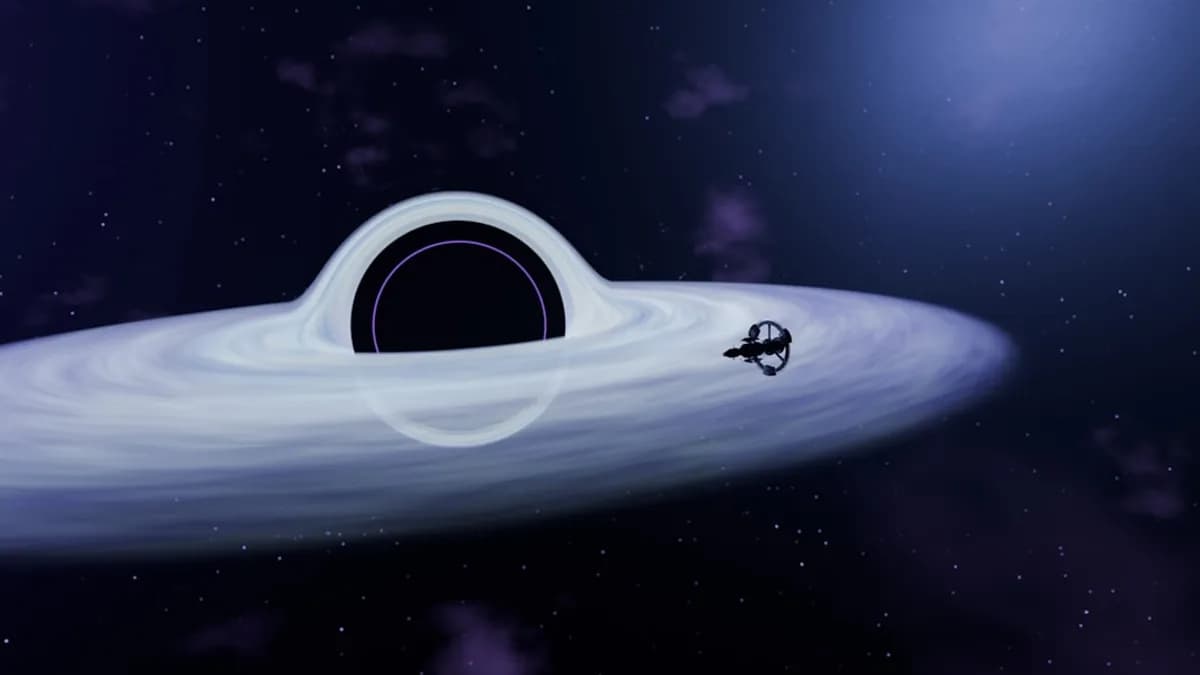
Why Discovering a 50 Billion Solar Mass Black Hole Challenges Our Understanding of Cosmic Giants
A black hole with a mass around 50 billion times that of the Sun doesn’t just break records—it breaks expectations. According to Notebookcheck, astronomers have identified this ultra-massive object in a distant galaxy, instantly raising questions about how such a colossal black hole could form and persist.
This scale of mass dwarfs the black holes found at the centers of most galaxies, including our own Milky Way. Theorists already struggle to explain black holes above ten billion solar masses, as conventional models of galactic growth and black hole feeding cycles hit hard physical limits. The discovery of a 50 billion solar mass black hole throws those limits into question—and puts pressure on existing theories of how galaxies and their central black holes co-evolve.
Crunching the Numbers: The Scale and Significance of a Black Hole 50 Billion Times the Sun’s Mass
Even without exact comparison data in the source, the basic numbers stagger. The black hole at the center of our galaxy, Sagittarius A*, is estimated at just over four million solar masses—meaning this newly discovered black hole is more than 10,000 times heavier. M87*, one of the largest previously imaged black holes, weighs in at several billion solar masses, still an order of magnitude below this new find.
A black hole on this scale would exert a gravitational pull capable of dominating its host galaxy’s dynamics. Its sphere of influence could extend over light-years, affecting orbits of stars, gas, and possibly even neighboring black holes. Measuring such mass is notoriously difficult, often relying on the motions of surrounding stars or gas. The margin for error is high, and the stakes are higher: an incorrect estimate could trigger a cascade of mistaken assumptions about galaxy evolution.
Double Trouble: The Potential Impact of a Second Supermassive Black Hole in the Same Galaxy
The real kicker: astronomers suspect a second supermassive black hole may also be present in this galaxy, according to Notebookcheck. If confirmed, this would make the system a rare double. Such pairs are thought to form when galaxies merge, but direct evidence is scarce.
Dual supermassive black holes can warp a galaxy’s structure and accelerate its evolution. Their mutual gravity can sling stars outwards, stir up gas, and—if they spiral together—set the stage for a future merger. Galaxies hosting two giants are not just novelties; they are laboratories for testing how the universe’s largest structures collide and change.
What We Know, Why It Matters, and What Is Still Unclear
Here’s what’s solid: astronomers have found one of the largest black holes ever, and there’s a strong hint of a second heavyweight lurking in the same galaxy. This discovery forces a rethink of how supermassive black holes grow and how their host galaxies adapt. The mere existence of such a massive black hole stretches the credibility of current formation models.
What remains unclear is the measurement certainty and the specifics of the second black hole. The techniques and data behind the mass calculation, as well as the evidence for a second supermassive object, are not detailed in the available source. That leaves key scientific questions unresolved: Is this mass estimate robust? Is the second black hole truly there, or could it be an observational artifact?
What to Watch: The Next Steps in Ultra-Massive Black Hole Research
The discovery of this black hole opens a new front in the search for cosmic extremes. Future confirmations, especially with more precise measurements and imaging, could either cement this galaxy as an outlier or force a rewrite of black hole formation theory. If both black holes are real, this galaxy could become a benchmark for studying the most violent and mysterious processes in the universe.
What would move the needle? Independent verification of the mass, ideally with different observational techniques, and clearer evidence for the second black hole. If these findings hold, expect a surge in theoretical work—and new proposals for next-gen telescopes—to explain how such monsters are born and how many more are lurking out there.