Webb’s Image of M77: Why Astronomers Are Paying Attention
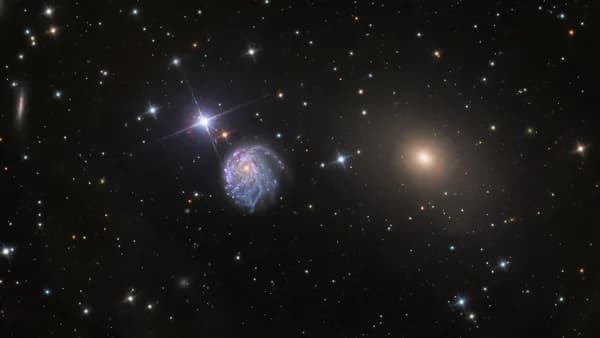
The James Webb Space Telescope just delivered a new image of the M77 galaxy that’s making astronomers stop and stare. What jumps out isn’t just the sharpness—it’s the blindingly bright core, a feature that’s rarely captured with this level of detail. M77 sits about 45 million light-years from Earth and spans roughly 90,000 light-years across, according to Notebookcheck.
This isn’t just another pretty picture. For researchers, every crisp galactic image is a puzzle piece in the hunt to understand how galaxies build themselves, grow, and age. When Webb’s advanced optics catch new details, it’s not just about resolution—it’s about unlocking data that ground-based telescopes have missed for decades. The M77 image gives astronomers a rare close-up of a distant galaxy’s core, offering a snapshot of galactic dynamics in action.
What We Know About M77’s Ultra-Bright Core
The centerpiece of Webb’s image is M77’s intensely luminous core. The source confirms the core’s exceptional brightness but stops short of explaining why it outshines the rest of the galaxy. The image shows a stark contrast: a compact, glowing center surrounded by the more diffuse light of the outer galaxy.
M77’s core stands out as a laboratory for studying the engines at the hearts of galaxies. While the source doesn’t specify the mechanics behind the brightness, similar galactic cores often hint at extreme environments—sometimes linked to dense star clusters or energetic events near the center. What’s clear from the data: this is no ordinary galactic nucleus.
The brightness and clarity Webb captured allow astronomers to compare M77’s center to those of other galaxies, sharpening questions about what fuels such luminosity and how these galactic hearts evolve.
How Webb’s Tech Raises the Bar for Galaxy Imaging
Webb’s image of M77 isn’t just visually stunning; it’s a technical feat. The telescope’s design is engineered for high-precision imaging at immense distances. Capturing a galaxy 45 million light-years away with such clarity highlights Webb’s resolving power and sensitivity.
While the source does not detail which instruments Webb used or how it processed the data, the result speaks for itself: a galaxy rendered in fine detail, with a sharp core and clearly outlined galactic features. This level of detail sets a new baseline for what telescopes can deliver from deep space, handing astronomers a tool for mapping galactic structure in unprecedented ways.
What the Image Shows About M77’s Size and Structure
The data puts M77 at about 90,000 light-years across—comparable in size to the Milky Way. Webb’s image reveals the full sweep of the galaxy’s structure, from the blazing core out to its faint edges.
The source does not specify features such as spiral arms, dust lanes, or star-forming regions, so those details remain to be confirmed. What is certain: the image captures both the scale and the complexity of M77, offering a clear visual map that can anchor further research.
Why This Matters and What Remains Unclear
This isn’t just a milestone for Webb’s camera roll. Each new high-resolution galaxy image raises questions about the physics driving galactic cores and the processes shaping galaxy growth. The ability to see detail in a galaxy 45 million light-years away means astronomers can now catalog and compare distant galaxies with more precision.
But there’s still a lot we don’t know. The underlying cause of M77’s ultra-bright core is not explained in the source. Nor does the data clarify whether the core’s luminosity is driven by a black hole, intense star formation, or another mechanism. The specifics of the galaxy’s internal structure—such as the makeup of the core or the activity at its center—remain open questions.
What to Watch: The Next Steps for Webb and Galactic Research
Webb’s image of M77 sets the stage for a wave of follow-up research. Astronomers will likely use this data as a reference point, targeting similar galaxies to see if they share M77’s core characteristics. Future observations could fill in the blanks: What exactly powers the core? How does the structure relate to galaxy evolution?
For now, the practical takeaway is clear. Webb has reset expectations for what can be observed in distant galaxies. As more images emerge, expect both new questions and new discoveries—each one chipping away at the mysteries of how galaxies like M77 come to shine so brightly, and what that means for our broader view of the universe.
Why It Matters
- Webb’s sharp image of M77’s core gives astronomers new clues about how galaxies form and change over time.
- The extremely bright nucleus offers a rare chance to study the powerful forces at the heart of distant galaxies.
- Advanced imaging from Webb surpasses previous ground-based observations, unlocking details missed for decades.