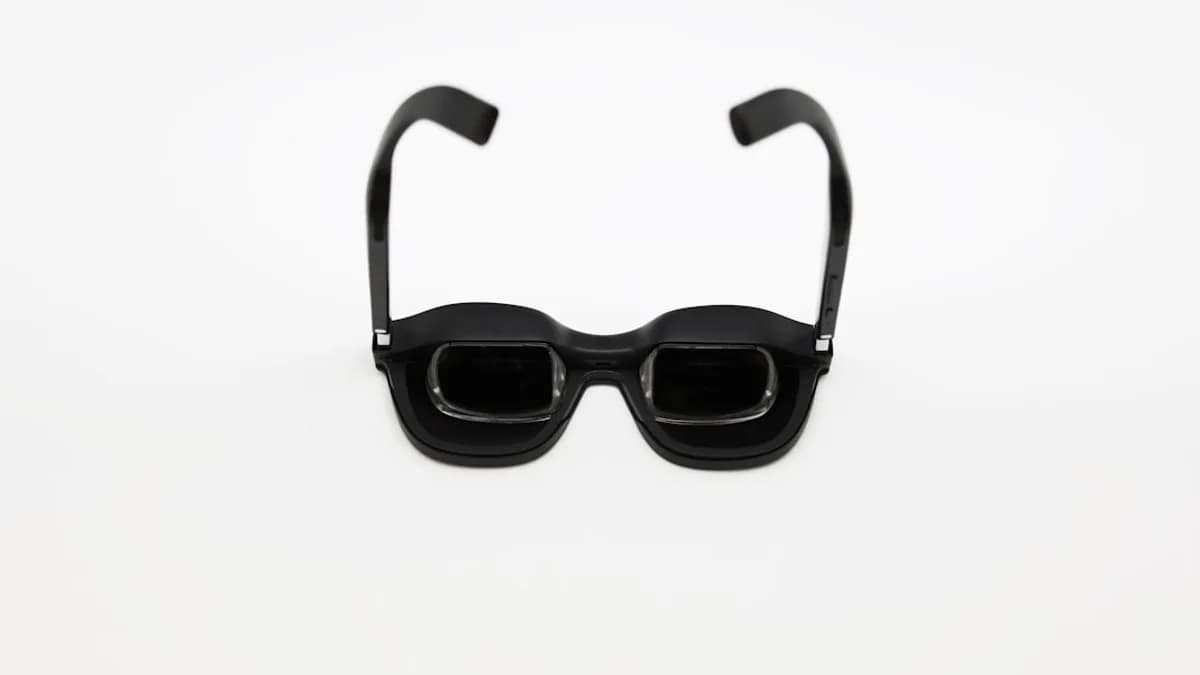
Snap Specs put the AR glasses bet in one number: 7 milliseconds. That is the claimed latency for content anchored in the real world, and it signals that Snap is aiming beyond camera glasses toward a wearable computing interface.
The new glasses are expected to launch in fall 2026 for $2,195, with shipments beginning first in the U.S., the U.K., and France, according to Notebookcheck. The pitch is not subtle. Snap wants glasses that show notifications, navigation, translations, and AI-assisted visual cues directly in the user’s field of view.
Snap Specs Turn AR From Camera Accessory Into Interface Bet
At first glance, Snap Specs still look like conventional glasses with a thicker frame. The difference is what Snap has packed into that frame: an AR display, two specialized Snapdragon processors, speakers, microphones, cameras, and controls based on voice commands and hand gestures.
That shifts the product category. Camera glasses capture the world. AR glasses must understand enough about what the user sees to place useful information back into that view. Snap’s examples make that clear: real-time translation subtitles, navigation, incoming notifications, and an AI assistant that can point out the location of a car’s coolant filler cap.
Snap’s official positioning around eyewear remains ambitious:
“Spectacles make computing more human.”
MLXIO analysis: the Specs announcement suggests Snap is trying to make that line operational. The company is not only selling a display. It is testing whether visual messaging, AR lenses, and camera-first software can become a wearable interface people actually use outside staged demos.
That is a harder problem than building an impressive prototype. The glasses have to be useful, acceptable in public, and comfortable enough to wear repeatedly. A spec sheet can win attention. Daily habit wins platforms.
Seven-Millisecond Latency Is the Real Technical Claim
The display covers a 51-degree field of view, can show 16 million colors, and is described as feeling roughly as large as a 24-inch desktop monitor viewed from a normal working distance. Those numbers matter, but the latency claim matters more.
In AR, delay breaks the illusion. If a label, subtitle, or navigation marker lags behind a user’s head movement, the overlay stops feeling anchored to the world. Snap’s claimed 7 milliseconds is therefore not just a performance flex. It is central to whether the experience feels usable.
| Snap Specs feature | Source-supported detail | MLXIO read |
|---|---|---|
| Display latency | 7 milliseconds | Key to stable world-anchored overlays |
| Field of view | 51 degrees | Wider than a narrow notification-only display |
| Color output | 16 million colors | Supports richer visual interfaces |
| Processing | Two specialized Snapdragon processors | Suggests Snap is splitting heavy AR work across dedicated silicon |
| Battery | Four hours glasses-only; 20 hours with charging case | The case is part of the product experience, not just an accessory |
MLXIO analysis: the dual-chip design likely reflects the messy workload of AR glasses. The device must handle display output, cameras, microphones, head-movement adaptation, gestures, audio, and AI-related features while staying wearable. That is a thermal and battery problem as much as a computing problem.
Snap’s battery framing is also important. Four hours is the expected runtime for the glasses themselves. Up to 20 hours depends on the charging case. That makes the case central to the usage model, closer to wireless earbuds than a laptop.
For readers tracking chip strategy across devices, this sits alongside a broader hardware theme we have covered in Snapdragon phone strategy: silicon choices increasingly define the limits of product design.
Snap’s Software Pitch Is More Than an AI Assistant on Your Face
Snap is not presenting Specs as a chatbot with lenses attached. The examples point to a broader interface: subtitles for live translation, notifications in view, navigation, and visual assistance tied to the real world.
The company already has a software base around the camera. Snapchat’s Google Play listing describes the app as opening “right to the Camera” and highlights Lenses, Filters, Bitmoji, Stories, Spotlight, Map, and Memories. It also lists 1B+ downloads and 39.5M reviews. That scale does not guarantee AR glasses adoption, but it gives Snap a cultural starting point many hardware-first products lack.
The harder question is whether playful AR effects can become daily utility. A face filter is easy to understand on a phone. Wearing a display on your face asks more from the user and from the people around them.
Snap appears aware of that tension. The front-facing LED indicates when photos or videos are being captured. That is a small hardware detail with large social meaning: glasses with cameras need visible signals, or they risk becoming uncomfortable in shared spaces.
From Spectacles to Snap Specs, the Product Name Now Carries More Weight
Snap’s eyewear branding has long revolved around Spectacles, and Snap’s own corporate site still says “Spectacles make computing more human.” Snap Specs now reads like a more direct hardware push: less fashion-object ambiguity, more flagship AR device.
But the source material does not provide a full timeline of prior models, so the safe conclusion is narrower. Snap is continuing to attach its AR ambitions to eyewear rather than keeping them confined to phone-based lenses.
That continuity matters because the new device has moved well beyond passive capture. It includes a display projected into the user’s field of view and software designed to react to head movement. That is the line between glasses as a camera accessory and glasses as a computing surface.
The price reinforces the point. At $2,195, Snap Specs are not being positioned as a casual add-on for every Snapchat user. They look more like an early flagship device aimed at proving what Snap thinks consumer AR should become.
Developers and Consumers Will Judge Different Versions of the Same Device
Developers may care most about whether the glasses can support compelling spatial experiences. Consumers will care about style, comfort, battery, price, and whether Specs solve problems faster than a phone.
Advertisers and brands will watch for another reason. If AR overlays become part of normal visual computing, the camera becomes more than a capture tool. It becomes a channel for contextual content. MLXIO analysis: that opportunity comes with obvious limits. Overlays that feel intrusive could damage the very habit Snap needs to build.
The stakeholder split looks sharp:
- Developers: Need enough devices in use to justify building for them.
- Consumers: Need daily usefulness, not just impressive demos.
- Brands: May see new creative formats, but must avoid visual spam.
- Snap: Needs hardware to support its software and advertising strategy, not become an expensive side project.
Battery claims will also face scrutiny. As we argued in our broader look at flagship battery trade-offs, headline endurance numbers only matter when they match real use. For Specs, the distinction between four hours on-device and 20 hours with the case will be central.
The Next AR Glasses Race Will Be Won by Habits, Not Spec Sheets
Snap Specs may accelerate AR experimentation, but the path to mainstream use is unresolved. The device has credible ingredients: low claimed latency, a wide field of view, dual Snapdragon processors, cameras, microphones, speakers, gesture control, voice control, and a charging-case model.
The unresolved tension is commercial. A $2,195 pair of glasses shipping first in three countries has to prove more than technical competence. It has to show that AR on the face can create repeat behavior that a phone cannot match.
The strongest evidence for Snap’s thesis would be simple: developers build useful experiences, users wear the glasses outside short sessions, and the AI and AR features become faster than pulling out a phone. The weakest evidence would be equally clear: strong demos, limited daily use, and a product remembered more for its specs than its habits.
The Bottom Line
- Snap is positioning Specs as a wearable computing interface rather than just camera glasses.
- The claimed 7-millisecond latency is central to making AR overlays feel anchored and useful in real time.
- At $2,195, the product will test whether consumers see enough value in advanced AR glasses to adopt them.