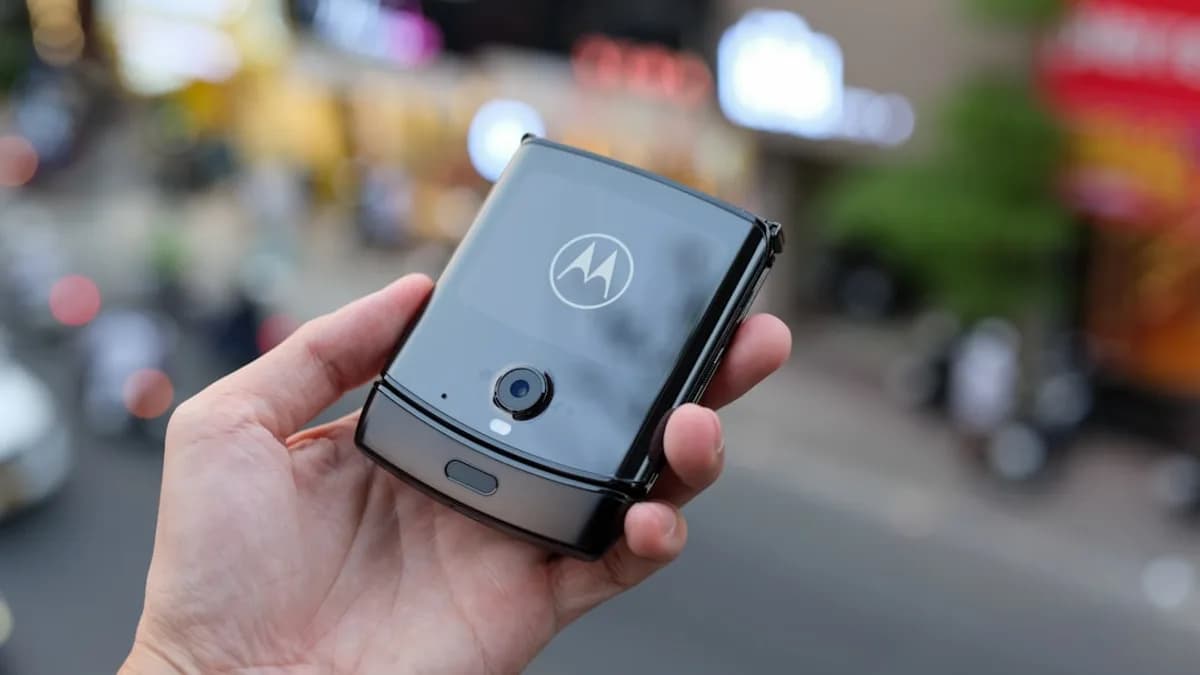
Motorola Razr Fold just posted 18 hours and 22 minutes in a Wi-Fi browsing test, putting clear daylight between its 6,000 mAh battery and Samsung’s Galaxy Z Fold7.
That matters most to buyers who want a book-style foldable as their main phone, not a fragile second device they baby between chargers. The Razr Fold, currently listed at around US$1,900 at Lenovo, “clearly beats Samsung” on battery life, according to Notebookcheck. The deeper signal is simple: Motorola is not trying to win this fight on subtle polish. It is attacking the most visible daily weakness in large foldables — endurance.
Core News: Motorola’s 6,000 mAh Bet Hits Samsung Where Users Feel It
Notebookcheck’s test gives Motorola a clean headline: 6,000 mAh, 18 hours and 22 minutes, and the best runtime among the tested devices in this comparison.
Samsung’s Galaxy Z Fold7, by contrast, carries a 4,400 mAh battery and reaches 14.3 hours in the same Wi-Fi browsing context. The gap is not cosmetic. It changes the charging rhythm of the device.
| Device | Battery capacity | Wi-Fi browsing runtime | Charging detail |
|---|---|---|---|
| Motorola Razr Fold | 6,000 mAh | 18 hours and 22 minutes | Up to 80 watts wired, no wireless charging |
| Samsung Galaxy Z Fold7 | 4,400 mAh | 14.3 hours | Not specified in source |
| Honor Magic V6 | 6,660 mAh | 16.2 hours | Not specified in source |
The most interesting comparison is not only Samsung. The Honor Magic V6 has a larger 6,660 mAh battery but still lands behind Motorola at 16.2 hours. That undercuts the lazy reading that capacity alone explains the result.
So what is Motorola actually proving here? That a large foldable can combine a big cell with enough efficiency to turn capacity into measured runtime.
Device Makers: The Battery Lead Came From Accepting a 243-Gram Trade-Off
The Razr Fold’s endurance is not free. Notebookcheck lists the phone at 243 grams, slightly heavier than most competitors in its comparison.
For device makers, this is the central engineering bargain. A book-style foldable has to make room for hinge hardware, two display surfaces, camera modules, cooling, speakers, and structural reinforcement. A larger battery competes with all of that.
Motorola appears to have accepted more weight to win runtime. That choice will not please everyone, but it is coherent. The source describes the phone as not “really heavy,” while acknowledging that users who carry it in a pants pocket every day may feel the difference.
The question for hardware teams is blunt: how much weight will buyers tolerate if the payoff is fewer charging breaks?
Motorola’s answer is backed by the test result. The Razr Fold does not merely carry a large cell; it converts that cell into a lead over Samsung and Honor in the stated Wi-Fi browsing test. That is the part competitors cannot dismiss as spec-sheet theater.
For readers tracking foldable hardware trade-offs beyond batteries, MLXIO has also covered pressure points around Samsung’s form factor in Galaxy Z Fold 8 Crease Betrays Samsung in One Week and display ambitions in Creaseless Fold Teases Apple’s iPhone Ultra Display.
Buyers: The Razr Fold Turns Charging Breaks Into the Main Comparison
For end users, the result is easier to understand than hinge geometry or display-layer chemistry. The Razr Fold lasts longer in the cited test.
Notebookcheck ties that directly to ordinary use cases: streaming video on the 8.1-inch OLED display, multitasking with two apps at once, and moving through airports or hotel lobbies where plugs are limited. Those are exactly the moments when a foldable’s big inner screen becomes useful — and expensive to power.
“Other foldables sometimes need to be plugged in much sooner.”
That line is the real sales pitch. Not thinner. Not flashier. Just less time hunting for a charger.
There is a caveat. The Razr Fold supports wired charging at up to 80 watts, but wireless charging is not available. For users who live on desk pads, car mounts, or bedside wireless chargers, that omission matters. Motorola wins endurance in this data set, but it gives up a convenience feature some premium-phone buyers expect.
The question for buyers: would you rather charge less often, or charge more flexibly?
For travelers, commuters, and heavy media users, the answer may lean toward Motorola. For users whose routine is built around wireless charging, the calculation is less clean.
Competitors: Samsung’s Standby Efficiency Still Loses to Motorola’s Bigger Cell
Samsung does have one technical win in the source data: standby power consumption.
The Razr Fold consumes between 1.1 and 1.7 watts in standby mode. The Galaxy Z Fold7 is more efficient at 0.63 watts. On its own, that would suggest Samsung has tighter idle behavior.
But the runtime result overwhelms that advantage. Notebookcheck states that the Galaxy Z Fold7’s runtime is 22 percent shorter than Motorola’s.
“a 22 percent shorter runtime speaks for itself.”
This is the nuance Samsung fans should not ignore. Efficiency matters, but it cannot always compensate for a smaller battery, especially when the device is built around a large foldable display.
The question for Samsung is whether future gains should come from more aggressive power management, a larger cell, or a different physical design tolerance. Notebookcheck’s data does not answer that. It only shows that, in this test, Samsung’s lower standby drain did not close the gap.
That distinction matters. Motorola has not proven superiority across cameras, durability, software behavior, service, or long-term battery health. It has proven a measurable battery-life advantage in a specific test, supported by a large capacity and fast wired charging.
Market Signal: Foldables Are Being Judged by Daily Compromise, Not Just Form Factor
The Razr Fold result pushes the foldable conversation toward a harsher standard: does the device survive a long day when used like a tablet-phone hybrid?
MLXIO analysis: that is where Motorola’s advantage has force. A foldable’s main promise is more screen area in a pocketable device. But the larger screen only matters if users can keep it on without rationing brightness, multitasking, maps, messaging, and video. Battery life is not a supporting spec here. It shapes whether people use the big display freely.
This also explains why the Honor Magic V6 comparison is useful. Its 6,660 mAh cell is larger than Motorola’s, yet its 16.2-hour result trails the Razr Fold. That points to a broader lesson for buyers: do not rank foldables by mAh alone. Look for independent runtime tests, standby drain, charging speed, display behavior, and whether the phone throttles under sustained use.
The question for the category: will the next winning foldable be the thinnest device, or the one with the fewest daily compromises?
For now, the Razr Fold has the cleanest battery claim in this data set. Samsung still has room to answer through capacity, efficiency, charging, or design changes. Motorola still has to show that its battery lead is matched by durability, software quality, camera performance, and long-term support.
The next evidence to watch is not another headline capacity figure. It is mixed-use testing across travel, video, multitasking, standby, and repeated charging cycles. If the Razr Fold keeps its lead there, Motorola’s 6,000 mAh choice will look less like brute force and more like the right foldable bet.
The Bottom Line
- Motorola’s Razr Fold delivers the longest tested browsing runtime among the compared foldables.
- The result gives buyers a clearer reason to consider Motorola over Samsung for daily battery endurance.
- Honor’s larger battery performing worse shows efficiency matters as much as capacity.