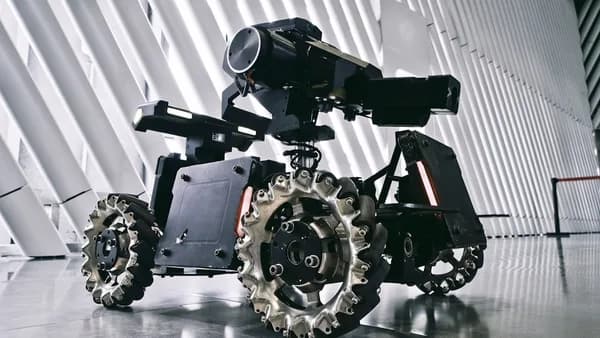
Anduril’s reported $100 billion valuation target would turn battlefield autonomy from a defense niche into one of Silicon Valley’s most expensive private-market bets.
The defense tech company is in talks to raise capital at about $100 billion, up from $61 billion in May and $30.5 billion in June 2025, according to TechCrunch, citing Reuters and anonymous sources. If completed, the round would do more than mark another venture funding win. It would signal that investors may now price autonomous weapons systems, drones, sensors, and battlefield AI software as strategic infrastructure.
That is the real story beneath the headline. Anduril is not being valued like a traditional contractor waiting on slow procurement cycles. It is being valued, at least by prospective investors, like a rare AI-and-robotics platform plugged into government-scale demand.
Anduril’s $100 Billion Target Turns Defense AI Into a Megacap-Style Bet
The reported funding talks create a valuation problem for the entire defense tech market: if Anduril is worth about $100 billion, investors must believe its opportunity is much larger than selling hardware into individual military programs.
That assumption rests on several linked bets. First, that drones and autonomous systems will remain central to modern warfare. Second, that software layers such as command-and-control platforms can sit across many hardware products. Third, that U.S. and allied procurement will keep moving toward faster, cheaper, more expendable systems.
MLXIO analysis: The provocative part is not simply the valuation. It is the category shift. A $100 billion Anduril would imply that private investors increasingly see defense autonomy as closer to core technology infrastructure than to old-line weapons manufacturing.
That does not make the valuation safe. It raises the stakes. Private valuations can reflect scarcity, narrative strength, and investor competition as much as present financial performance. Talks may still fail to close at the reported number. Anduril did not immediately return TechCrunch’s request for comment.
The New Math: $30.5 Billion to $100 Billion in Roughly a Year
The numbers explain why this round matters.
| Metric | Reported figure |
|---|---|
| June 2025 Series G valuation | $30.5 billion |
| May valuation | $61 billion |
| Reported target valuation | About $100 billion |
| May raise | $5 billion |
| 2025 revenue disclosed by Anduril in May | $2.2 billion |
| Defense tech venture funding, first six months of the year | Over $12 billion |
| Defense tech startup funding in all of 2025 | Nearly $10 billion |
Reuters reported that Anduril may structure the fundraise in two stages, with the second stage bringing in investors at a higher valuation. Both tranches could close within the year.
The jump is stark. A move from $30.5 billion in June 2025 to about $100 billion would be more than a threefold increase. Even compared with May’s $61 billion mark, the reported target would add roughly $40 billion in private-market value.
MLXIO analysis: That kind of step-up implies investors are underwriting more than current revenue. They are likely pricing in contract expansion, allied demand, production scaling, and the possibility that software-heavy defense platforms carry better economics than traditional hardware-only programs.
This is the same strategic-scarcity logic we see in other platform fights, including our coverage of the $53B Stripe PayPal bid and the battle for 440M users: when investors believe an asset controls a critical interface, the valuation conversation changes.
Anduril Built Its Premium Around Products, Not Procurement Theater
Anduril was founded in 2017 by Palmer Luckey, Trae Stephens, Matt Grimm, Joe Chen, and Brian Schimpf. Its product set includes unmanned aerial systems, counter-UAS systems, semi-portable autonomous surveillance systems, and networked command-and-control software.
The company has signed contracts with the U.S. Department of Defense, Air Force, Army, Dutch Ministry of Defence, NATO, U.K. Defence Ministry, Poland, and others, according to the source material.
Its pitch differs from the legacy defense model described in the supplied Built In context. Instead of waiting for a government request and then building under the usual contractor structure, Anduril funds more of its own product development before selling finished systems to government buyers.
That model requires heavy capital. It also explains why venture investors care.
- Product speed: Anduril can develop systems before a specific contract award.
- Software layer: Its Lattice platform connects autonomous systems and field data.
- Hardware breadth: The company operates across drones, missiles, robotic submarines, and autonomous aircraft.
- Government pull: Demand is tied to drones, autonomous craft, and AI’s role in warfare.
The funding backdrop is unusually strong. Defense tech venture funding more than doubled to over $12 billion in the first six months of the year, already above the nearly $10 billion raised by startups in the space during all of 2025.
That is the symptom. The condition beneath it is battlefield demand. War in the Middle East and Eastern Europe has sharpened interest in drones, autonomy, and lower-cost systems that can be replaced without crippling the buyer’s budget.
For readers tracking which technologies separate durable winners from inflated stories, this fits the pattern we analyzed in Key Trends Splitting Tomorrow's Winners From Losers: the winners tend to sit where technical capability meets urgent spending.
Palantir, SpaceX, and Anduril Show How Government Tech Became Venture-Scale
Anduril’s trajectory fits a broader shift already visible in the supplied history. Its founders drew from Oculus, Palantir, and the venture world around Founders Fund. The early idea was blunt: build a defense company with startup speed and sell into government demand that most venture-backed companies had avoided.
That was not the default Silicon Valley posture. The supplied context points to employee resistance at major tech firms over military AI work, including Google’s decision not to renew its Project Maven contract after an employee petition. Anduril took the opposite stance and leaned into military work.
The comparison to Palantir and SpaceX matters because both showed that government markets could support large tech companies when the product solved a hard operational problem. Palantir did it with data platforms. SpaceX did it in aerospace procurement. Anduril is trying to do it with autonomy, AI-enabled sensing, and weapons manufacturing.
MLXIO analysis: The reported $100 billion target suggests investors see Anduril as the next company in that lineage, not simply another defense vendor. That is a high bar. It requires more than contract headlines. It requires repeatable production, software integration, and customer trust across multiple governments.
A $100 Billion Anduril Creates Different Risks for Each Stakeholder
Investors see scarcity. Anduril sits at the intersection of AI, robotics, national security, and government spending. Its investor list includes Thrive Capital, Andreessen Horowitz, Founders Fund, ICONIQ, Flux Capital, Greycroft, Altimeter, 1789 Capital, and current U.S. Vice President JD Vance, according to PitchBook as cited in the source.
Government buyers see a different equation. Faster product cycles could help militaries adopt drones and autonomous systems more quickly. But reliance on any fast-scaling vendor raises hard questions about performance, accountability, supply chains, and procurement dependence.
Rivals also face pressure. The source material names several companies riding the same wave:
| Company | Reported funding or valuation detail |
|---|---|
| Shield AI | Raised $1.5 billion in March |
| Mach Industries | Quadrupled valuation to $1.8 billion last month |
| Helsing | Raised $1.8 billion at an $18 billion valuation this month |
A common thread is the shift toward cheaper, more expendable “attritable” systems. In defense, attritable systems are designed to be lost in combat without creating the same financial or strategic shock as high-end platforms.
Mach and Anduril have also moved on propulsion supply. Mach acquired solid rocket motor maker Exquadrum for $50 million in May. The Pentagon has funded Anduril’s effort to expand domestic solid rocket motor manufacturing capacity.
The Next Test Is Whether Defense AI Can Carry Software-Style Expectations
A completed round at about $100 billion would reset benchmarks for defense startups. It could make capital easier for companies with real procurement traction. It could also punish weaker startups that borrow the defense AI story without contracts, manufacturing plans, or credible government buyers.
Anduril’s own execution pressure would intensify. The company said in May that revenue more than doubled to $2.2 billion in 2025 from a year earlier. The next question is whether that growth can scale into the valuation being discussed.
The watch items are concrete:
- Contracts: More large awards from the U.S. and allied governments would support the thesis.
- Production: Expansion projects, including the $1 billion Long Beach campus and Arsenal-1 near Columbus, Ohio, will show whether Anduril can build at scale.
- Supply chain: Solid rocket motor capacity remains a bottleneck named in the source material.
- Profit path: A premium valuation will need evidence that revenue growth can translate into durable economics.
- Public-market readiness: Any move toward listing would test whether public investors accept the private-market story.
The reported $100 billion valuation is not proof that defense tech has permanently joined the top tier of AI investing. It is the test. The evidence that confirms it will come from contracts, production, and margins — not the headline number.
The Bottom Line
- A $100B valuation would position defense autonomy as a major Silicon Valley investment category.
- Investors appear to be pricing drones, sensors, and battlefield AI as strategic infrastructure rather than niche defense products.
- The funding talks signal rising confidence that U.S. and allied militaries will keep shifting toward faster, software-driven procurement.