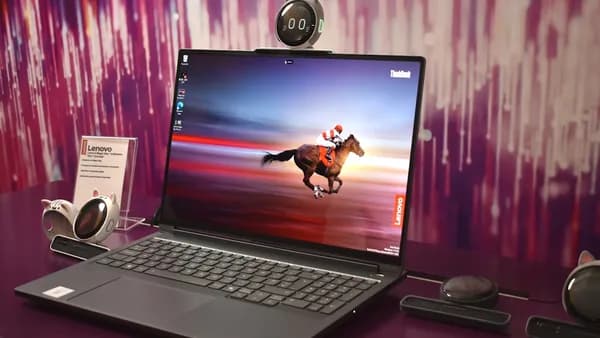
OLED laptop brightness was supposed to be the compromise; Samsung Display is now trying to make it the selling point.
The company has begun mass-producing tandem OLED laptop panels certified under VESA DisplayHDR True Black 1400, with Lenovo already shipping a laptop using the panel and ASUS, Dell Technologies and MSI expected to follow, according to Notebookcheck. Samsung says the new panel can hit up to 1,600 nits at the panel level, above the 1,400-nit requirement for VESA’s new top OLED HDR tier.
That matters because OLED laptops have usually sold themselves on black levels, contrast and color. Samsung is now pushing brightness into the same conversation.
OLED’s old weakness was brightness; Samsung is attacking it with two emissive layers
The assumption around laptop OLED has been simple: great blacks, strong contrast, excellent media playback — but brightness limits that keep it from fully replacing the best high-end LCD options, including pro-focused displays like the Asus ROG Strix XG259QNSR Ace, in every scenario.
Samsung’s answer is tandem OLED. Instead of using one organic emissive layer, the panel stacks two organic emissive layers. Both layers emit light, which lets the display produce higher brightness at the same current, or reduce stress on each layer at a given brightness level.
Samsung says that architecture does two things at once:
- Brightness: The new tandem OLED panel reaches up to 1,600 nits at the panel level.
- Efficiency: The stacked design improves light-emitting efficiency versus a single-stack OLED.
- Longevity: Under typical laptop operating brightness conditions, Samsung says the panel offers more than twice the lifespan of a conventional single-stack OLED panel.
- Materials: Newly developed organic materials also contribute to the brightness and stability gains.
The useful way to read this: Samsung is not just overdriving a normal OLED panel for a bigger spec sheet. It is changing the display structure so the work is split across two emissive layers.
For readers tracking OLED portable hardware more broadly, MLXIO has also covered display-focused launches such as the 185Hz OLED RedMagic Tablet 5 Pro launch date and laptop OLED pricing in the HP OmniBook 5 OLED deal below $600.
DisplayHDR True Black 1400 raises the bar, but the number needs context
VESA DisplayHDR True Black 1400 is the new certification tier aimed at emissive displays such as OLED, where individual pixels can turn off and produce true black levels. Samsung Display says the tier was announced by VESA this month.
The requirements are specific. A certified display must reproduce black levels of 0.0005 nits or lower while reaching 1,400 nits of peak brightness at a 10% On Pixel Ratio. OPR means the percentage of active pixels among all pixels on the screen. In plain terms, the test measures a bright area covering part of the screen, not the entire panel blasting at maximum brightness.
That distinction matters. Samsung’s 1,600-nit claim does not mean the whole laptop screen runs at 1,600 nits all the time. It refers to peak brightness at the panel level, and Samsung separately notes the VESA requirement is 1,400 nits at a 10% OPR.
The jump is still meaningful. Samsung says True Black 1400 requires 40% higher peak brightness than True Black 1000, the previous highest certification level.
Before vs. after looks like this:
- Previous top tier: DisplayHDR True Black 1000.
- New tier: DisplayHDR True Black 1400.
- Brightness requirement: Up 40% versus the previous top tier.
- Black level requirement: 0.0005 nits or lower.
- Samsung panel claim: Up to 1,600 nits at the panel level.
For HDR work, that gap is the point. Brighter highlights can make specular detail in video, photos and games more convincing while preserving OLED’s low black floor. Samsung says it will show the panel at K-Display 2026 in Seoul from July 22 to 24, using video content designed around creator use cases such as video editing and review.
Lenovo is the first proof point; ASUS, Dell and MSI are still mostly placeholders
The concrete laptop example is Lenovo Yoga Pro 9i Aura Edition (16", 11). Samsung says the Lenovo machine features the tandem OLED panel and earned VESA DisplayHDR True Black 1400 certification on July 8.
That makes Lenovo the early case study. It gives buyers and reviewers the first real chance to test whether Samsung’s brightness and lifespan claims translate into a better premium laptop experience outside a display booth.
The next wave is less defined. Samsung says it is supplying tandem OLED panels that support True Black 1400 to multiple global PC makers, and that ASUS, Dell Technologies and MSI products are expected from the second half of this year through next year.
What Samsung has not provided is just as important:
- No confirmed model names for ASUS, Dell or MSI.
- No confirmed panel sizes beyond the Lenovo reference.
- No confirmed resolutions for the upcoming models.
- No confirmed refresh rates.
- No pricing.
- No battery-life figures for shipping laptops.
So the safe read is narrow: the panel is moving from announcement to commercial laptops, but implementation will depend on each PC maker. A high-brightness OLED panel can be paired with many different chassis, thermals, batteries and software tuning choices. Those decisions will shape the actual user experience as much as the panel certification.
For adjacent Lenovo coverage, MLXIO recently looked at the 990g Lenovo ThinkBook 14x with OLED and dual SSD slots, though Samsung’s new announcement concerns a different Lenovo model and panel class.
The trade-off shifts from “can OLED get bright?” to “how long can laptops hold it?”
Samsung’s announcement makes one thing clear: peak OLED brightness is rising. It does not answer every buyer question.
The biggest caveat is sustained behavior. A 1,600-nit panel-level peak is not the same as long-duration full-screen brightness. Reviewers will need to test how these laptops behave under real HDR playback, creative workloads and everyday brightness settings.
Battery life is another open variable. Samsung says tandem OLED can produce greater brightness using the same current or reduce the load on each emissive layer at the same brightness level. That is promising for efficiency, but it is not a battery-life guarantee. A laptop running brighter HDR content can still draw more power than one used at lower brightness.
OLED longevity also remains part of the buying calculus. Samsung’s claim of more than twice the lifespan under typical laptop operating brightness conditions directly addresses one concern around single-stack OLED wear. But the source material does not provide burn-in test results, warranty terms or model-specific mitigation details.
Brad Jung, Vice President and Head of IT Business Sales, Marketing & Product Planning Team at Samsung Display, framed the panel as a premium laptop push:
“Our high-performance OLED panel for laptops that meets the True Black 1400 standard is a prime example of Samsung Display's advanced materials technology. We will continue to expand our OLED lineup to deliver differentiated product experiences in the premium laptop market.”
For buyers, the practical move is to treat DisplayHDR True Black 1400 as a serious signal, not a final verdict. Watch for independent reviews of the Lenovo Yoga Pro 9i Aura Edition first, then compare ASUS, Dell and MSI machines as they arrive. The specs to scrutinize are sustained brightness, color accuracy, battery life and warranty coverage — not just the biggest nit number on the product page.
The Bottom Line
- Samsung is targeting one of OLED laptops’ biggest weaknesses: peak brightness.
- Lenovo is already shipping a laptop with the panel, with ASUS, Dell Technologies and MSI expected to follow.
- Tandem OLED could make premium laptops brighter, more efficient and longer-lasting.