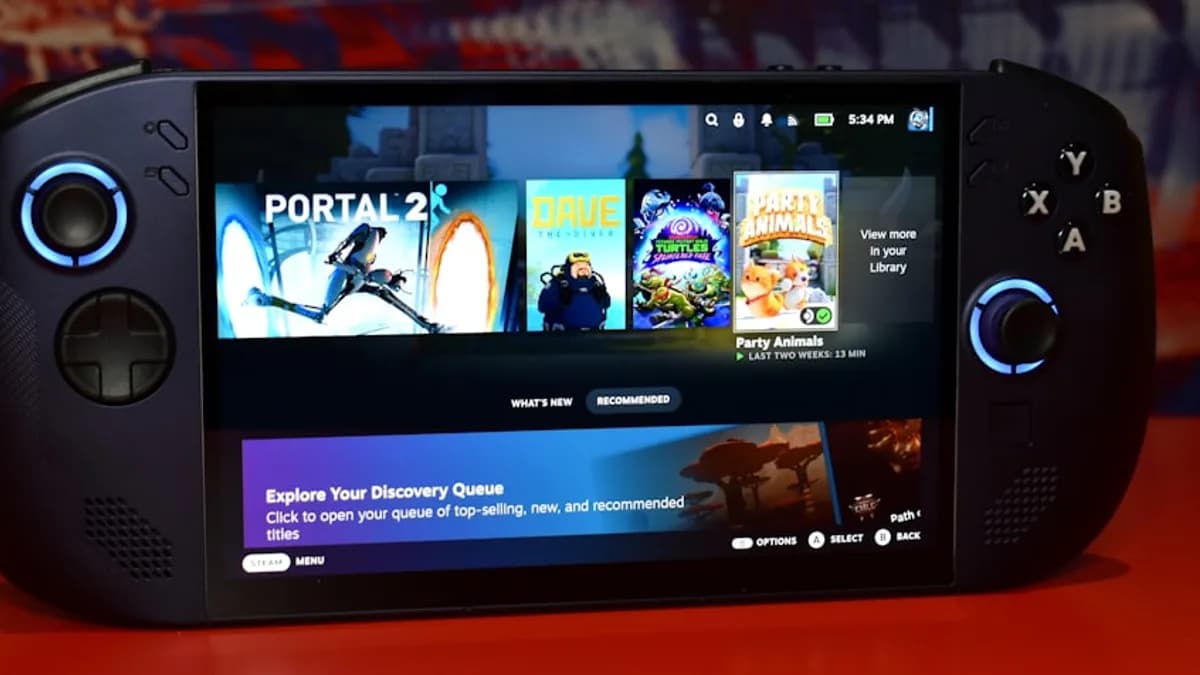
Lenovo’s Legion C700 teaser signals a handheld built around PC game streaming first, not a traditional portable Windows gaming PC. The upcoming Legion C700 will come with a streaming dongle that connects to a gaming PC and, with companion Windows software, promises local game streaming latency “as low as 10ms,” according to Notebookcheck.
Lenovo has already positioned the device as a “cloud” gaming handheld, rather than a machine expected to run Windows or Linux out of the box. The company has also claimed a thin-and-light build: 14.9mm thick and 556 grams, which Notebookcheck says would make it lighter than the Go S and ROG Ally X.
Lenovo teases Legion C700 handheld with a dedicated PC game-streaming dongle
The strongest read of Lenovo’s teaser is that the Legion C700 is being framed as a companion device for an existing gaming PC. The new detail is the dongle: a USB stick paired with Windows software that lets the handheld stream games locally from a PC. Lenovo’s pitch is not just “play in the cloud”; it is “play your PC games on a lighter handheld with very low claimed latency.”
Lenovo’s teaser says the PC streaming setup can reach latency “as low as 10ms,” according to Notebookcheck’s report.
That figure is the headline claim. It suggests Lenovo wants the Legion C700 to compete on responsiveness, the metric that can make or break handheld streaming. But the number is still Lenovo’s claim, not an independent test result.
The counterpoint is simple: streaming PC games is not the same as running them natively. Notebookcheck makes that distinction directly, noting that Lenovo is offering something closer to a first-party version of a Moonlight and Sunshine setup — a local streaming approach where a PC renders the game and a client device displays and controls it.
That comparison matters because it narrows what Lenovo is trying to solve. The company is not merely announcing another handheld form factor; it is trying to reduce setup friction by tying the handheld, dongle and Windows companion software into one branded path. What would prove that reading wrong is a final spec sheet showing that Lenovo is primarily selling the C700 as a native-game handheld, with streaming treated as a secondary feature.
Lenovo has not yet given a concrete launch date or price. Notebookcheck says the device is set for August 2026, but also notes there is still no exact launch date or pricing.
Low-latency local streaming could separate Legion C700 from conventional handheld gaming PCs
The Legion C700’s most useful promise is not raw handheld power; it is the possibility of letting a nearby PC do the heavy work. If the device is as thin and light as Lenovo claims, the streaming-first approach helps explain the design. A handheld that relies on a PC for demanding games does not need to make the same native-performance argument as a full handheld gaming PC.
| Device approach | Where the game runs | What Lenovo is emphasizing |
|---|---|---|
| Conventional handheld gaming PC | On the handheld itself | Native local play on handheld hardware |
| Legion C700 teaser pitch | Streamed from a gaming PC | 10ms claimed local streaming latency with a dongle and Windows software |
| Android-style handheld possibility | On-device for supported games, streamed for PC titles | Hybrid use, if Lenovo ships capable hardware and software support |
Notebookcheck says the C700 is a “cloud” gaming handheld and may ship as an Android device. That does not rule out native PC-game playback entirely. The report notes that if Lenovo uses a capable SoC and Android, emulators such as GameHub and GameNative could allow many Windows games to run at respectable frame rates.
That is the strongest counterpoint to the streaming-first interpretation. Lenovo may be building a hybrid device: stream from a PC when available, run some games locally when practical, and avoid committing publicly to a Windows handheld model. The teaser, however, puts the dongle front and center, so the current evidence still favors streaming as the clearest selling point.
The practical test will be latency and consistency, not the teaser language. Lenovo’s “as low as 10ms” claim is specific enough to set expectations, but local streaming quality depends on the full path between PC, software, dongle and handheld. The source does not detail the connection method, supported protocols or pairing process, so the real-world experience remains unproven.
Lenovo’s recent hardware moves have also shown the company experimenting across PC categories. For broader context on its gaming and compact-PC positioning, MLXIO has covered the €500 Gap Exposes Lenovo Legion 5’s Real Win Over LOQ and the $727 Lenovo Lecoo Pro 14 Grabs Rare eGPU Power for Less.
Legion C700 launch details, specs and real-world latency tests remain the key questions
The C700 now has a clearer pitch, but it still lacks the spec detail buyers need to judge it. The teaser described by Notebookcheck does not provide the processor, display size, refresh rate, battery capacity, control layout or supported streaming methods. It also does not give pricing.
The operating-system picture is clearer, but not settled at the product level. Lenovo has called the device a “cloud” gaming handheld, and Notebookcheck says it will not run Windows or Linux out of the box and could ship as Android. That would put more pressure on the streaming software and dongle to make PC access feel native enough.
Regional availability is another open question. Notebookcheck reports that Lenovo has partnered with Tencent Start for the Legion C700 and says that makes a wide global launch less likely. That is not the same as confirmation of a limited release, but it is a meaningful caveat for buyers outside the likely launch market.
Pricing may decide whether the C700 feels like a clever PC companion or an awkward middle ground. If Lenovo targets users who already own gaming PCs, the value case depends on the handheld’s build, screen, controls and streaming reliability. If it prices the device closer to full handheld PCs, buyers will expect more proof that streaming and Android-side native play justify the trade-off.
The next useful signal from Lenovo will be less glamorous than a teaser: exact specs, final software details and independent latency tests. Until those arrive, the Legion C700 is best read as a thin, light handheld built around a first-party local streaming bet — promising on paper, but still waiting for proof beyond the 10ms claim.
The Bottom Line
- Lenovo is signaling a handheld strategy focused on streaming from a PC rather than replacing one.
- The claimed 10ms latency targets the biggest concern with game streaming: responsiveness.
- At 556 grams and 14.9mm thick, the C700 could appeal to players who want a lighter handheld experience.