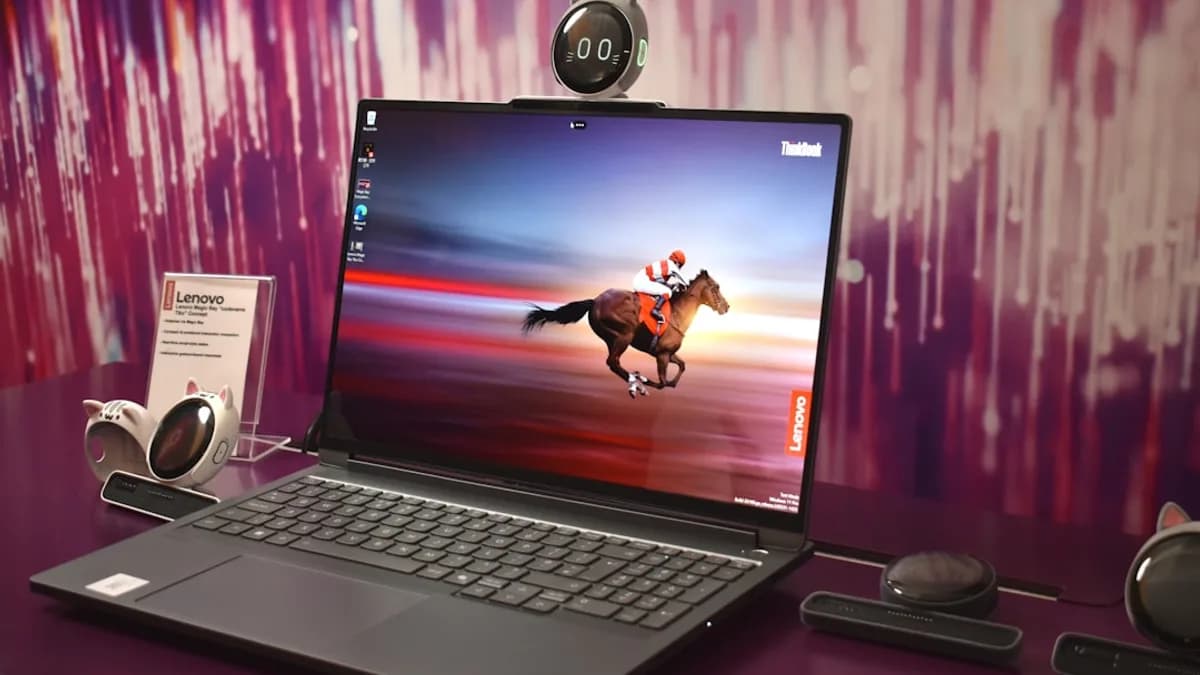
Lenovo’s new 14-inch ThinkBook now gives buyers a sub-1 kg laptop with a 120 Hz OLED option and a spare M.2 2280 SSD slot — a combination that usually forces compromises in ultraportables. The ThinkBook 14x has started selling internationally in selected markets after appearing earlier in China as the ThinkBook X AI 2026, according to Notebookcheck.
Lenovo is selling the machine in Australia, Germany, Hong Kong, Malaysia and Singapore. The rollout appears low-key: the laptop surfaced on Lenovo’s PSREF database more than a month ago, and some retailers listed it ahead of the official sales push.
Lenovo’s sub-1 kg ThinkBook reaches buyers without a launch-stage spectacle
The headline spec is weight, a theme that also frames the Lecoo Air 14 LNL. The ThinkBook 14x weighs 990 g when configured with its 54.7 Wh battery, making it far lighter than the ThinkBook 14 Gen 9, which Notebookcheck says weighs around 1.4 kg.
That gap matters because both are 14-inch productivity laptops, not tiny secondary machines. Lenovo is effectively offering a ThinkBook with a full-size work screen in a chassis that slips under the 1 kg line.
| Model | Weight cited by source | Positioning from available specs |
|---|---|---|
| ThinkBook 14x | 990 g with 54.7 Wh battery | Lighter 14-inch ThinkBook with OLED option and dual SSD slots |
| ThinkBook 14 Gen 9 | Around 1.4 kg | Heavier 14-inch ThinkBook referenced by Notebookcheck |
The processor choice is more conservative than the chassis design. Lenovo uses Intel Lunar Lake, not the newer Panther Lake platform cited by Notebookcheck. Current CPU options include the Core Ultra 5 226V, Core Ultra 7 256V and Core Ultra 7 266V.
Notebookcheck says the Core Ultra 7 256V and Core Ultra 7 266V deliver strong graphics performance because of their Arc 140V iGPU. The Core Ultra 5 226V is the weaker option, trailing its Lunar Lake peers in CPU and GPU performance.
For readers comparing Lenovo’s business-laptop branding and value positioning more broadly, MLXIO has separately covered the ThinkBook-versus-ThinkPad question in €450 Cheaper ThinkBook Beats ThinkPad—So Why Pay Up?, a Lenovo ThinkCentre mini PC discount, as well as the ThinkPad E16 Wildcat Lake.
The OLED-and-dual-SSD mix is the real specification story
The display stack gives the ThinkBook 14x its sharper edge. Lenovo lists three 120 Hz display options, with the top configuration using an 1800p OLED panel with variable refresh rate support.
That OLED panel is rated at 500 nits SDR peak brightness and 1,100 nits in HDR mode. In practical terms, the panel spec points to smoother motion than a 60 Hz screen and stronger contrast than the basic IPS option, though independent testing will still have to confirm color accuracy and real-world brightness behavior.
The base Eurozone configuration does not use that OLED panel. Lenovo’s starting model there comes with a 120 Hz IPS display rated at 400 nits peak brightness.
Storage is the other standout. Lenovo offers 256 GB, 512 GB or 1 TB of M.2 2242 storage, and the chassis includes a spare M.2 2280 slot for expansion.
That is unusual in a laptop weighing less than 1 kg. Many thin machines limit buyers to a single short SSD slot, soldered memory and little room to grow. Here, Lenovo keeps storage expansion alive even while cutting chassis weight.
Memory is less flexible at launch. Notebookcheck says Lenovo currently offers the ThinkBook 14x with 16 GB of RAM, while the company’s PSREF database indicates 32 GB RAM SKUs are planned later.
Pricing starts at €919, but the configuration picture is incomplete
In the Eurozone, pricing starts at €919 for a configuration with a Core Ultra 5 226V, 16 GB RAM, 512 GB storage, a 65 Wh battery and the 120 Hz IPS display rated at 400 nits.
Outside the Eurozone, Notebookcheck lists the ThinkBook 14x at AUD 2,003, HKD 10,721, MYR 5,762 and SGD 2,402 (~$1,857) in Australia, Hong Kong, Malaysia and Singapore, respectively. The source does not provide a full matching specification for each of those regional prices, so direct price-to-price comparison should wait for more complete listings.
The battery options also need attention. The lightest cited weight uses the 54.7 Wh battery, while the Eurozone entry configuration listed by Notebookcheck uses a 65 Wh battery. That means buyers should check the exact configuration before treating the 990 g figure as universal.
Current confirmed launch details:
- Markets: Australia, Germany, Hong Kong, Malaysia and Singapore
- Processors: Core Ultra 5 226V, Core Ultra 7 256V, Core Ultra 7 266V
- RAM at launch: 16 GB currently listed
- Future RAM indication: 32 GB SKUs shown on PSREF
- Storage: M.2 2242 drive options plus spare M.2 2280 slot
- Top display: 1800p OLED, 120 Hz VRR, 500 nits SDR, 1,100 nits HDR
- Starting Eurozone price: €919
MLXIO is also tracking Lenovo’s higher-end hardware pricing separately, including the gaming-focused $1,200 Cut Puts RTX 5090 Lenovo Legion 9i in Play Now.
The first reviews need to test whether the weight cut carries hidden costs
The ThinkBook 14x looks strongest on paper where ultraportables often get squeezed: display quality and upgradeable storage. A 120 Hz OLED option and dual M.2 slots give it a clearer identity than a standard thin business notebook.
The open questions are practical. Reviewers still need to test battery life, sustained Lunar Lake performance, fan noise, display calibration, chassis temperature and how easily that spare M.2 2280 slot can be accessed.
The near-term watch item is whether Lenovo expands the ThinkBook 14x beyond its current international listings and whether the promised 32 GB RAM configurations arrive broadly. If they do, this model could become Lenovo’s template for a lighter ThinkBook class: business-leaning, premium-screen, and still upgradeable where storage is concerned.
Key Takeaways
- The ThinkBook 14x brings a rare mix of sub-1 kg weight, a 14-inch screen, and upgrade-friendly dual SSD storage.
- Its 120 Hz OLED option makes it more appealing for users who want premium display quality in a business-style laptop.
- The international rollout gives buyers in selected markets another lightweight productivity option beyond Lenovo’s heavier ThinkBook models.