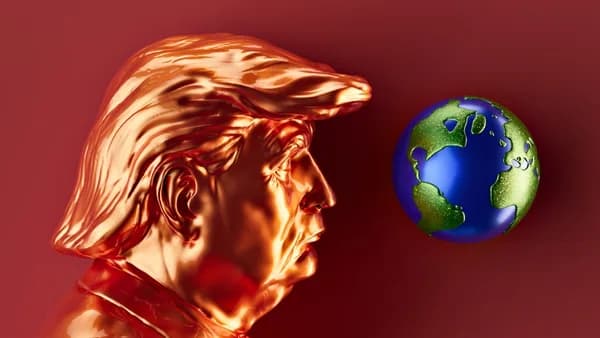
Dell Technologies did not rally because Donald Trump invented its AI story; it rallied because a political endorsement landed on top of an already explosive AI server narrative.
According to Notebookcheck, Dell shares climbed as much as 9% intraday before closing up 4.43% at $411.80 on Monday after U.S. President Donald Trump told attendees at a White House event to buy a Dell computer. The sharper tension is that this was not a random aside. It was reportedly Trump’s third public endorsement of Dell in five months.
That turns a hardware rally into something messier: part enterprise AI infrastructure trade, part political market signal, part ethics controversy.
Trump directly told attendees to “go out and buy a Dell computer” during the White House event, according to the supplied source material.
Trump’s Dell Endorsement Turned an AI Server Rally Into a Political Market Event
The easy read is that Trump moved Dell stock with one line. The more useful read is narrower: his endorsement added a short-term sentiment jolt to a company already being repriced around AI infrastructure demand.
That distinction matters. Dell’s core investor case is not consumer laptops. It is servers built for workloads tied to generative AI, enterprise data centers, and large-scale compute deployments. Trump’s comment, though, dragged that fundamentals story into a different arena: presidential influence over public markets.
The White House event was tied to the rollout of the Trump Accounts program, according to the supplied context. The provided excerpts do not detail the program’s structure or include specific funding commitments connected to the event.
So the endorsement did not happen in a vacuum. It came during an official ceremony, alongside prior Trump remarks promoting Dell. That is why the market reaction was not just a trading story. It became a governance story.
MLXIO analysis: Political attention can compress timelines. A business story that might normally unfold through order updates, guidance, and quarterly margins can suddenly reprice around a televised remark. That does not make the underlying AI server thesis false. It makes the signal noisier.
Dell’s AI Server Numbers Are the Real Fuel Beneath the Spike
The reported stock move was sharp: as much as 9% intraday, then a 4.43% close at $411.80. Additional supplied context says the stock traded at $420.44 on Tuesday, up $3.17, or 0.76%, and had risen more than 220% so far in 2026.
The more important numbers sit inside Dell’s server business.
| Dell metric from supplied material | Reported figure |
|---|---|
| AI-optimized server revenue growth | 757% year-over-year |
| Full-year revenue guidance | Toward $60 billion |
| Monday stock close | $411.80 |
| Monday daily gain | 4.43% |
That is why the endorsement had room to matter. Dell already had a narrative investors could chase.
The company’s mature PC business may still shape brand visibility, and Dell’s own consumer storefront continues to market products such as XPS laptops. MLXIO has separately tracked that consumer angle in $699 Dell XPS 13 Makes Apple's MacBook Neo Sweat Hard. But this stock story is not mainly about retail PC demand. It is about whether Dell can turn AI server orders into revenue at scale.
The supplied context also says Dell’s gross margin compressed from 21% to 18% as the product mix shifted more heavily toward AI servers. That detail is crucial. AI servers can expand revenue while pressuring profitability if the mix carries lower margins.
For readers tracking why infrastructure demand is rising in the first place, MLXIO’s coverage of One Command Spins Up a Private vLLM Server on HF Jobs shows the kind of model-serving workflows that sit downstream from this hardware cycle.
A Third Trump Product Plug Raised the Conflict-of-Interest Temperature
The ethics issue hinges on repetition and financial exposure.
Notebookcheck reports that Trump’s latest Dell plug was his third public endorsement of the company within five months, following earlier appearances in February and May. The same source material says critics pointed to federal financial disclosures showing Trump had purchased Dell stock.
That does not establish illegality by itself. The supplied material does not report a legal finding. But it does explain why watchdog scrutiny intensified.
The White House position, according to the source, is that Trump’s assets are held in a trust managed by his children, which it says removes any conflict of interest. Ethics experts dispute that characterization because a true blind trust requires an independent trustee with no personal ties to the beneficiary.
The distinction is not academic. A public figure praising a company can move attention. A president praising a company during an official event, while disclosures show stock exposure, creates a different reputational and market structure.
Before vs. after the latest endorsement:
- Before: Dell’s rally could be framed mainly as an AI server growth story.
- After: The rally also carries questions about political influence and market-moving speech.
- Before: Investors could focus on revenue growth and guidance.
- After: They must separate business momentum from endorsement-driven sentiment.
- Before: Trump’s Dell comments could be treated as isolated.
- After: Three endorsements in five months suggest a pattern, not a one-off.
Different Audiences Are Reading the Same Dell Move Differently
Investors have the cleanest split. Short-term traders may focus on the endorsement as a momentum catalyst. Long-term holders have a harder task: deciding whether 757% AI-optimized server revenue growth and full-year revenue guidance toward $60 billion can support the valuation after a major run.
Ethics watchdogs see a different story. For them, the key facts are the reported stock purchases and the family-managed trust structure. Their concern is not whether Dell makes strong servers. It is whether public office and private financial exposure are too close.
Enterprise customers likely have a narrower procurement lens: server availability, performance, support, and roadmaps. The supplied material does not report customer reactions, so any claim about buyer behavior would be speculation.
Trump allies or supporters may frame the remarks as advocacy for a major American company, but the supplied material does not provide their reactions. That absence matters. The public record here is heavy on market data and ethics scrutiny, lighter on confirmed political defense.
Political Brand Power Is Not the Same as Server Revenue
This episode sits at the intersection of two forces that should not be collapsed into one.
One is political brand power. A president’s words can move attention quickly, especially when the comment is direct and product-specific. The supplied context says some analysis described this kind of boost as a “sentiment premium,” separate from underlying financial performance.
The other is Dell’s actual AI server business. A 757% year-over-year jump in AI-optimized server revenue is not a meme-stock metric. Full-year revenue guidance toward $60 billion is not a television applause line. Those figures are why Dell had an investment case before Trump spoke.
MLXIO analysis: The risk for investors is not that the political catalyst replaces the AI thesis. The risk is that it distorts the price signal. A rally that mixes revenue growth, guidance, presidential speech, and ethics headlines becomes harder to read.
This is also the enterprise-side version of a broader filter MLXIO has applied in Key Trends Splitting Tomorrow's Winners From Losers: durable winners tend to show up in operating data, not just narrative velocity.
Dell’s Next Test Is Turning AI Server Attention Into Earnings Quality
Dell’s next challenge is not getting noticed. It has that.
The harder test is converting AI server demand into profitable revenue while managing the margin pressure already visible in the supplied context. If AI servers drive volume but compress margins further, the market may start asking whether the revenue surge is carrying enough earnings power.
The political story has its own watch points. Further Trump endorsements of Dell, new financial disclosures, updated comments from ethics experts, or any official response from Dell would all sharpen the debate. The supplied material does not establish what comes next, so the right stance is evidence-based caution.
The clearest confirmation of Dell’s bullish case would be updated earnings showing continued AI server revenue growth, order conversion, and margin resilience. The clearest challenge would be slower conversion, weaker guidance, or signs that endorsement-driven buying faded without operational follow-through.
For now, Dell’s rally says two things at once: AI infrastructure demand is real enough to move a legacy hardware giant, and political speech can still bend the short-term tape around that story. The next earnings update will show which force is doing more of the work.
Disclaimer: This MLXIO analysis is for informational and educational purposes only. It is not financial, investment, legal, tax, or professional advice. It does not provide buy, sell, hold, price-target, portfolio, or personalized recommendations. Verify information independently and consult qualified professionals before making decisions.
The Bottom Line
- Dell’s rally shows how AI infrastructure demand is reshaping investor expectations for legacy hardware companies.
- Trump’s repeated endorsements raise questions about presidential influence on individual public stocks.
- The stock move blended fundamentals, political signaling, and market sentiment into one high-profile trading event.