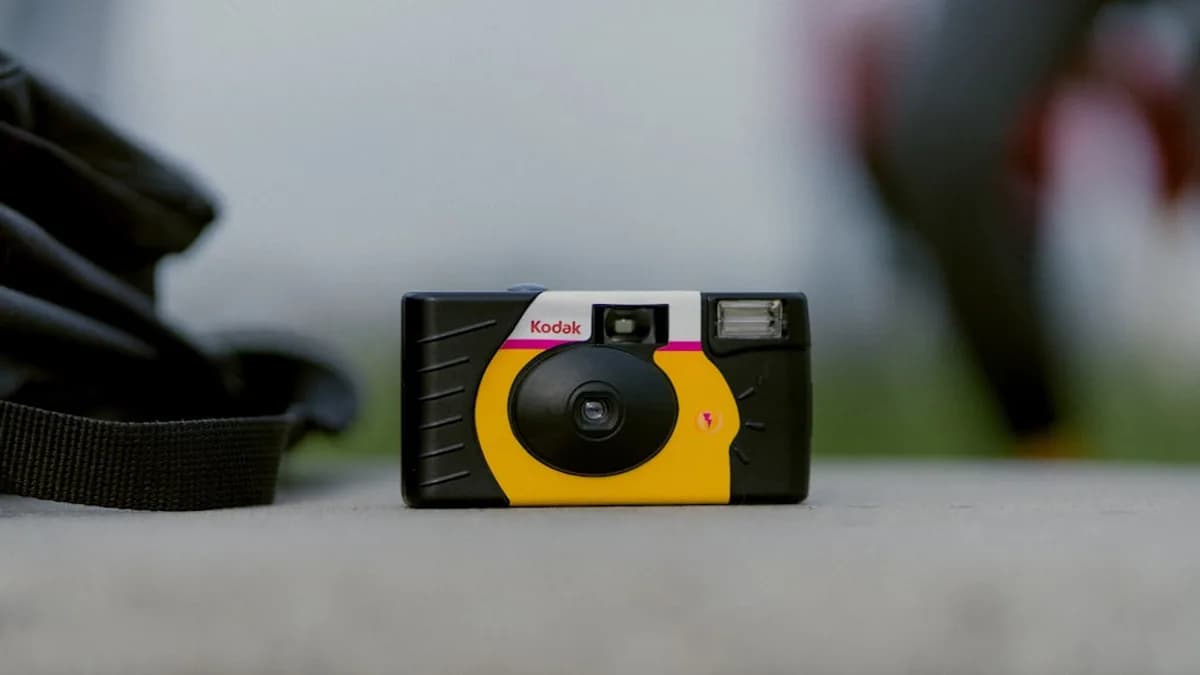
Can a $35 reusable Kodak-branded film camera turn analog photography from a hobbyist commitment into an impulse buy?
That is the sharper question behind Reto’s Kodak EC35, a pocketable 35mm point-and-shoot built around fixed settings, a 25mm lens, and a sliding cover that doubles as a shutter lock, according to Notebookcheck. The product is not trying to beat serious film cameras on optics or control. It is trying to remove the excuses: price, complexity, and fragility.
Can a $35 Kodak EC35 make film feel low-risk again?
The Kodak EC35 is best read as a pricing move, not a technical one. Reto has taken the functional idea of a disposable camera — load film, point, shoot, use flash when needed — and put it inside a reusable body.
That matters because the source material frames the current film entry point as intimidating. Notebookcheck says shooting 35mm film continues to grow in popularity, while vintage SLRs can bring steep learning curves and high price tags for newcomers. The EC35 answers that with a simple proposition: buy a new camera for $35, avoid manual exposure, and start shooting.
The Kodak name also does work here. Reto is expanding a lineup of affordable Kodak-branded cameras, and the branding gives the EC35 a familiar shelf presence for buyers who may not know Reto but recognize Kodak immediately. MLXIO analysis: this is nostalgia packaged as accessibility. The camera is not selling precision. It is selling permission to try film without first becoming “a film person.”
That makes the EC35 a very different camera story from the spec-heavy hardware cycle we track in smartphone coverage, including Factory Log Cracks iPhone 18 Pro Max Camera Secrets and Galaxy Z Fold 8 Drops 200MP Camera but Keeps Top Price. The EC35 goes the other direction: fewer features, fewer decisions, lower stakes.
What does the 25mm fixed-exposure design actually give up?
The EC35’s core spec sheet is deliberately narrow:
| Feature | Kodak EC35 detail |
|---|---|
| Film format | 35mm film |
| Lens | 25mm |
| Aperture | f/10, fixed |
| Shutter speed | 1/100 second, fixed |
| Flash | Built-in, powered by one AA battery |
| Controls | Fixed exposure, no manual settings |
| Colors | Midnight Black, Vanilla White, Butter Yellow, Lavender, Powder Blue, Blush Pink, Avocado |
The trade-off is obvious. Fixed exposure makes the EC35 easy to use, but it also limits the camera’s ability to adapt. A fixed f/10 aperture and 1/100 second shutter speed mean users are leaning on available light or the built-in flash. There is no aperture dial to open up indoors. There is no shutter control to slow things down.
That is not a flaw in the product so much as the product’s entire logic. The EC35 is designed to remove choice. For a first-time film shooter, fewer controls can mean fewer missed moments caused by hesitation. For anyone who wants creative exposure control, it will feel cramped immediately.
The sliding cover is the most practical design detail. It protects the lens and mechanically locks the shutter, so the camera can sit in a backpack or jacket pocket without accidentally burning a frame. In film, that matters. Every accidental shot costs one exposure from the roll.
Is the $35 sticker price the real cost of shooting the Kodak EC35?
No. The $35 price lowers the entry point, but it does not capture the full cost of analog shooting.
Notebookcheck says buyers can also choose a $45 bundle that includes a roll of Kodak Ultramax 400 film. That tells you the camera body alone is only part of the spend. Film is consumable. A flash battery is required for low light or indoor use. Processing, scanning, and reprints sit outside the camera’s sticker price, though the supplied sources do not give prices for those services.
That distinction matters for how the EC35 competes. Against single-use disposable cameras, the reusable body is the obvious advantage: users can reload it rather than discard the entire device after one roll. Against used compact cameras or vintage SLRs, the advantage is different: the EC35 is new, cheap, and simple.
Against Reto’s own broader lineup, the positioning is also clear. Engadget’s supplied context says the EC35 sits below Reto’s $100 Kodak Snapic A1 and the $50 EKTAR H35 half-frame camera. Notebookcheck also points to another $35 Reto camera, the Kodak Charmera, but that device is digital rather than analog.
| Camera | Type | Price in supplied sources | Core distinction |
|---|---|---|---|
| Kodak EC35 | 35mm film | $35 / $45 bundle | Reusable disposable-style film camera |
| Kodak Charmera | Digital | $35 | Keychain-sized, 1.6MP CMOS, microSD |
| Kodak Snapic A1 | Film camera | $100 | Higher entry price than EC35 |
| EKTAR H35 | Half-frame film | $50 | Lower-cost film option above EC35 |
MLXIO analysis: the EC35’s price is meant to win the first decision — “Should I try film?” — not the long-term economics of shooting roll after roll.
Why does this feel like the disposable-camera idea coming back in reusable form?
The EC35 borrows the disposable camera’s strongest idea: make the act of shooting almost thoughtless.
Its 25mm lens, fixed exposure, built-in flash, and pocket body echo the broader category of simple consumer film cameras. The difference is that the EC35 is reloadable. It keeps the easy point-and-shoot behavior while avoiding the one-and-done hardware model.
That is the core analog cycle repeating. Film cameras once competed on convenience for mass-market users. Today, based on the supplied sources, the EC35 is aimed at beginners who want the experience of shooting film without the cost and complexity associated with vintage SLRs. The reason has changed. The design philosophy has not.
This is also why the camera’s limitations may be part of the appeal. A fixed-focus, fixed-exposure film camera produces a different kind of decision-making. You choose the moment, not the settings. For some buyers, that is the point.
Who will like the Kodak EC35 — and who will reject it fast?
Casual shooters get the clearest benefit. The EC35 offers a low-risk way to try 35mm film without hunting for a used camera, checking old electronics, or learning manual exposure.
Enthusiasts will see the compromises immediately. Fixed settings restrict creative control. The supplied PhotographyTalk context describes the lens as a 25mm, f/10, 2-element acrylic, fixed-focus optic, which signals a camera built for lo-fi simplicity rather than sharp technical output. That does not make it bad. It makes it specific.
Film labs and retailers are harder to assess from the available material. MLXIO inference: more beginner-friendly cameras can introduce new film users, but fixed-exposure cameras may also produce more uneven rolls, especially indoors or in poor light. The source material does not provide data on lab demand, processing volumes, or customer outcomes, so that remains an open commercial question.
For readers interested in pocketable hardware with a similarly low-cost, utility-first pitch, our coverage of 3 Heads, $45: Niwalker ES01 Bets Pocket Lights Need Choice offers a useful contrast. Both products sell compactness and affordability, but the EC35 adds the recurring cost and unpredictability of film.
What should beginners realistically expect from the Kodak EC35?
The EC35 should normalize reusable film cameras over single-use disposables if buyers accept its limits. That is the practical promise: keep the disposable-style ease, but reload the camera for another roll.
Expect wide framing from the 25mm lens. Expect best results in brighter conditions or with flash. Expect missed shots when light falls outside what f/10 and 1/100 second can handle. Expect the camera to feel more like a memory tool than a precision instrument.
The forward-looking test is simple. If the EC35 gains retail traction, Reto and other licensed-brand camera makers have a clear path: more colors, more bundles, minor lens changes, and adjacent products priced for first-time buyers. If it struggles, the reason may not be the camera body at all. The evidence to watch is whether beginners who buy a $35 film camera keep buying rolls after the first one.
Key Takeaways
- The $35 price makes film photography feel more approachable for beginners.
- Fixed settings and a shutter-locking sliding cover reduce complexity and accidental shots.
- Kodak branding gives the camera nostalgic appeal for casual buyers who may not know Reto.