Can a $44.90 camera win attention by making the act of framing visibly imperfect? That is the real question raised by the Godox C100, a partially transparent compact camera that is now available internationally through Amazon with free shipping, according to Notebookcheck.
The headline feature is not resolution. It is not video quality. It is the fact that Godox, better known for lighting gear, built a tiny camera that doubles as a light meter and replaces the conventional rear display with a transparent viewing window. That makes the C100 less a normal compact camera than a deliberate gadget provocation: cheap, odd, useful in one specific way, and compromised everywhere else.
Is the Godox C100 a real camera or a collectible tech object?
The answer is both, but the balance tilts toward object.
The Godox C100 takes photos and records video at 1,920 x 1,080 pixels. Video is capped at 26 frames per second. Notebookcheck says image quality is “significantly better” than the Kodak Charmera, but also says the low resolution and narrow dynamic range make the C100 clearly a toy camera.
That positioning matters. Godox is not selling a cheap substitute for a serious compact. It is selling a camera whose weirdness is the product.
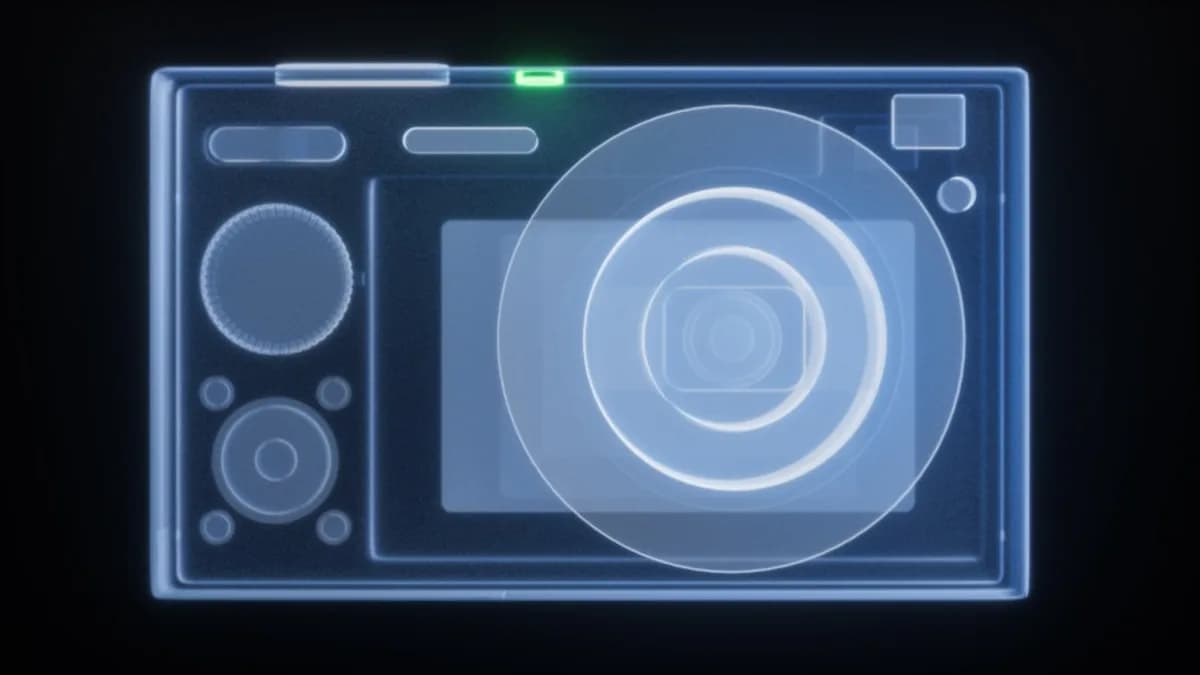
The partially transparent design pushes that further. The camera’s see-through window is not just decoration; it is the shooting interface. Battery details, exposure parameters in light-meter mode, and frame lines appear directly on the window rather than on a conventional display.
That gives the C100 a stronger identity than most low-cost cameras. It looks like something made to be handled, shown, and argued about. The drawback is immediate: the same design that makes it interesting also makes it harder to use in the way most people now expect cameras to work.
For readers tracking unusual camera interfaces more broadly, MLXIO has also covered Weird Pixel Art Invades Your iPhone Camera With NeoCam and Motorola Razr Ultra 2026 Turns Hinge Into Camera Weapon. The C100 sits in that same broader question: when does the camera experience become as important as the image?
What does the transparent viewfinder actually change?
It removes precision.
The C100 has no conventional display. Instead, users look through a transparent viewing window that acts as the viewfinder. Notebookcheck says early hands-on videos show that composing precisely is nearly impossible because the visible frame changes depending on how far the camera is held from the eye.
That is not a small usability issue. It changes the whole shooting workflow.
With a smartphone or standard digital compact, the screen shows the image plane. With the C100, the user sees an approximation through a transparent window. The camera becomes less about exact framing and more about accepting misses.
Digital Camera World’s James Artaius, who tested the camera, described the device in more playful terms:
“This might be the most fun $45 I've ever spent on camera stuff.”
That enthusiasm is important, but so is the caveat. Digital Camera World said the C100’s “intelligent transparent display” is “basically a see-through LCD screen with a UI that shows your image frame, battery and shooting mode.” It also noted the camera can shoot 16:9, 4:3, 3:2 or 1:1 images, with frame lines changing to match the selected aspect ratio.
So the C100 is not blind. It gives guidance. It just does not give the kind of certainty buyers are trained to expect.
Why does the light-meter function matter more than the camera specs?
Because it gives the C100 a reason to exist after the novelty fades.
Notebookcheck says the C100 can function as an external light meter to determine correct exposure. The example given is an analog camera without a built-in light meter, such as the Leica M4.
That is the most practical part of the product. A toy camera that also acts as a light meter becomes more than a novelty desk object for some photographers. It can sit in a bag as a secondary tool.
Still, the source material does not confirm how accurate the light meter is. Digital Camera World said it planned to test the C100 against a Sekonic meter, but the supplied material does not include those results.
That leaves the core utility unresolved:
- Confirmed: The C100 has a light-meter function.
- Confirmed: It displays exposure parameters on the transparent window.
- Unclear: How accurate the meter is across real shooting conditions.
- Unclear: Whether photographers will trust it for film work beyond casual use.
That distinction matters. The camera specs mark the C100 as a toy. The light meter is the feature that could make it useful.
What do the numbers say about the $45 proposition?
The pricing is the sharpest part of the story.
Notebookcheck says Amazon is accepting orders at $44.90 with free shipping. It also says Godox lists the camera in China for the equivalent of $25, meaning an import can be cheaper.
| Product / device | Source-supported detail | What it implies |
|---|---|---|
| Godox C100 | $44.90 on Amazon; equivalent of $25 in China | Low enough to be treated as a gadget purchase, not a camera investment |
| Godox C100 photo/video | 1,920 x 1,080 pixels | Specs align with toy-camera positioning |
| Godox C100 video | 26 fps | Not aimed at serious video production |
| Kodak Charmera | C100 image quality described as significantly better | Godox is competing inside the low-cost toy-camera tier |
| Escura InstantSnap | 1.3MP, 480p video, no light meter, according to Digital Camera World | C100 adds resolution and utility versus that referenced design |
MLXIO analysis: the price changes how buyers judge the product. At under $50, the C100 does not need to beat a phone. It needs to be fun enough, strange enough, or useful enough to justify the experiment.
That is a lower bar, but not an easy one. Cheap gadgets still fail when the novelty burns off quickly.
Why does this fit the screenless and lo-fi camera impulse?
The C100’s appeal depends on constraint.
Digital Camera World compared the shooting experience with other screen-free cameras including the Canon Ivy Rec and Instax Pal, saying those have optical finders that provide only a vague approximation of the frame. It argued the C100 is more accurate because the camera is positioned just above the finder.
That does not make it precise. It makes it intentionally different.
The recurring appeal of devices like this is that they interrupt the normal loop: shoot, review, correct, repeat. Digital Camera World called the C100 “a brilliant camera for kids” because users have to wait to get home to see what they shot. That is not a performance claim. It is a workflow claim.
This is where the C100 becomes more interesting than its spec sheet. The low resolution, narrow dynamic range, and awkward composition are not hidden defects. They are part of the bargain.
For creators, the transparent body and unusual shooting method may be the content before the image is judged. For photographers, the light meter is the serious hook. For casual buyers, the lack of a normal display could be charming for an hour and frustrating after that.
Did Godox copy a good idea or improve a weak one?
Digital Camera World raised the uncomfortable comparison directly, saying the C100 takes “a great deal of inspiration” from the Escura InstantSnap, which debuted at CP+ 2025.
The differences listed in the supplied material are not minor. Escura’s camera is described as 1.3MP, limited to 480p video, and lacking a light meter. The C100 shoots 1,920 x 1,080 stills and video and adds the meter function.
That does not settle the design-origin question. It does clarify Godox’s product strategy: take a strange screenless camera concept, make the image output less weak, add a photographer-facing tool, and price it low enough to soften objections.
MLXIO analysis: if the C100 gains traction, it likely will not be because buyers think it is the best compact camera. It will be because it turns technical limitation into personality while adding just enough utility to avoid feeling disposable.
What would prove the C100 is more than a viral toy?
The next evidence has to come from repeat use, not unboxing clips.
The strongest confirmation would be independent testing that shows the light meter is accurate enough to trust, especially for analog photographers using cameras without built-in meters. Strong sample galleries would also help show whether the C100’s narrow dynamic range can still produce consistently pleasing images in normal conditions.
The weakest signal would be the opposite: lots of attention around the transparent design, but little evidence that owners keep shooting with it after the first round of videos.
The practical takeaway is simple. The Godox C100 is not a budget performance camera. It is a low-cost, screenless, transparent camera-light-meter hybrid with real constraints and one clever utility feature. If the light meter holds up, Godox has something stranger and more useful than a toy. If it does not, the C100 remains what its specs already suggest: a fun $45 object built for curiosity, not precision.
Key Takeaways
- The C100 shows how low-cost cameras can compete on design and novelty rather than pure specs.
- Its transparent viewfinder makes it distinctive but also less convenient than a normal rear display.
- At $44.90, it targets gadget collectors and casual experimenters more than serious photographers.