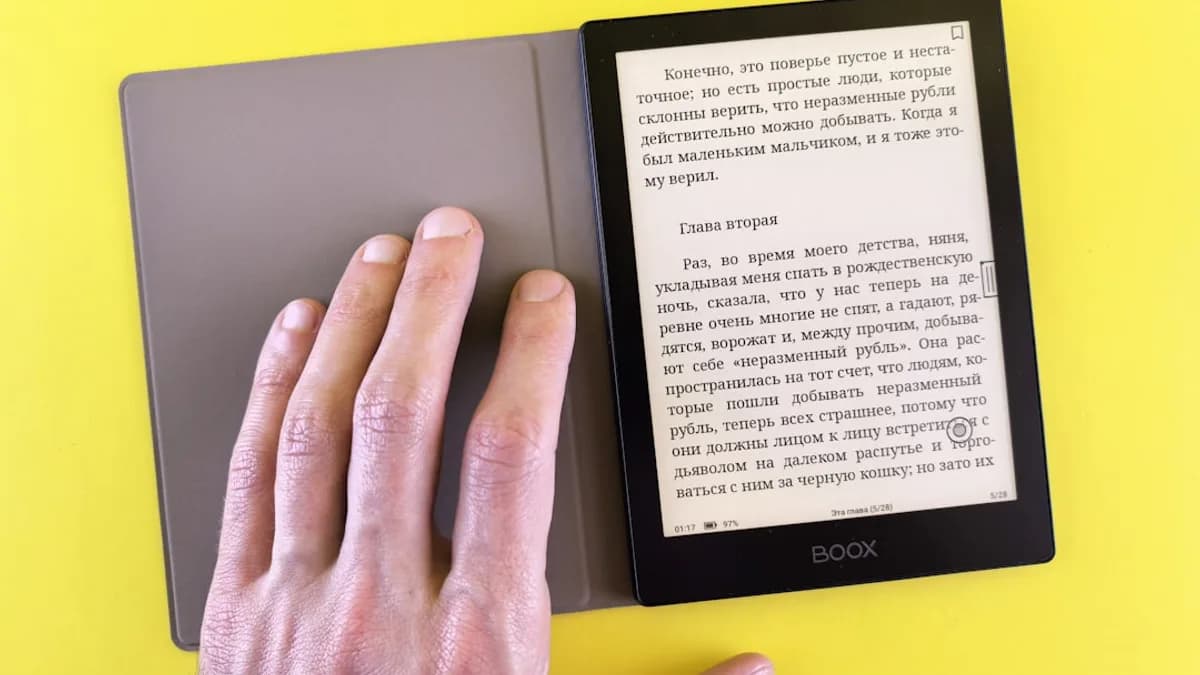
Onyx has teased the Boox Picco, a new e-reader with a 3.97-inch E-Ink display that is smaller than even compact mainstream smartphones. That matters most for readers who want a device that slips into a pocket without becoming another phone-shaped distraction machine.
The Boox Picco will be the first model in the new Boox Tile series, according to Notebookcheck. Onyx has not confirmed pricing, availability, processor details, battery size, weight, or whether the device will run full Android. That restraint is the story. The teaser shows enough to reveal the product bet, but not enough to prove whether the bet works.
Onyx’s Core Move: A 3.97-Inch Reader That Stops Chasing Smartphone Scale
The Boox Picco appears to reject the direction of larger mobile screens. Notebookcheck says the device resembles a simple white smartphone, with a flat bezel and a slightly wider chin below the display. But its 3.97-inch screen puts it below even the most compact mainstream smartphones.
So what is Onyx really testing here?
MLXIO analysis: The Picco looks less like an attempt to replace a phone and more like an attempt to carve reading away from the phone. That distinction matters. A small E-Ink device can win by being intentionally limited, not by matching a smartphone feature sheet.
Confirmed details are narrow but telling:
- Display: 3.97-inch E-Ink panel
- Color: Grayscale only
- Lighting: Front lighting for night reading
- Storage: microSD card support for books
- Design: White, phone-like body with flat bezel and wider lower chin
- Product family: First device in the new Boox Tile line
- Unknowns: Price, availability, specifications, software platform
The most important signal may be the product-family branding. Onyx is not just teasing a one-off compact reader. It is introducing a separate Tile line. That suggests the company sees ultra-compact E-Ink as a category worth testing, not just a novelty SKU.
Device Makers Face a Harder Design Problem: Tiny E-Ink Leaves Less Room for Software Ambition
A 3.97-inch e-reader creates obvious engineering trade-offs. The screen is the point, but also the constraint. How much interface can fit before the device stops feeling like a reader and starts feeling like a cramped gadget?
Notebookcheck compares the Picco with the Xteink X4 Pro, which has a 4.3-inch display and is described as one of the most compact e-readers on the market. Onyx’s existing small-device direction, by contrast, has so far included models closer to smartphone size, such as the Boox Palma 2 Pro, which Notebookcheck notes at $399 on Amazon.
| Device | Confirmed screen detail | Position in source material | Key distinction |
|---|---|---|---|
| Boox Picco | 3.97 inches | New Boox Tile model teased by Onyx | Smaller than compact mainstream smartphones |
| Xteink X4 Pro | 4.3 inches | Named compact rival | One of the most compact e-readers on the market |
| Boox Palma 2 Pro | Not specified in supplied source | Existing Onyx device similar in size to a smartphone | Listed by Notebookcheck at $399 on Amazon |
MLXIO analysis: The smaller the display, the more every software decision matters. Font size, margins, menu depth, page-turn behavior, and library navigation all become product-defining choices. A 3.97-inch screen likely means fewer words visible per page than on larger readers, and more frequent interaction with the device.
That is not automatically a flaw. It may be the whole proposition.
Onyx’s official shop currently highlights broader BOOX categories such as the Go Series, Note Series, Palma 2 Pro, Go 6 (Gen II), Go 10.3 (Gen II) Lumi, and the 7-inch Page eBook reader. Against that lineup, Picco would sit at the extreme end of portability.
For broader display-hardware context, MLXIO has also tracked how device makers keep making product-defining screen choices, including in Key Display Bet Gets Cut From Cheaper Apple Vision Pro and Creaseless Fold Teases Apple’s iPhone Ultra Display. Picco is a smaller example of the same strategic reality: the display sets the product’s ceiling.
Buyers Get Pocketability, but Also the Limits of a 4-Inch Reading Canvas
For end users, the Picco’s appeal starts with the obvious: size. A 3.97-inch E-Ink reader can go places larger e-readers cannot. But what kind of reading actually benefits from that format?
Notebookcheck confirms two buyer-facing features: front lighting and microSD storage. The first makes the Picco usable at night. The second suggests the device is meant to carry a personal library without depending entirely on fixed internal storage, though Onyx has not disclosed capacity or file support.
The software question is more important than it looks. Notebookcheck says that if Onyx takes a similar technical approach to Xteink, the Picco may not be a full-fledged Android device. Instead, it could be an e-reader whose software is mainly built for e-books. But Onyx has not confirmed that.
That uncertainty splits the buyer case:
- If Picco is simple: It becomes a focused pocket reader.
- If Picco runs broader Android-style software: The small display may become the limiting factor.
- If pricing lands high: Buyers may compare it with larger BOOX devices.
- If pricing lands low: It could be treated as a secondary reading device.
The source does not provide battery-life claims, weight, refresh behavior, or app support. Any claim about reduced distraction, longer endurance, or comfort would be premature unless Onyx confirms the hardware and software stack.
Xteink and Other Compact E-Ink Makers Now Have a Direct Boox Answer
The Picco puts Onyx into a size class where Xteink X4 Pro already has a named presence. Notebookcheck’s comparison is direct: Xteink’s 4.3-inch reader is among the most compact e-readers, while Picco drops lower at 3.97 inches.
Does being smaller automatically make Picco better?
No. Smaller only helps if the interface, battery, storage, and reading flow match the form factor. Otherwise, compactness turns into friction.
MLXIO analysis: The competitive pressure here is not about raw specs yet. Onyx has not supplied them. The pressure is about legitimacy. Once Boox enters a niche, the niche looks less experimental. The new Tile branding reinforces that.
Still, the Picco cannot be judged as a full product until Onyx answers basic questions:
- Software: Is it a focused reader or a broader device?
- Price: Is it positioned as an accessory or a premium specialty reader?
- Availability: Which markets get it, and when?
- Specs: Battery, storage limits, weight, chipset, and supported formats remain unconfirmed.
- Series roadmap: Is Tile only Picco, or the start of multiple compact models?
Notebookcheck notes that because teaser images have already appeared, launch may not be far away. That is a reasonable inference, but not a date.
The Market Signal: Picco Makes E-Readers Feel More Like Companion Devices
The strongest read on the Boox Picco is that Onyx is testing whether e-readers can shrink into companion hardware rather than compete as main reading screens. That is a narrow but meaningful thesis.
A larger reader can handle more text, bigger documents, and a more comfortable interface. A tiny reader must justify itself differently: instant carry, quick reading sessions, and low physical friction. The Picco’s confirmed front light, microSD slot, and grayscale E-Ink panel point toward that kind of role, but the missing specs still matter.
The evidence that would strengthen the case is straightforward. Onyx needs to confirm software that fits the 3.97-inch screen, pricing that does not force comparison with larger devices, and availability that makes the Tile line more than a teaser.
The evidence that would weaken it is just as clear: vague launch details, cramped software, or a price that makes the device feel like a premium curiosity. For now, the Picco is best read as a compact E-Ink signal from Onyx — not proof of a new category, but a serious test of how small dedicated reading hardware can get before portability stops being enough.
Key Takeaways
- The Boox Picco targets readers who want a truly pocketable e-reader instead of another phone-sized screen.
- Its small grayscale E-Ink design suggests Onyx is prioritizing focused reading over smartphone-like features.
- Key details such as price, availability, battery size, and software platform remain unconfirmed.