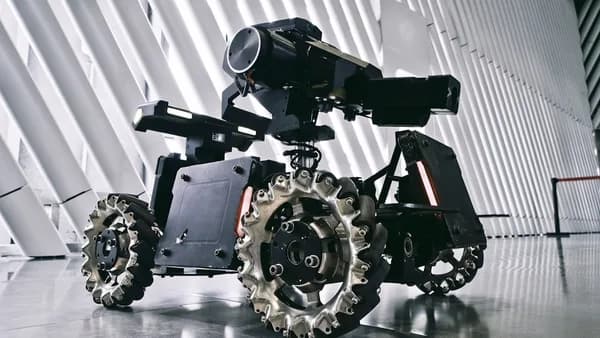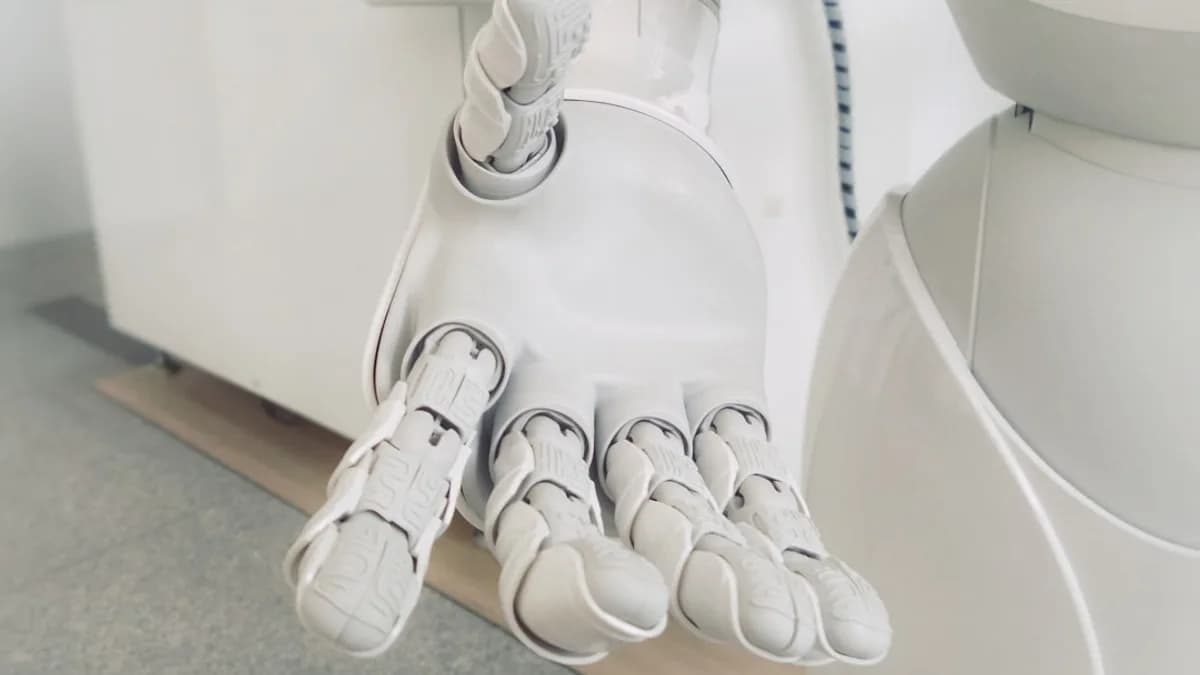
BrainCo’s WAIC 2026 demo turns brain-controlled robots from a prosthetics story into a broader robot-platform story. At the 2026 World Artificial Intelligence Conference in Shanghai, the company showed a system that uses an EEG headset and AI software to translate brain signals into commands for robotic hands, arms, humanoids, and other robot form factors, with BrainCo claiming the control loop runs in under 200 milliseconds.
The reported demo included a company representative missing his left hand remotely controlling a robotic hand by thought alone, while table-mounted robotic arms and humanoids were also controlled from a distance, according to Notebookcheck. BrainCo’s own launch materials describe a person wearing a lightweight EEG headset who thought about grabbing a cup and watched a robotic arm perform the action without a button press, voice command, or visible physical movement.
That is not a consumer PC-building appliance. Not yet. But it is a useful signal: brain-computer interfaces are being packaged less like one-off lab demos and more like developer infrastructure for robotics, embodied AI, assistive devices, and remote manipulation.
BrainCo’s WAIC demo points beyond novelty robotics
The useful part of BrainCo’s announcement is not the “thought-controlled robot” headline. It is the claim that one brain-signal interface can drive multiple robot types. BrainCo is positioning the Brain-Controlled Robot AI Platform as a bridge between human intent and robotic action, rather than as a single prosthetic or single-arm demo.
That matters because the first serious use cases are unlikely to look like a couch-bound PC builder commanding a humanoid to install a GPU while snacks remain untouched. The better near-term frame is hands-free manipulation where the user’s own hands are unavailable, unsafe to use, or physically unable to perform the task. That could mean assistive robotic arms for people with limited mobility. It could mean rehabilitation systems. It could mean teleoperated robots in controlled industrial or research environments.
The Cheetos-and-PC-building example is still useful, as a stress test for the idea. A user wearing an EEG headset might want a robot to pick up a screwdriver, hold a component steady, move a cable, or keep a workspace clean while their own hands remain off the hardware. The joke exposes the real challenge: brain-controlled robotics only becomes valuable when it can do something precise, repeatable, and safer than a human improvising.
BrainCo’s stronger claim is that this is a platform. In its press release, the company says the system can work with commercially available robots, including humanoid machines, robotic arms, and four-legged robotic dogs, without requiring proprietary robot hardware. That platform framing fits the broader robotics question MLXIO has been tracking in Key Trends Splitting Tomorrow's Winners From Losers: the advantage increasingly goes to companies that can connect AI control systems to useful physical execution, not just show polished software.
The counterpoint is obvious. A stage demo does not prove rugged real-world performance. Public demonstrations usually happen in controlled settings, with known objects, tuned tasks, and prepared users. The thesis still holds because BrainCo is not only showing a robot moving. It is showing an interface stack: EEG capture, AI intent decoding, command translation, and robot execution. What would weaken the case is evidence that the system only works after heavy calibration, with narrow commands, or under conditions too fragile for routine use.
How BrainCo turns EEG signals into robot movement
BrainCo is not claiming to read rich private thoughts. It is claiming to decode control intent from brain-signal patterns and convert that intent into robot commands. That distinction matters. “Pick up the cup” in a demo is not the same thing as a machine understanding an unspoken paragraph in a user’s head.
The pipeline has three stages. First, the user wears an EEG headset, sometimes described as a brain cap, that detects electrical activity from the scalp. Second, BrainCo’s software filters and interprets those signals to identify motor or control intent. Third, an AI control layer converts the decoded intent into instructions the robot can execute.
BrainCo describes this framework as “Neuro-Embodied-AI”: the BCI decodes intent, the AI layer breaks that intent into actionable steps, and the robot’s own systems handle physical execution. The company’s technical claim is that the full process takes under 200 milliseconds. That number is important because lag can make remote robot control feel clumsy, especially when the task requires timing or visual correction.
“A decade of BCI research has given us the ability to decode what a person intends to do and translate that into machine action,” said Nyx He, Partner and Senior Vice President of BrainCo. “By integrating brain-computer interfaces, AI, and embodied AI, we believe it will define the next chapter of human-machine collaboration.”
Different robots make the control problem harder in different ways. A robotic hand may need grip selection, finger movement, and force control. A table-mounted arm adds spatial positioning, collision avoidance, and path planning. A humanoid adds more joints, balance constraints, and task sequencing. BrainCo’s platform pitch is that the user does not manually control every joint; the system maps high-level intent into robot actions.
The strongest counterpoint is that EEG is noisy. Scalp-level signals are faint, and real users move, blink, tire, lose focus, and operate in messy environments. BrainCo’s demo suggests the system can work for prepared tasks, but public materials do not establish how well it performs across users, over long sessions, or under distractions. The platform thesis still holds if the AI layer reduces the amount of direct neural control required. It fails if users must concentrate intensely on every small movement.
The WAIC 2026 demos showed breadth, not full autonomy
The most important detail from WAIC is that BrainCo showed control across several robot categories, not just a single prosthetic hand. The company demonstrated robotic-arm tasks such as grasping a cup and picking up an apple. Notebookcheck also reported remote control of a robotic hand by a representative missing his left hand, plus mind-control demonstrations involving table-mounted robotic arms and humanoids.
BrainCo also introduced an Embodied AI Data Collection Solution at WAIC. According to the company, that system uses a dual-arm wheeled data collection platform and a high-precision glove to capture robot execution, human demonstration, virtual simulation, and EEG data from the operator. The point is to train robots not only on what the body does, but also on the neural intent behind the action.
That is a more consequential product pairing than the demo videos alone. BCI control creates a command interface. Data collection creates training material for robots to become better at executing those commands. If BrainCo can connect the two, the system could shift from “user thinks, robot moves” toward “user signals intent, robot plans and completes a task.”
| Demo element | What it suggests | What remains unproven |
|---|---|---|
| Cup grasp | Basic object selection and grip execution | Accuracy across many objects and users |
| Apple lift | More delicate grasping than a fixed object | Grip-force consistency and failure handling |
| Robotic hand control | Assistive and prosthetic relevance | Long-session comfort and daily reliability |
| Humanoid/arm control | Platform ambition beyond one device | Real-world task complexity and safety |
| Under 200 ms loop | Low-latency intent-to-action pipeline | Benchmark conditions and repeatability |
The caveat is that these are still public demonstrations. They reveal direction and ambition, not field reliability. Readers should watch for hard metrics: calibration time, task success rate, false-command rate, supported command types, and whether movement is continuous or mostly command-based. BrainCo’s announcement is strongest as a developer-platform signal, not as proof that everyday thought-controlled robots are ready for homes.
A hands-free PC build exposes the hard parts BrainCo still has to solve
A PC-building scenario is funny because it is practical enough to be revealing and delicate enough to be unforgiving. Imagine a user wearing BrainCo’s EEG headset while a robotic arm helps assemble a desktop. The user signals intent: pick up a screwdriver, hold a GPU, move a cable, or push a snack bowl away from the motherboard tray.
Some steps are plausible earlier than others. Gross manipulation is easier: lift a box, place a tool, move packaging, hold a component in position. Fine assembly is much harder: align RAM, seat a connector, manage fragile pins, apply the right screw pressure, or route cables without scraping components. The robot must understand objects, force, geometry, and consequences.
This is where AI assistance becomes the difference between novelty and usefulness. The user should not need to “think” every millimeter of movement. A viable system would let the human provide high-level intent while the robot handles grip force, collision avoidance, trajectory planning, object recognition, and recovery when something slips. One analogy fits here: the BCI should act less like a piano key for every joint and more like a director giving cues to a skilled crew.
The safety requirements would be non-negotiable. Consumer or industrial systems would need emergency stops, force limits, object detection, command confirmation, and protection against unintended movements. A robot arm holding a GPU is one thing. A robot arm near a person’s face, tools, hot components, or lab materials is another.
BrainCo has not shown, in the supplied materials, that its platform can build PCs or perform comparable consumer assembly tasks. The point of the example is diagnostic. If the platform can eventually handle mixed gross and fine manipulation with low false positives, it becomes useful. If it struggles outside simple pick-and-place tasks, it remains a compelling demo rather than a practical interface.
Professional users may adopt BCI robot control before hobbyists do
The first buyers for BrainCo-style control are more likely to be institutions than home users. Professional environments can absorb training, calibration, supervision, and specialized workflows. They also have clearer reasons to pay for hands-free or remote control.
Medical and accessibility use cases sit closest to BrainCo’s existing work. The company showed the Revo 3 Dexterous Hand, a 21-degree-of-freedom robotic end-effector with full-palm tactile sensing, sub-millimeter grasping precision, and 70N grip force. It also displayed the Intelligent Bionic Hand, a 383g prosthetic that decodes neural and electromyographic signals for five-finger independent movement with 0.1° control precision, and the Intelligent Bionic Leg, a smart prosthetic knee joint using sensor data and proprietary algorithms to adapt to movement state.
Industrial and hazardous-environment teleoperation is another plausible path. A worker could direct a robot in a clean room, factory cell, lab, disaster zone, or maintenance setting while remaining physically distant. In those contexts, a BCI does not have to replace joysticks, motion capture, voice commands, or autonomous planning. It can become another control layer for situations where hands, speech, or body motion are inconvenient.
Robotics research is also a natural fit. Developers testing humanoids, arms, or quadrupeds already work with imperfect interfaces. BrainCo’s pitch that its platform can connect to different robot hardware gives researchers a way to test brain intent as one more input channel. That lines up with themes in Key Trends Reveal the Future Bets Leaders Can't Ignore, where the decisive question is not whether AI looks impressive in isolation, but whether it can attach to real workflows.
The counterpoint is cost and complexity. BrainCo has not provided consumer pricing in the supplied materials, and the public demo does not establish how much setup a normal user needs. Professional adoption still makes sense because supervised settings can tolerate calibration and training if the task value is high enough. Home use would demand far more polish.
The real barrier is reliability, not imagination
BrainCo has shown a credible direction for BCI-controlled robotics, but the hard problems are still reliability, safety, data rights, and accountability. EEG control must work through noisy signals, user fatigue, movement artifacts, concentration shifts, and day-to-day variation. A system that performs well for a short demo may still struggle during a long work session.
Latency is only one metric. BrainCo’s under 200 milliseconds claim addresses responsiveness, but practical systems also need low false positives, fast calibration, stable performance across users, comfortable hardware, and graceful failure modes. A robot should not interpret a stray mental state as a command. It should know when to pause, ask for confirmation, or hand control back to a safer interface.
Brain-signal data also raises privacy and security questions. Even if a platform is decoding intent rather than reading complex thoughts, EEG data remains sensitive. Developers and customers will need to know what is collected, how it is stored, whether it is used for model training, and how robot command channels are protected against unauthorized access or spoofing.
Workplace use adds another layer. If employers deploy BCI-controlled robots, the same headset that enables hands-free control could become a monitoring device. That creates questions around consent, data minimization, and who is responsible when a robot makes a harmful move: the user, the developer, the robot manufacturer, or the organization operating the system.
BrainCo’s WAIC 2026 platform should be judged by the next evidence it produces. Useful signals would include third-party testing, published task-success rates, supported robot integrations, calibration requirements, safety architecture, and examples beyond controlled pick-and-place demos. If those arrive, thought-controlled robots move from spectacle toward infrastructure. If they do not, the Cheetos-and-PC future stays a great headline — and a useful reminder that brain-controlled robotics will be won by boring reliability, not imagination alone.
The Bottom Line
- BrainCo is positioning brain-computer interfaces as a broader robotics control layer, not just a prosthetics technology.
- The claimed under-200-millisecond control loop suggests the system is aimed at responsive real-time robot interaction.
- Near-term impact is more likely in assistive tech and remote manipulation than consumer hands-free PC building.