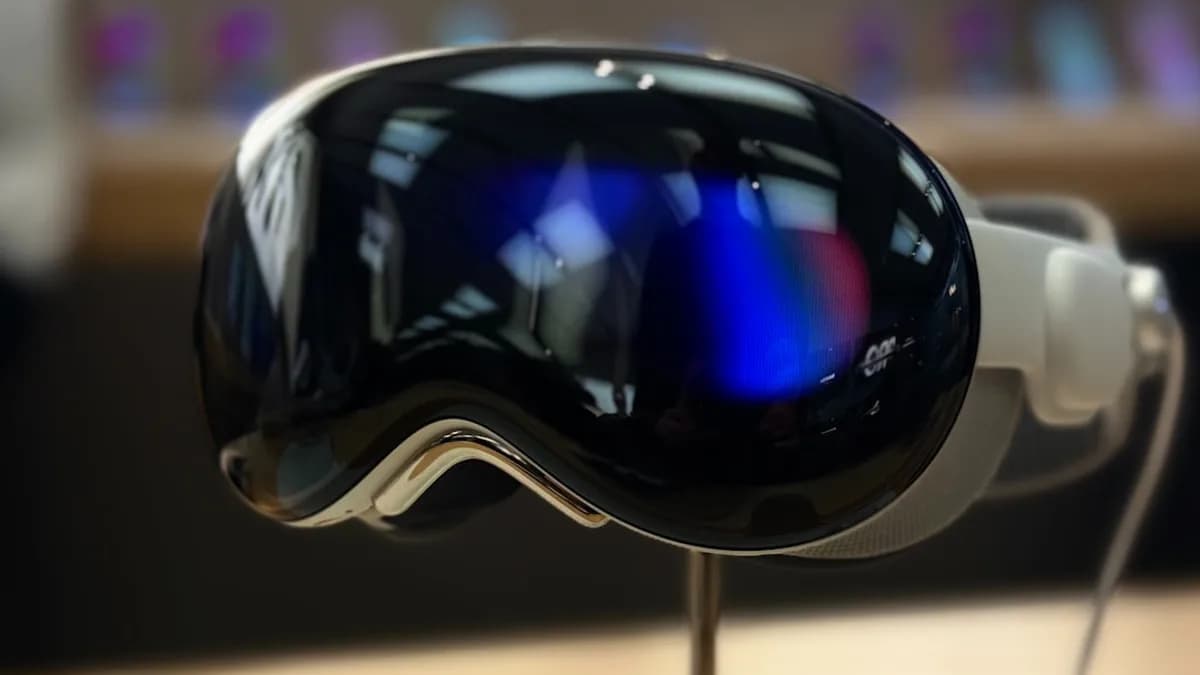
Samsung Display’s reported shutdown of G-VR suggests Apple’s cheaper Vision Pro problem is still buried in the panel stack, not in a missing sales pitch. The latest supply-chain signal points to a harder truth for Apple Vision Pro: making spatial computing cheaper may require changing the part that most defines the experience.
According to 9to5Mac, citing The Elec, Samsung Display has fully scrapped development of a component tied to Apple’s rumored lower-cost extended reality device. The project, known as G-VR, had been considered for a cheaper, lighter follow-up to Vision Pro and was once expected to enter mass production “sometime after 2028.”
G-VR makes Apple’s cost-down problem visible
The reported cancellation matters because G-VR was not a random supplier experiment. The Elec described it as a display approach aimed at cutting manufacturing costs versus the OLEDoS technology used in the current Vision Pro.
“G-VR was an improved version of the silicon substrate-based OLEDoS technology used in Apple Vision Pro. It used a method of forming OLED on a glass substrate for displays. Because it could dramatically lower manufacturing costs compared with existing OLEDoS, it had been considered a likely candidate for Apple’s lower-cost, lighter XR device.”
That sentence carries the strategic weight of the report. Apple’s current headset experience depends heavily on premium displays. If the lower-cost display path gets wound down, the cheaper headset story weakens.
The numbers show the trade-off:
| Display path | Reported role | Pixel density |
|---|---|---|
| Vision Pro OLEDoS | Current premium display technology | 3386 PPI |
| Samsung Display G-VR | Candidate for lower-cost, lighter XR device | 1600–1700 PPI |
That is roughly half the pixel density of the current Vision Pro. The report says this lower-density panel was still attractive because it could sharply reduce manufacturing costs. MLXIO analysis: that framing suggests Apple was exploring a clear compromise — preserve enough visual quality to support the product, while cutting one of the headset’s most expensive-feeling technical pillars.
The counterpoint is simple. A scrapped component project in the Vision Pro rumor cycle is not the same as a public product cancellation. Apple could shift suppliers, change specifications, or revive a different display architecture later. But display-related pullbacks are unusually meaningful in a headset because the panel is not a background component. It is the product.
A cheaper Vision Pro cannot be built from marketing alone
The first Apple Vision Pro launched at $3,499, a price that immediately framed it as premium computing hardware rather than a broad consumer device. A cheaper model would need more than a softer message. It would need a different bill of materials.
The source material points directly to the display as one of the likely pressure points. G-VR existed because Apple was reportedly considering a lower-cost XR follow-up, and because glass-substrate OLED could reduce manufacturing costs compared with the silicon substrate-based OLEDoS used in Vision Pro.
That distinction matters for Apple’s product choices. Cutting price by trimming accessories, storage tiers, or retail packaging would not solve the core problem if the display stack remains expensive. The product’s appeal rests on visual immersion. Apple can reduce cost only so far before the cheaper model stops feeling like a Vision Pro.
This is different from ordinary promotional pricing. A temporary discount, such as those we track in iPhone 17 Pro Drops $290 as Apple Deals Hit Pro Gear, changes the buyer’s upfront cost without changing the product architecture. The same is true of broader offer cycles like Apple Deals Slash AirPods 4 to $99, M5 iPad Pro $350 Off. A lower-cost Vision headset would require the harder version: redesigning the economics of the device itself.
The roadmap signals now point away from a smooth post-2028 launch
The Elec report says G-VR was expected to reach mass production “sometime after 2028,” but the project “began being wound down earlier this year” after Apple shifted strategy toward AI smart glasses. That timeline already pushed a cheaper Vision-style device well beyond the current product cycle. Scrapping the panel project makes the path look less direct.
The 9to5Mac report also cites recent roadmap chatter that has moved in the same direction. Last October, Bloomberg reported that Apple had “hit pause on a planned overhaul to its Vision Pro headset to redirect resources” toward smart glasses. Last March, Mark Gurman reported that Apple had been working on a slimmer and lighter successor to the $3,499 Vision Pro, but did not expect it before “late 2028 or 2029.”
There is still a counterpoint. A pause is not a cancellation. Apple often studies multiple hardware paths before deciding what ships. A supplier project ending could reflect technical mismatch, timing, cost, or Apple choosing another design.
But the pattern is harder to dismiss when paired with Ming-Chi Kuo’s reported view that “for now, only two smart glasses products remain visible in the roadmap,” with no sign of the immersive headset he had previously described. MLXIO analysis: individually, each report is incomplete. Together, they suggest Apple’s near-term attention has shifted from making Vision Pro cheaper to figuring out what wearable AI device should come next.
Apple’s own language keeps Vision Pro alive, but not necessarily cheaper
Apple has not framed Vision Pro as a failed experiment. 9to5Mac notes that Greg Joswiak recently told Tom’s Guide that Vision Pro “reached into the future” to show how digital and physical worlds could come together. In the same interview, John Ternus said Apple thinks less about “shipping technology” and more about using technology to build better products and experiences.
That language leaves room for long-term commitment. It also gives Apple room to slow down. If Vision Pro is an early view of spatial computing rather than a mass-market device, Apple does not have to rush a compromised cheaper version into the lineup.
For skeptics, that sounds like the only defensible way to talk about an expensive headset that has struggled to gain mainstream traction, as 9to5Mac’s take puts it. For enthusiasts, it signals Apple still cares about the category even if the cheaper headset is delayed or reworked.
The key difference is product definition. A cheaper Vision device needs cheaper parts, yes. But it also needs Apple to decide what the lower-cost version is allowed to lose. If the answer is “not much,” the display problem becomes even harder.
Suppliers, developers, buyers, and investors will not read this signal the same way
Samsung Display may see a narrower business message: the reported G-VR route no longer matches Apple’s near-term plan. That could mean lower confidence in volume, a technical change, or Apple moving toward another display strategy. The source does not establish which.
Apple, meanwhile, may view the pullback as discipline rather than retreat. MLXIO analysis: if the lower-cost display would weaken the experience too much, delaying the device is more rational than shipping a headset that undermines the premium Vision Pro pitch.
Developers face a different issue. A lower-cost Vision device would likely matter because a larger installed base gives more reason to build native spatial apps and immersive content. If the cheaper model slips, the software opportunity stays narrower for longer.
Consumers and investors may focus on timing. Buyers who expect a cheaper Vision headset could wait. Investors may ask how quickly Vision Pro can move from prestige hardware to a meaningful product line. The Samsung Display report does not answer either question, but it makes both harder to ignore.
The next proof point is not a rumor — it is a replacement panel path
The cheaper Vision Pro story is no longer just about whether Apple wants a lower price. It is about whether Apple can find a display and optics path that cuts cost without visibly damaging the experience that makes Vision Pro distinct.
Evidence that would strengthen the “delayed cheaper headset” thesis would include more supplier projects winding down, more reports of Apple moving mixed-reality hardware talent toward smart glasses, or no sign of a replacement panel program. Evidence that would weaken it would be more concrete: another supplier developing a comparable low-cost display, a revised headset timeline, or Apple signaling that a lighter Vision device remains active.
For now, the G-VR cancellation points to fewer shortcuts, later price cuts, and a slower climb from impressive luxury device to scalable spatial computing platform.
The Bottom Line
- Samsung Display reportedly scrapping G-VR weakens a key cost-cutting path for a cheaper Apple Vision Pro.
- The lower-cost display candidate had roughly half the pixel density of the current Vision Pro panel.
- Apple’s spatial computing strategy may remain constrained by expensive display technology.