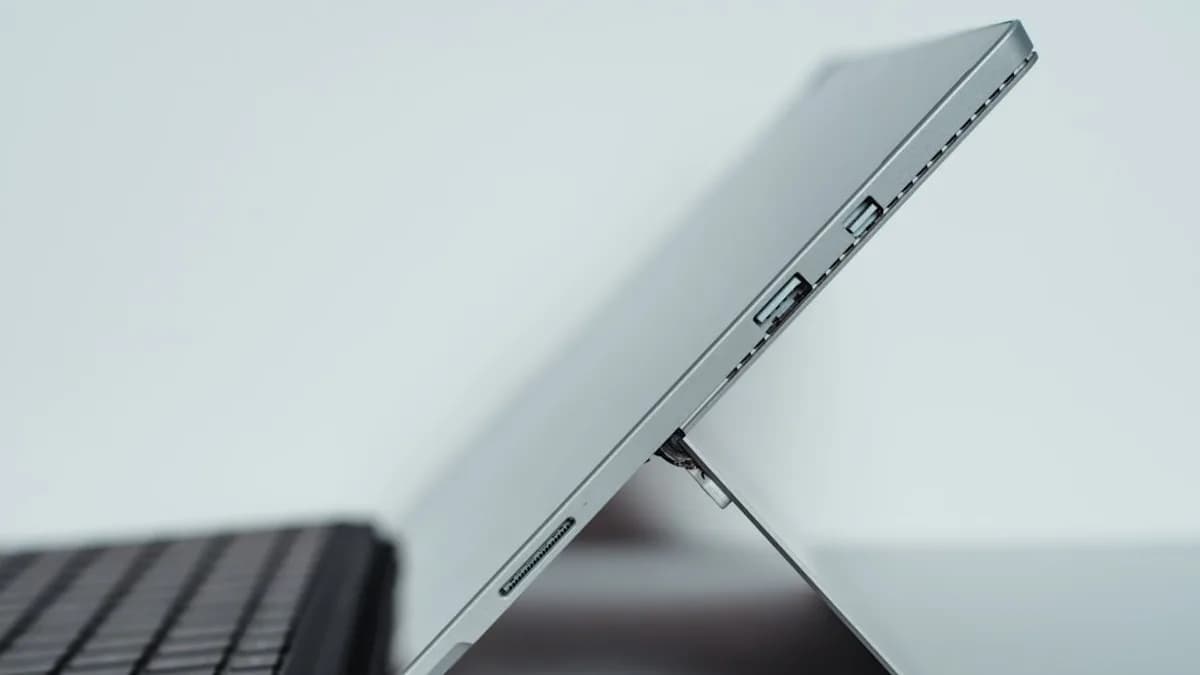
Asus’s most revealing laptop spec at Computex 2026 was not a CPU, GPU, or display panel — it was the more than 400 hinge iterations behind a single premium opening motion. That detail, shared during an ASUS Design Center briefing in Taipei, points to emerging design trends in how high-end notebooks are being built: the finished machine is only the visible result of hundreds of rejected mechanical, material, and ergonomic choices.
On the sidelines of Computex 2026, Asus designers described the R&D behind modern Zenbook S16 laptops, ROG, and Vivobook laptops, according to Notebookcheck. The company’s argument was direct: silicon still matters, but the laptop experience is completed by chassis feel, hinge behavior, materials, thermals, acoustics, portability, packaging, and the way users naturally move through tasks.
That is the useful read-through for buyers and the premium Windows market. Asus is not just selling thinner machines with faster parts like those tracked in Core 7 350 benchmarks. It is trying to make the physical product feel less interchangeable.
Four hundred hinge trials expose where premium laptop value hides
The hinge anecdote is the clearest evidence that “premium” is often engineered into moments users barely notice — until they fail. Asus said perfecting one premium hinge mechanism can require more than 20 engineering parameters and more than 400 experimental iterations. The goal is a narrow tactile balance: enough stiffness to prevent display wobble, but smooth enough for one-finger opening.
That sounds minor next to an RTX 5090 Laptop option or a Core Ultra 9 386H, but it is the interaction users repeat every day. A powerful laptop with a wobbly screen or awkward lid immediately feels cheaper than its spec sheet suggests. That is why Asus’s claim matters: the hinge is not decoration. It is a mechanical handshake between user and machine.
“Every detail has a reason.”
That line, presented by Asus designers, is marketing language — but the process behind it is concrete. Notebookcheck describes cycles of sandblasting, polishing, testing, and fine-tuning before Asus settles on the hinge feel. MLXIO analysis: if Asus can make those details consistent across product lines, it gains a form of differentiation that is harder to compare in a spec table but easy to feel in a store or review unit.
Zenbook, ROG, and Vivobook are being designed as different behaviors, not just different SKUs
Asus’s design method starts with user behavior before it becomes metal, glass, plastic, ports, or vents. The company described a multidisciplinary process involving design, engineering, UX research, color-material-finish development, packaging, and visual communication. Its stated aim is to study how people naturally use laptops, then make hardware adapt to those habits rather than forcing users to adapt to the device.
The source supports that most clearly in dual-screen machines. For Zenbook Duo and ROG Zephyrus Duo GX651, Asus said designers validate how users shift between typing, sketching, viewing, and sharing content across two displays. That explains why early prototypes start as cardboard mockups. Before the expensive work of aluminum, PCBs, cooling, and batteries, the team tests proportions and angles.
ROG follows a separate track. Asus said its gaming design work maps users across hardcore versus casual play and solo action versus social interaction, then builds around six motivators: technology, immersion, competition, captivation, ACG (Anime, Comic, Games) content, and edgy trending. That does not mean every ROG laptop should look aggressive. It means Asus is trying to align visual form with the kind of gamer it thinks each machine serves.
For adjacent context on Asus hardware positioning, MLXIO has also covered ROG performance machines and Asus display hardware. The common thread is that Asus increasingly presents hardware as an experience package, not a parts list.
The hard numbers show the design squeeze
The most interesting Asus laptops in the source are studies in compression: more power, more screens, more battery, and less room for error.
| Device | Source-supported design constraint |
|---|---|
| ROG Flow X13 | 110 W combined CPU/GPU power in an 18.7 mm convertible chassis |
| ROG Zephyrus 14 | Core Ultra 9 386H and RTX 5070 Ti Laptop, nearly 140 W, in a 16.3 mm build |
| ROG Zephyrus Duo GX651 | Dual-screen design with up to an RTX 5090 Laptop |
| ROG Zephyrus Duo GX651 internals | 99 Whr dual battery bank, upgraded dual-fan cooling, custom immersive audio hardware, and limited hinge space |
| Ceraluminum laptops | Material said to withstand up to 25 kg of direct stress |
Those numbers explain why design and engineering cannot be separated. A dual-screen gaming laptop with a 99 Whr battery and upgraded cooling system does not leave generous room for hinge hardware. A 16.3 mm performance chassis changes the thermal, acoustic, structural, and layout problem all at once.
Asus also highlighted Ceraluminum, its aluminum-ceramic composite. The company says it combines aluminum’s lightness and durability with ceramic scratch resistance, enables premium velvety textures on Zenbooks, withstands up to 25 kg of direct stress, and is 100% recyclable. The strongest counterpoint is that the source does not provide independent durability testing for those claims. Still, the material choice fits the broader thesis: Asus is using surface feel and structural performance as product signals, not just aesthetic finish.
Computex showed Asus treating design as a headline, not a footnote
The Computex 2026 story here is not that Asus had fast laptops; it is that the company used a major tech event to put design methodology beside silicon. Notebookcheck’s report opens with several component-heavy machines, including the ROG Zephyrus Duo GX651, Zenbook A16, and Vivobook S16, but then shifts to the visit at Asus HQ, where designers explained the “Asus Design Story.”
That sequence matters. The devices still depend on chips, batteries, cooling, and displays. But Asus is arguing that the differentiator is how those pieces are arranged around human behavior. The company has taken those ideas to London Design Week and Milan Design Week, where it says themes included slimness, structural durability, tactile duality, and distinct auditory signatures.
Awards reinforce the message. Asus cited the 2026 iF Design Gold Award and Red Dot “Best of the Best” Awards for the Zenbook Duo and ROG Zephyrus Duo lineups. Awards do not prove a laptop is better for every buyer. They do show that Asus wants design credibility to carry strategic weight alongside benchmark performance.
Different users define “better” in incompatible ways
The hardest part of Asus’s design brief is that there is no universal laptop user. The company explicitly said there is no one-size-fits-all formula across product lines. That is why gaming machines are segmented by play style and motivation, while dual-screen machines are validated around task transitions such as typing, sketching, viewing, and sharing.
Engineers, meanwhile, face a different scoreboard: component layout, port count, thermals, noise, power draw, and performance have to coexist with the chosen aesthetic. Notebookcheck’s author notes that the site emphasizes chassis, build quality, cooling, dimensions, and weight in reviews because those factors affect both performance and longevity. That aligns with Asus’s claim that hardware engineering follows design, not the reverse.
The counterpoint is important: the source does not give repairability data, service manuals, failure rates, or long-term wear results. It also does not quantify whether design awards translate into sales. So the defensible conclusion is narrower. Asus has shown how it thinks premium laptops should be built; it has not proven that every design choice will age better in the field.
The practical buyer lesson is to test the machine, not just the silicon
For PC buyers, the Asus R&D story is a reminder to inspect the parts of a laptop that spec sheets flatten. Hinge resistance, screen stability, palm-rest feel, chassis flex, cooling noise, weight distribution, display angle, and port placement can decide whether a fast notebook feels premium after the first week.
This does not make CPUs and GPUs irrelevant. The source itself highlights demanding configurations, from the ROG Flow X13 to the ROG Zephyrus 14 and ROG Zephyrus Duo GX651. But Asus’s own presentation suggests that performance only becomes useful when the surrounding object lets it breathe, stay stable, open cleanly, and fit real workflows.
MLXIO analysis: this is also where midrange lines such as Vivobook become interesting. The source says the Snapdragon X1-based Vivobook S16 stands out as a productivity machine with excellent battery life, while sharing Asus’s broader focus on design and materials. If the company can push lessons from Zenbook and ROG into more accessible devices without losing durability or comfort, that would make the design program more than a premium halo exercise.
The next proof point is fewer visible compromises
The thesis will hold if future Asus laptops make mechanical quality, cooling behavior, materials, and task-specific layouts feel obvious in daily use — not just visible in launch decks. Evidence that would support it includes stable hinges over time, dual-screen designs that simplify rather than complicate workflows, quiet thermal behavior under load, and recyclable materials that do not feel fragile or ornamental.
Evidence against it would be just as clear. If thinner chassis create obvious heat, noise, wobble, or service trade-offs, then the design story becomes packaging around old compromises. If Vivobook, Zenbook, and ROG converge into the same visual language with different stickers, the user-identity argument weakens.
For now, Asus’s most useful Computex message is that the premium laptop is not finished when the silicon is selected. It is finished only after hundreds of small decisions disappear into a lid that opens cleanly, a chassis that stays rigid, and a machine that feels inevitable in the user’s hands.
The Bottom Line
- Asus is signaling that premium laptop value depends on physical design, not just CPU, GPU, or display specs.
- The 400-plus hinge iterations show how much hidden engineering goes into everyday interactions like opening a laptop.
- For buyers, chassis feel, hinge stability, thermals, acoustics, and portability can matter as much as headline performance.