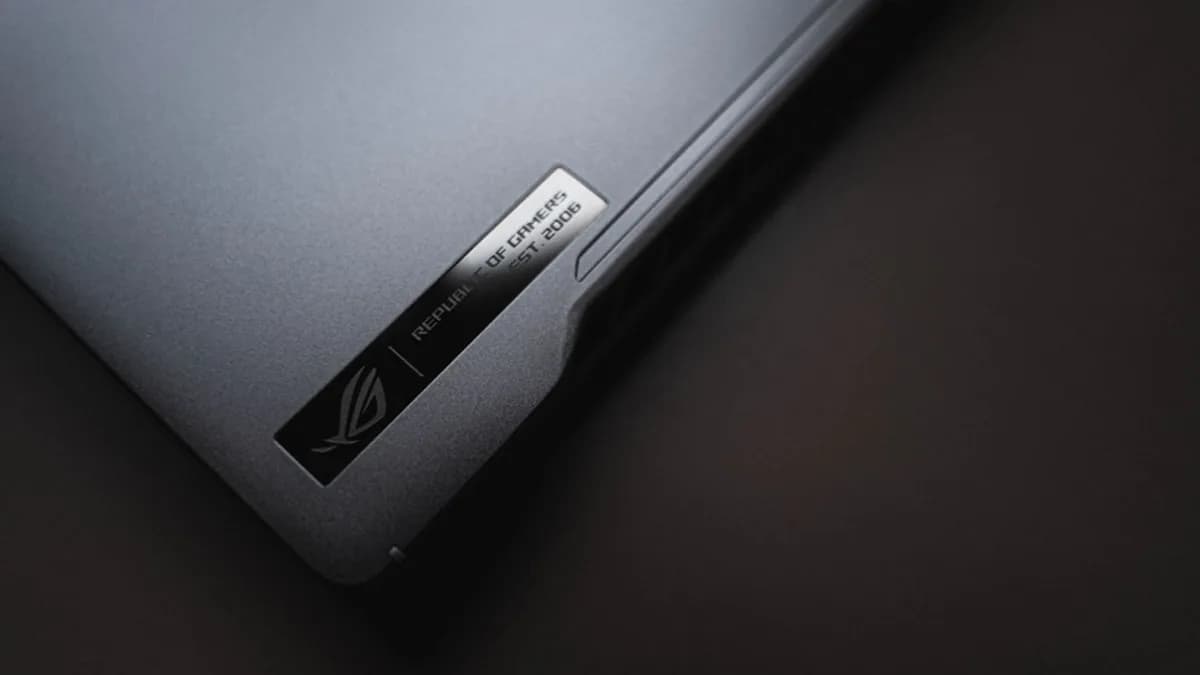
160 W is the number Asus is using to separate its new US ROG Zephyrus G16 from the version it was already selling: the updated 16-inch gaming laptop now pairs an Nvidia GeForce RTX 5080 Laptop GPU with 64 GB of RAM and an Intel Core Ultra 9 386H processor.
The new configuration has quietly landed in the US after Asus previously offered the latest G16 only with a GeForce RTX 5070 Ti and 32 GB of RAM, according to Notebookcheck. This is not a full redesign. It is a higher-power SKU aimed at buyers who thought the first US model left too much performance on the table.
160 W and 64 GB push the US Zephyrus G16 above the launch SKU
The headline change is the GPU ceiling. Asus now allows the GeForce RTX 5080 in the ROG Zephyrus G16 (2026) to draw up to 160 W in Manual Mode, including 25 W assigned to Nvidia Dynamic Boost.
That matters because laptop GPUs with the same branding can land in very different performance bands depending on power limits and cooling. In this case, Asus is giving the RTX 5080 more room than the earlier RTX 5070 Ti configuration.
Notebookcheck says the previous RTX 5070 Ti version had a boosted TGP of 140 W. The new RTX 5080 gets 10 W more in Turbo Mode and 20 W more in Manual Mode.
| US ROG Zephyrus G16 configuration | GPU | RAM | GPU power detail | VRAM |
|---|---|---|---|---|
| Earlier US model | GeForce RTX 5070 Ti | 32 GB | 140 W boosted TGP | 12 GB |
| New US model | GeForce RTX 5080 | 64 GB | Up to 160 W, including 25 W Dynamic Boost | 16 GB |
The RAM jump is just as direct. Asus doubles memory from 32 GB to 64 GB, giving the new SKU broader appeal for creators, streamers, developers and AI-assisted workloads that can punish lower-memory configurations.
Asus’ own product page for the ROG Zephyrus G16 (2026) GU606 lists the machine with up to 64 GB LPDDR5X-8533MHz memory, up to 2 TB PCIe 4.0 SSD storage, and a 2.5K ROG Nebula HDR OLED panel with 240 Hz, 0.2 ms, and 1100 nits peak brightness. The company also lists the chassis at 1.49 cm and 1.85 kg.
For adjacent high-end PC hardware coverage, MLXIO readers can also track Nvidia-focused systems like the Asus ROG NUC RTX 5090, RTX 5090 Lenovo Legion 9i, Nameless Nvidia RTX Spark Mini PC Puts HP in Apple’s Lane and RTX Spark Yoga Pro 9n Leak Rattles MacBook Pro Plans.
The 20 W manual-mode gap is the performance story
Notebookcheck’s benchmark data suggests moving from the GeForce RTX 5070 Ti to the GeForce RTX 5080 should deliver a 16% performance improvement in gaming. That is the cleanest early number attached to the new G16 SKU.
The gap may be larger in games that lean harder on VRAM. The RTX 5080 carries 16 GB, while the RTX 5070 Ti carries 12 GB. Notebookcheck describes that as a third more VRAM.
That gives the new Zephyrus G16 two separate performance levers: more GPU class and more GPU memory. The power limit gives the chip more headroom, while the VRAM increase can matter when higher-resolution textures, ray tracing workloads, or creator projects push beyond the smaller frame buffer.
Analysis: The key buyer question is not whether the RTX 5080 name is stronger than the RTX 5070 Ti name. It is whether Asus can keep the 160 W configuration fed and cooled inside a relatively portable 16-inch chassis. The official specs point to ROG Intelligent Cooling, including a vapor chamber and Tri-Fan Technology depending on SKU, but independent testing will have to show sustained performance.
The trade-off is familiar but still important. Higher GPU power can mean more heat, more fan noise, and faster battery drain under load. Asus has not solved or failed those issues on paper; it has simply raised the performance ceiling.
That makes the new G16 more interesting for people who use one machine for gaming and production. A 64 GB memory configuration is easier to justify if the same laptop is also handling video editing, large project files, development workloads, or local AI-assisted tasks rather than just games.
$4,799 turns the RTX 5080 upgrade into a value test
The upgrade is not cheap. Notebookcheck says Asus lists the new ROG Zephyrus G16 configuration at a $4,799 MSRP, which is 29% higher than the RTX 5070 Ti model.
The reported price gap is $1,100. Part of that can be attributed to the move to 64 GB of RAM, but the buyer still has to accept a steep premium for the RTX 5080 GPU, higher power limit, extra VRAM, and larger memory configuration.
This is where the early benchmark number cuts both ways. A 16% gaming uplift is meaningful, especially in demanding titles, but the MSRP increase is larger than the quoted average gaming gain. That does not make the upgrade irrational; it means the value case depends heavily on whether the buyer also needs the RAM and VRAM.
As we reported in $680 Vanishes From HyperX Omen Max 16 Before Shipping, premium gaming laptop pricing can move fast around launch windows. For the Zephyrus G16, the watch item is whether the $4,799 MSRP holds, drops through retail promotions, or stays attached to limited availability.
The next useful data will come from independent reviews that compare this 160 W RTX 5080 G16 against both lower-power RTX 5080 laptops and larger gaming notebooks. Thermal testing matters most. If Asus can sustain high GPU power without aggressive throttling, the new Zephyrus G16 becomes a much stronger US option than the initial RTX 5070 Ti model.
If not, the extra wattage becomes a spec-sheet win that buyers will need to weigh against heat, noise and the $1,100 premium.
The Bottom Line
- The new RTX 5080 configuration gives US buyers a higher-power Zephyrus G16 option without waiting for a redesign.
- Doubling RAM to 64 GB makes the laptop more attractive for creators, streamers, developers, and AI-assisted workloads.
- The 160 W GPU ceiling highlights how laptop GPU performance can vary significantly even within the same product line.