MLXIO
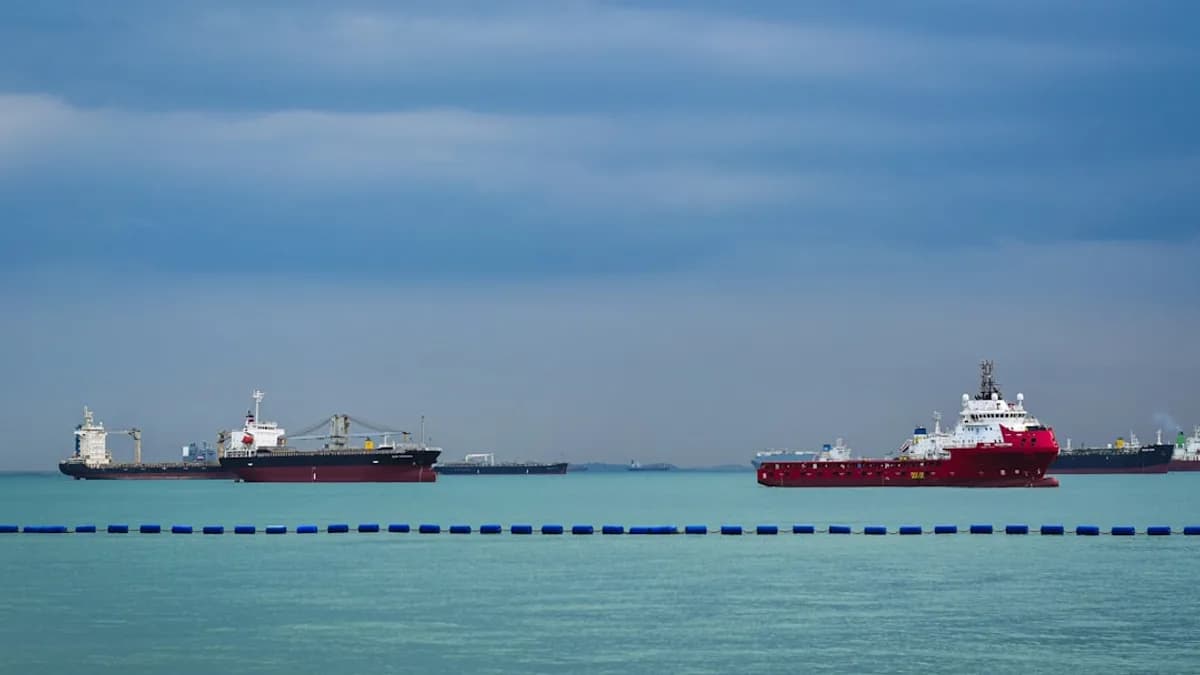
three large ships in the ocean with a sky background
FinanceJuly 13, 2026· 6 min read· By MLXIO Insights Team

4% Oil Price Spike Exposes Hormuz Traffic Collapse

Share

MLXIO Intelligence

Analysis Snapshot

71
High
Confidence: LowTrend: 20Freshness: 100Source Trust: 75Factual Grounding: 91Signal Cluster: 60

High MLXIO Impact based on trend velocity, freshness, source trust, and factual grounding.

Thesis

High Confidence

Oil prices rose as traders priced higher disruption risk from sharply slower Strait of Hormuz traffic amid renewed US-Iran tensions, rather than a confirmed full closure.

Evidence

  • CryptoBriefing reported Brent crude climbed roughly 4% as Hormuz shipping slowed to a multi-week low.
  • The article cites recent tracking showing as few as six vessel crossings over one 12-hour window versus 130 vessels per day before the war.
  • CryptoBriefing reported Hormuz traffic below 2% of typical throughput and more than 150 vessels stranded because of military tensions.
  • AP reported about 20% of the world's oil supply passes through the Strait of Hormuz.

Uncertainty

  • The article says there is no confirmed, universally accepted full closure of the Strait of Hormuz.
  • Oil price references vary by benchmark, contract, timestamp and settlement basis.
  • The duration of the Hormuz traffic slowdown is unclear.

What To Watch

  • Fresh vessel-tracking data for Hormuz crossings and stranded cargoes.
  • Further US-Iran military escalation or de-escalation signals.
  • Whether crude prices remain elevated enough to pressure fuel costs, shipping expenses and inflation.

Verified Claims

Brent crude climbed roughly 4% as shipping through the Strait of Hormuz slowed amid renewed US-Iran military tensions.
📎 “Brent crude climbed roughly 4% as shipping through the Strait of Hormuz slowed... amid renewed US-Iran military tensions”High
The Hormuz disruption described in the article is not a confirmed full closure, but a market response to higher disruption risk.
📎 “The trigger is not a confirmed, universally accepted full closure. It is the market pricing a higher probability of disruption”High
CryptoBriefing reported Hormuz traffic operating below 2% of typical throughput, with more than 150 vessels stranded because of military tensions.
📎 “Hormuz traffic is operating below 2% of typical throughput, with more than 150 vessels stranded”High
Related reporting cited Windward data showing only six vessels crossed the Strait of Hormuz in a 12-hour window.
📎 “only six vessels crossing between 18:00 GMT on Thursday and 06:00 GMT on Friday”High
AP reported that about 20% of the world’s oil supply passes through the Strait of Hormuz.
📎 “AP reported that about 20% of the world’s oil supply passes through the strait”High

Frequently Asked

Why did oil prices spike after the Strait of Hormuz slowdown?

Oil prices rose because markets priced in a higher risk of disruption from delayed tankers, stranded cargoes, rerouting risk, insurance stress and possible military escalation.

Was the Strait of Hormuz fully closed?

The article says the trigger was not a confirmed, universally accepted full closure, but rather the market pricing a higher probability of disruption.

How much did Brent crude rise during the Hormuz disruption?

Brent crude climbed roughly 4%, with benchmark prices moving above the $74–$76 per barrel range cited in the report.

How severe was the reported drop in Hormuz vessel traffic?

CryptoBriefing reported traffic below 2% of typical throughput, while related Windward data showed only six crossings during one 12-hour window.

Why does the Strait of Hormuz matter for global oil markets?

The Strait of Hormuz is a major energy chokepoint; the article cites AP reporting that about 20% of the world’s oil supply passes through it.

Updated on July 13, 2026

130 vessels crossed the Strait of Hormuz each day before the war, but recent tracking cited in related reporting showed as few as six crossings over one 12-hour window — a collapse now feeding straight into oil prices.

4% oil spike starts with a traffic collapse at Hormuz

Brent crude climbed roughly 4% as shipping through the Strait of Hormuz slowed to a multi-week low amid renewed US-Iran military tensions, according to CryptoBriefing. The move pushed benchmark prices above the $74–$76 per barrel range cited in the report and reversed a recent downturn.

The trigger is not a confirmed, universally accepted full closure. It is the market pricing a higher probability of disruption: delayed tankers, stranded cargoes, rerouting risk, marine insurance stress and further military escalation.

CryptoBriefing reported that Hormuz traffic is operating below 2% of typical throughput, with more than 150 vessels stranded because of the military tensions. Related reporting cited Windward data showing only six vessels crossing between 18:00 GMT on Thursday and 06:00 GMT on Friday, compared with 18-22 daily crossings earlier this month.

That matters because Hormuz is one of the world’s most important energy chokepoints. The route carries a major share of global oil flows and is also a conduit for liquefied natural gas. AP reported that about 20% of the world’s oil supply passes through the strait.

“The Strait of Hormuz is a vital maritime corridor for global trade. Iran does not control it,” US Central Command said in a statement cited in related reporting.

Markets are reacting to the risk that the corridor stays impaired even if it is not formally shut. That is the dangerous middle ground for traders: enough uncertainty to lift crude, not enough clarity to price the ceiling.


$74, $77.74 and $78.82 show the same shock through different oil benchmarks

Several price references are circulating because reports are using different contracts, timestamps and benchmark descriptions. They point in the same direction: energy markets are adding a Hormuz risk premium.

Source reference Oil price move cited Timing or basis
CryptoBriefing Brent up about 4%, above $74–$76 per barrel July 13 report on Hormuz slowdown
Related market-data report Crude up about 4% to above $74 per barrel Monday move after US-Iran strikes
AP US oil up 6.3% to $71.23; Brent up 6.7% to settle at $77.74 Settlement figures in AP report
Al Jazeera-cited market snapshot Brent September futures at $78.82 as of 08:00 GMT Highest since June 22

The distinction matters. A spot reference, a futures contract and a settlement price can all describe the same market shock without matching tick-for-tick.

For traders, the bigger signal is the reversal. Oil had weakened after an interim US-Iran peace agreement raised expectations of increased Middle East energy supplies, according to the supplied market-data report. The latest exchange of strikes has damaged that assumption.

Related MLXIO reading for readers tracking the same pressure point: Oil Prices Jump 5% as Hormuz Panic Grips Global Traders. For a broader market-strategy lens, see Key Trends Splitting Tomorrow's Winners From Losers.

Hormuz disruption risk feeds inflation pressure and broader market stress

Higher crude does not stay confined to oil screens. AP reported that higher oil prices raise the prospect of costlier gasoline for US drivers and higher prices for other goods, at a time when people in many countries have already been hit by inflation.

That is the macro risk. If crude remains elevated, it can pressure fuel costs, shipping expenses and inflation forecasts. The supplied sources do not cite a central bank response, so any rate-policy effect remains a scenario rather than a confirmed market outcome.

Equities also reacted in the related reporting. Major Asian stock markets fell Monday: Japan’s Nikkei 225 closed nearly 2% lower, while South Korea’s Kospi plunged 9%. Hong Kong’s Hang Seng Index finished about 0.1% higher.

The risk-asset read-through is less direct but still relevant. CryptoBriefing framed the story through market volatility, and the same risk-off mechanics can hit speculative assets if investors cut exposure during geopolitical shocks. The supplied material does not provide Bitcoin, Ether or broader crypto price moves, so the crypto impact should be treated as a watch item, not a confirmed selloff.

Natural gas is part of the same stress map. AP reported that European natural gas prices rose more than 40% after QatarEnergy halted LNG production following attacks on its facilities.

“Infrastructure is at risk throughout the region, and it’s not just at risk because of deliberate attacks, but also inadvertent attacks,” said Kevin Book, managing director at Clearview Energy Partners, in the AP report.

That quote captures the market’s core fear: in a dense energy corridor, even limited military action can create outsized logistical and insurance consequences.


Tanker flows, CENTCOM signals and OPEC/IEA updates set the next price move

The next oil move will likely depend less on speeches and more on traffic. Traders will be watching real-time vessel counts, tanker queues, freight rates, marine insurance costs and whether ships resume normal patterns through Hormuz.

Military signals also matter. Related reporting said the US carried out further strikes after accusing Iranian forces of attacking the MV GFS Galaxy, a Cyprus-flagged container ship. Tehran has claimed the strait would be closed “until further notice,” while US Central Command rejected that claim.

Iran’s Persian Gulf Strait Authority also warned that vessels crossing outside its preferred route would not receive safe-passage guarantees.

“The consequences arising from transit through unauthorized routes shall be the responsibility of the owner, operator, and vessel commander,” the authority said, according to related reporting.

CryptoBriefing flagged OPEC and the International Energy Agency as key actors that may update market expectations. Any signal on supply, surplus forecasts or spare barrels could shift pricing quickly.

The practical scenario for markets is blunt: even without a universally recognized blockade, prolonged uncertainty around Hormuz can keep a geopolitical premium embedded in crude. If vessel traffic normalizes, that premium could fade. If the strait stays near a trickle, oil traders will keep pricing the risk that today’s disruption becomes tomorrow’s supply shock.


Disclaimer: This MLXIO analysis is for informational and educational purposes only. It is not financial, investment, legal, tax, or professional advice. It does not provide buy, sell, hold, price-target, portfolio, or personalized recommendations. Verify information independently and consult qualified professionals before making decisions.

The Bottom Line

  • The Strait of Hormuz carries about 20% of the world’s oil supply, making disruptions globally significant.
  • Even without a confirmed closure, delayed shipping and stranded cargoes are already lifting crude prices.
  • Higher oil prices can quickly feed into fuel costs, inflation expectations and broader market volatility.


Strait of Hormuz Traffic Before vs. During Tensions

MetricBefore/TypicalRecent/Current
Vessel crossings130 vessels per day before the warAs few as 6 crossings in one 12-hour window
Traffic levelTypical throughputBelow 2% of typical throughput
Stranded vesselsNot citedMore than 150 vessels stranded
Oil price reactionRecent downturnBrent crude up roughly 4% above the $74-$76 per barrel range

Hormuz Vessel Crossings Fell Sharply

Before war daily crossings
vessels130
Recent 12-hour crossings
vessels6

Disclaimer: Content on MLXIO is produced using AI-assisted research, drafting, and verification workflows and is intended for informational and educational purposes only. It does not constitute financial, investment, legal, tax, medical, or professional advice of any kind. All analysis reflects available information at the time of publication and may not be current. Verify information independently and consult qualified professionals before making decisions. Editorial policy

MLXIO

Written by

MLXIO Insights Team

Algorithmic Research & Human Oversight

Powered by advanced algorithmic research and perfected by human oversight. The Insights Team delivers highly structured, cross-verified analysis on emerging tech trends and digital shifts, filtering out the fluff to give you high-fidelity value.

Related Articles

red and white ship on sea under cloudy sky during daytime
FinanceJul 13, 2026

Oil Prices Jump 5% as Hormuz Panic Grips Global Traders

Oil spiked as US-Iran strikes and renewed sanctions turned Hormuz fears into a supply-risk trade.

8 min read

Donald Trump beside man in black suit
FinanceMay 11, 2026

Trump Rejects Iran Peace Plan, Sparks Oil Price Surge

Trump’s outright rejection of Iran’s peace proposal triggered a spike in oil prices, highlighting how political tensions unsettle global energy markets.

3 min read

a large boat floating on top of a large body of water
FinanceMay 5, 2026

Iran Sparks Oil Shock Fears as WTI Crude Eyes $150

Iran's missile threats near the Strait of Hormuz risk disrupting 20% of global oil transit, sending WTI crude prices toward $150 per barrel.

7 min read

a foggy day at an amusement park
FinanceMay 15, 2026

US-Iran Peace Slashes WTI Crude Oil Price Forecasts for 2026

Eased US-Iran tensions cut WTI crude oil price forecasts for May 2026 as markets slash risk premiums tied to potential supply shocks.

5 min read

50 us dollar bill
FinanceMay 11, 2026

RBI Dumps Rupee to Shield India from US-Iran Oil Shock

RBI’s rupee intervention exposes India’s economic vulnerability as US-Iran tensions spike oil prices, rattling currency markets and inflation outlook.

4 min read

A solar-powered security camera with a clear view.
TechnologyJul 13, 2026

‘Not My Job’ Lands Flock CEO in Camera Abuse Firestorm

Flock’s CEO says police misuse isn’t his job, exposing the accountability gap behind AI-assisted license plate surveillance.

7 min read

pink and white vr goggles
TechnologyJul 11, 2026

1,656 KG Steam Frame Shipment Starts Valve's VR Clock

Valve's 1,656 KG VR shipment doesn't prove a date, but it makes Steam Frame look far closer to launch.

13 min read

a room that has a bunch of drawers in it
CryptoJul 11, 2026

Circle Grabs US Trust Bank Nod — USDC Moves Inside Finance

Circle’s OCC win gives USDC a federally supervised custody stack—but not bank-deposit status.

8 min read

Two cell phones sitting next to each other on a window sill
TechnologyJul 12, 2026

Crease Almost Vanishes in Galaxy Z Fold 8 Ultra Leak

A powered-on Fold 8 Ultra leak shows a nearly invisible crease, but Samsung has not confirmed the phone, specs, or launch.

6 min read

Canon DSLR camera on brown wooden table during daytime
TechnologyJul 12, 2026

$89 TTArtisan Lens Dumps Rings to Grab Full-Frame Buyers

TTArtisan’s $89 full-frame 50mm f/1.8 Neo brings autofocus but strips out aperture and focus rings.

7 min read

Stay ahead of the curve

Get a weekly digest of the most important tech, AI, and finance news — curated by AI, reviewed by humans.

No spam. Unsubscribe anytime.