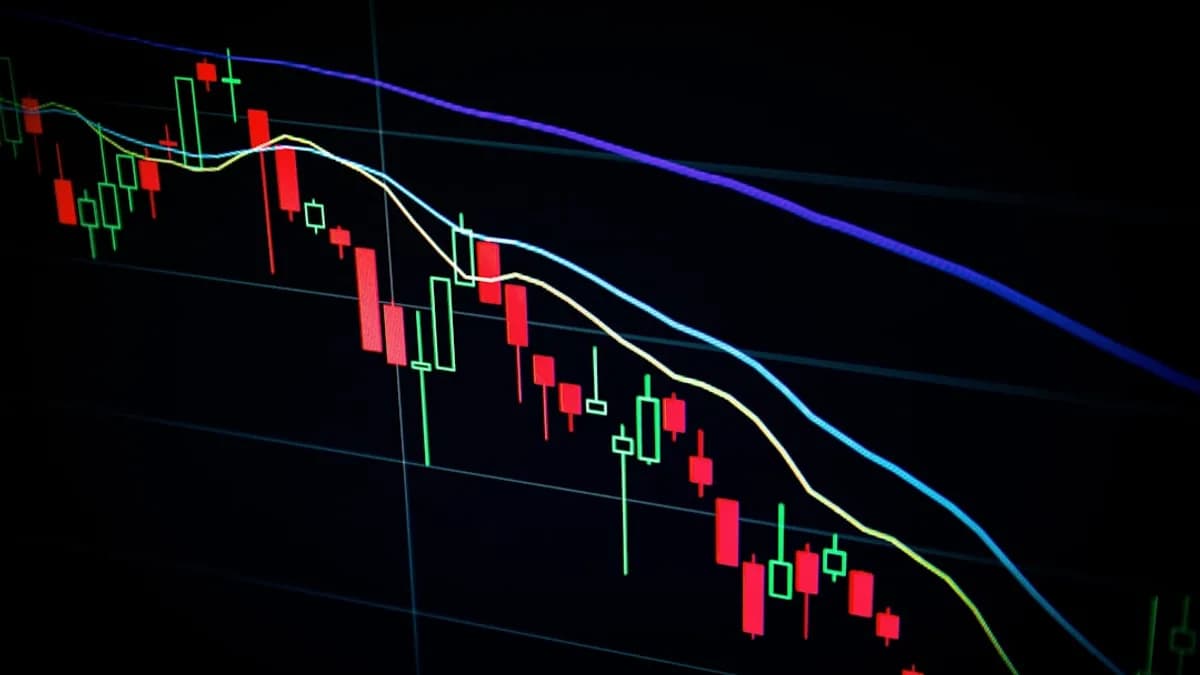
How can MemeCore’s M token carry a large headline valuation one day and see its market cap fall below $1 billion the next?
That is the real question behind M’s collapse. The token fell 74% in 24 hours, according to CryptoBriefing, pushing its market cap below the billion-dollar threshold. Exact price points, pre-crash valuation estimates, and trading-volume figures vary across market data sources and should be verified venue by venue before being treated as firm inputs.
The headline is a price crash. The deeper story is valuation quality. M did not just trade lower. It exposed how quickly a high market cap can fracture when liquidity is uncertain, supply questions are unresolved, and confidence depends on a narrow set of market assumptions.
How did a high headline valuation rest on uncertain daily volume?
The numbers need to be read carefully.
A token can show a large market cap if its quoted price is applied across circulating supply. But that does not mean the market can absorb large sell orders near that quoted price. M’s crash showed the difference between paper valuation and real exit liquidity.
| Metric | Reported point | Why it matters |
|---|---|---|
| 24-hour move | Down 74% | Shows the scale of the collapse |
| Market cap threshold | Fell below $1 billion | Marks a major break in headline valuation |
| Price levels | Varied across market data sources | Exact intraday figures should be verified by venue |
| Pre-crash valuation | Described as substantially higher | Large valuations can overstate usable liquidity |
| Post-crash valuation | Below the billion-dollar mark | Signals a sharp reset in market confidence |
| Trading depth | Requires venue-level confirmation | Volume alone does not prove durable exit liquidity |
That last line is the stress point. When turnover is low relative to valuation, market cap becomes a fragile signal. It may describe the last traded price multiplied by supply, but it does not prove that buyers exist in size if holders rush for the exit.
This is why market cap alone is a weak stability test for speculative tokens like the $ARG fan token. Investors also need to examine trading venue depth, wallet concentration, circulating supply, and fully diluted valuation. Those factors are not proof of wrongdoing. They are the plumbing that determines whether a quoted valuation can survive selling pressure.
After a 74% one-day crash, that plumbing becomes hard to ignore.
Was this just volatility, or did supply concentration turn price risk into structure risk?
Volatility explains movement. It does not fully explain collapse.
The available reporting establishes the severity of the selloff, but it does not, on its own, prove a specific mechanism such as insider selling, coordinated manipulation, or exchange failure. That distinction matters. A sharp move can be real without every theory around it being verified.
The supply issue still matters because concentration changes the market’s psychology. If traders believe a small group of wallets can move price, every bounce becomes suspect. Buyers hesitate. Sellers accelerate. Liquidity that looked available at higher prices can disappear once confidence breaks.
This does not require a confirmed insider dump. Perception alone can weaken bids.
For investors, the due diligence questions are blunt:
- Who controls supply? If a handful of addresses dominate circulating tokens, market pricing is less democratic than it appears.
- Where does trading happen? Sparse venue coverage can magnify shocks.
- How much volume is real and repeatable? A single day’s volume figure does not prove durable liquidity.
- What does FDV imply? A large fully diluted valuation can make a token look larger than its active market can support.
- What has the team communicated? Investors should separate verified project updates from assumptions or market chatter.
Price action alone does not explain market structure. When a token loses this much value this quickly, investors have to inspect the plumbing.
Why does this crash challenge the way crypto investors read market cap rankings?
M’s decline is a warning against treating market cap as a proxy for resilience.
A token with a high quoted valuation can still be brittle if only a small portion trades actively. That is especially true for speculative assets where attention, exchange visibility, and holder coordination can matter more than cash flows or protocol usage.
This is not a claim that all attention-driven tokens share M’s risks. It is a reminder that visibility is not liquidity. For readers tracking how crypto narratives can attach to sports, fandom, or mass-market attention, MLXIO has covered adjacent questions in Crypto Crashes FIFA World Cup at Ecuador vs Ivory Coast and $ARG Ignored Messi Hat-Trick as Fan Tokens Flinched. Those stories are not evidence about M. They are useful context for separating narrative heat from tradable depth.
The M case is simpler and harsher: a token that had carried a large headline valuation saw that valuation reset below $1 billion in a single day. That should make investors pause before assuming a large market cap means a deep market.
The lesson is not “never buy speculative tokens.” It is that speculative-token risk cannot be measured by price momentum alone. The real risk often sits in the gap between the displayed valuation and the market’s ability to honor that valuation under pressure.
What should traders, holders, and exchanges take from the Kraken angle?
Different players will read the same collapse differently.
For short-term traders, M’s crash is a reminder that volatility cuts both ways. A rebound after a steep drawdown may look attractive, but without reliable liquidity data, it is not a strategy. It is exposure to another air pocket.
For long-term holders, the question is whether the token’s thesis survives a credibility shock. Price can recover faster than trust. Holders need verified information on supply structure, venue depth, project communication, and whether the market can support the token without relying only on speculative momentum.
For exchanges, the cleaner takeaway is broader than any single venue. Specific claims about Kraken’s listing process, due-diligence review, or possible reconsideration are not established by the cited material. What the crash does raise is a general listing-standard question: when a listed asset loses 74% in a day, investors will look more closely at liquidity, disclosures, supply distribution, and surveillance.
That does not prove any exchange did anything wrong. It does put market-quality standards in focus. After a collapse of this size, the scrutiny shifts from “what happened to price?” to “how resilient was the market structure around the asset?”
What evidence would show M’s market is healing rather than just bouncing?
M now faces a liquidity credibility test.
A speculative rebound is possible in any token after a violent drawdown. But a bounce alone would not answer the core question raised by the crash. The stronger evidence would be visible improvement in market quality.
Watch for:
- Sustained volume: Not one burst, but repeated trading activity that supports the new valuation.
- Clear communication: Project updates addressing the collapse and any relevant supply or market-structure questions.
- Wallet transparency: Better evidence around holder concentration and whether large addresses remain a threat to price stability.
- Exchange response: Any venue-level action or comment related to liquidity, monitoring, or listing standards.
- Price behavior under selling pressure: If M can absorb exits without another sharp gap lower, the market structure case improves.
The bearish thesis would be strengthened if M remains thinly traded, supply questions persist, and the project provides little verifiable information going forward. It would weaken if volume deepens, concentration concerns are addressed with verifiable data, and the token stabilizes without relying on another wave of speculative buying.
For now, M’s collapse says something broader than “one token fell.” It shows how quickly a billion-dollar label can vanish when liquidity cannot carry the valuation.
Disclaimer: This MLXIO analysis is for informational and educational purposes only. It is not financial, investment, legal, tax, or professional advice. It does not provide buy, sell, hold, price-target, portfolio, or personalized recommendations. Verify information independently and consult qualified professionals before making decisions.
The Bottom Line
- M’s 74% plunge shows how quickly crypto headline valuations can collapse when liquidity is thin.
- The drop below $1 billion in market cap highlights the gap between paper value and real exit liquidity.
- Investors should verify price, supply, and trading-depth data across venues before relying on token valuations.