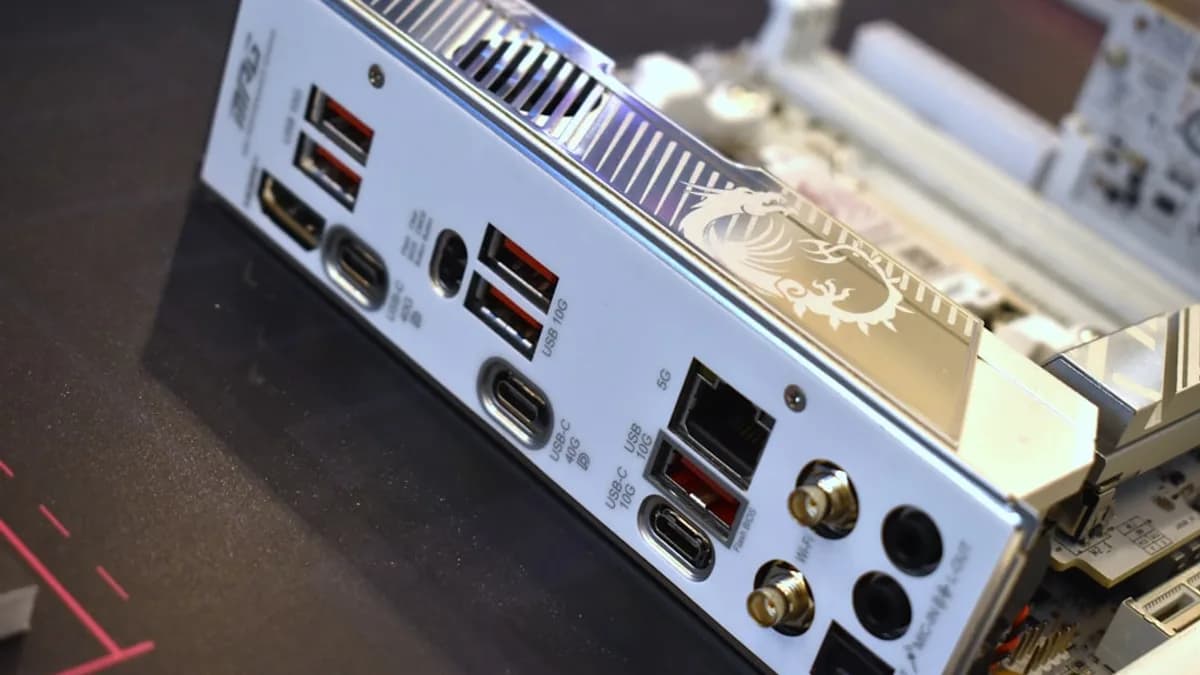
GMKtec EVO-X3 turns the mini PC into a modular workstation bet
GMKtec is not treating the EVO-X3 as a clean-sheet successor to the EVO-X2; it is using the same flagship AMD silicon and changing the expansion story around it. The new mini PC has been formally announced in China with the AMD Ryzen AI Max+ 395 and, more importantly, an OCuLink port, according to Notebookcheck.
That makes the EVO-X3 look less like a routine compact desktop refresh and more like a bet on modular performance. The old mini PC compromise was simple: small box, limited graphics expansion, thermals under pressure. OCuLink changes that equation by giving users a path to external PCIe expansion, most obviously for an external GPU dock.
The tension is obvious. The EVO-X3 could appeal to creators, developers, AI hobbyists, and compact gaming users who want a small machine that can grow beyond integrated graphics. But the source material leaves the hard questions unanswered: price, real cooling performance, OCuLink implementation quality, and global launch timing.
GMKtec has confirmed a June 22, 2026 launch in China. Notebookcheck says a global launch “should be around the horizon,” but no global date or pricing has been supplied.
Ryzen AI Max+ 395 gives the EVO-X3 premium silicon before the software catches up
The launch model keeps the same Ryzen AI Max+ 395 APU used in the EVO-X2. That matters because GMKtec is not downgrading the compute base while it reworks the chassis and I/O. The chip remains the anchor of the product: CPU performance, integrated Radeon graphics, and local AI acceleration all sit in one package.
MLXIO analysis: the choice signals that GMKtec sees the EVO-X3 as a high-end compact workstation, not a cheap office box. The APU is the fixed core. OCuLink is the pressure valve. If the integrated graphics are enough, users can stay inside the box. If they need more graphics horsepower, the external PCIe route gives the system room to scale.
Readers following the broader AI PC push can pair this with our coverage of Bosgame’s local AI desktop bet and OneXPlayer’s AI PC push. The common question is not whether vendors can put AI-labeled hardware in compact machines. They can. The question is whether real workloads justify the premium.
GMKtec also disclosed at Computex 2026 that the EVO-X3 will later be available with the Ryzen AI Max+ 495. The key upgrade there is memory support: up to 192GB unified memory, versus 128GB on the Ryzen AI Max+ 395 EVO-X3.
| System / configuration | Processor | Memory ceiling | Expansion change |
|---|---|---|---|
| EVO-X2 | Ryzen AI Max+ 395 | 128GB | No OCuLink, per Notebookcheck |
| EVO-X3 launch model | Ryzen AI Max+ 395 | 128GB | Adds OCuLink |
| EVO-X3 later model | Ryzen AI Max+ 495 | 192GB | OCuLink plus larger unified memory ceiling |
That later configuration is the more interesting AI workstation angle. Unified memory capacity can matter for local model work, though the actual value will depend on software support, memory bandwidth behavior, thermals, and how GMKtec configures the system.
OCuLink is the EVO-X3 upgrade that challenges USB4-only expansion
OCuLink is the most meaningful change from the EVO-X2. It provides a more direct external PCIe path than typical USB4-based expansion, which is why enthusiasts care about it for external GPUs and high-bandwidth accessories.
The EVO-X3 still includes USB4 ports, according to GMKtec’s Computex 2026 disclosures cited by Notebookcheck. That gives buyers two expansion lanes with different personalities. USB4 is familiar and flexible. OCuLink is more specialized, but potentially more attractive when the goal is feeding an external GPU with fewer protocol compromises.
MLXIO analysis: this is where the EVO-X3 stops being just another premium mini PC. A Ryzen AI Max+ 395 mini desktop without OCuLink is a sealed bet on the APU. A Ryzen AI Max+ 395 mini desktop with OCuLink becomes a modular machine: compact by default, expandable when docked.
There are caveats. The source does not confirm dock compatibility, cable behavior, hot-plug reliability, BIOS options, or eGPU performance. Those details will decide whether OCuLink feels like a polished feature or an enthusiast workaround. Buyers who want plug-and-play simplicity may still prefer a less experimental setup. Buyers chasing bandwidth in a small footprint may tolerate more friction.
The EVO-X3’s reshaped EVO-X2 design must prove it can cool flagship AMD hardware
The EVO-X3 is described as a reshaped EVO-X2 rather than a full replacement. Notebookcheck says the new chassis is slimmer but taller than the prior model, which “should” imply a different internal cooling setup.
That wording matters. GMKtec has not published the cooling design details in the supplied source material. No fan size, heat pipe layout, vapor chamber claim, noise rating, sustained wattage figure, or thermal benchmark has been confirmed.
For this class of machine, cooling is not a footnote. It is the product. A flagship APU in a mini PC can post attractive headline specs, but sustained rendering, compiling, gaming, and local AI inference expose the gap between peak capability and repeatable performance.
MLXIO analysis: the EVO-X3’s taller shape may give GMKtec room to revise airflow, board layout, or exhaust routing. But that remains an inference until reviews measure sustained clocks, acoustic behavior, SSD temperatures, and whether performance drops after the first benchmark run.
The EVO-X2 “did relatively well” in Notebookcheck’s review, according to the report. That gives GMKtec a credible baseline. It does not prove the EVO-X3 will handle the same silicon, expanded I/O, and possible higher-end future configurations without new trade-offs.
Mini PC specs race moves from small desktops to creator-class boxes
The EVO-X3’s confirmed feature set shows how far high-end mini PCs have moved from basic compact desktops. This machine is being positioned around Ryzen AI Max+, OCuLink, WiFi 7, USB4, and dual internal storage expansion.
The storage spec is concrete. The EVO-X3 retains two M.2 slots, and each can hold up to an 8TB SSD, giving the system support for up to 16TB of internal storage. That is not just a convenience spec. For video projects, local datasets, development environments, and game libraries, internal storage capacity affects whether a compact system can stand in for a larger desktop.
The communications side also moves upmarket. GMKtec disclosed WiFi 7 support and USB4 ports at Computex 2026. The source does not list Ethernet, display outputs, port count, or complete board layout, so the I/O picture is still incomplete.
The broader point is narrower but important: GMKtec is combining compact size with features normally associated with more flexible workstations. Not all of those features are proven yet. But the direction is clear inside the supplied facts.
The numbers that will decide whether EVO-X3 becomes workstation hardware
The EVO-X3 already has enough confirmed numbers to frame the buying test:
- Launch date: June 22, 2026, in China.
- Launch APU: Ryzen AI Max+ 395.
- Later APU option: Ryzen AI Max+ 495, planned later in 2026.
- Memory ceiling: 128GB on Ryzen AI Max+ 395; up to 192GB unified memory on Ryzen AI Max+ 495.
- Storage ceiling: two M.2 slots, up to 8TB each, for 16TB total.
- Expansion: OCuLink added; USB4 ports also planned.
- Networking: WiFi 7 confirmed.
The missing numbers are just as important. GMKtec has not supplied pricing, global availability, sustained power limits, benchmark data, fan noise, OCuLink throughput results, or thermal measurements.
MLXIO analysis: reviews should focus less on short benchmark bursts and more on repeatable workloads. The relevant tests are sustained CPU runs, iGPU performance over time, local AI inference behavior, SSD thermals under load, gaming with and without OCuLink, and acoustic performance when the APU is pushed hard.
The buying math also remains open. An OCuLink setup may require a dock, desktop GPU, power supply, and cables. Without official pricing for the EVO-X3, it is impossible to judge whether the complete system makes more sense than another compact desktop approach.
For GMKtec, the next proof point is not the spec sheet
The EVO-X3 raises the bar on paper because it fixes the EVO-X2’s missing OCuLink port while keeping top-end AMD silicon and preparing a higher-memory Ryzen AI Max+ 495 variant. That is a credible premium mini PC strategy.
Different buyers will judge it differently. Gamers will care about eGPU behavior. Creators will care about sustained performance and storage. Developers will care about memory capacity, local AI workflows, and platform stability. Mainstream buyers may see the whole OCuLink setup as too much work.
The strongest confirmation would come from independent reviews showing stable thermals, clean OCuLink performance, sensible BIOS options, and pricing that does not make the modular route hard to justify. The weakest signal would be a hot, loud system whose best specs only appear in short bursts.
For now, the EVO-X3 is a sharper version of the EVO-X2 idea: same launch APU, better expansion, more ambitious future memory ceiling. The watch item is whether GMKtec turns those pieces into a dependable compact workstation, or merely a very dense spec sheet.
The Bottom Line
- OCuLink gives the EVO-X3 a path beyond integrated graphics through external PCIe expansion.
- Keeping the Ryzen AI Max+ 395 positions the system as a premium mini workstation rather than a basic desktop.
- Price, cooling performance, OCuLink quality, and global availability remain key unknowns.