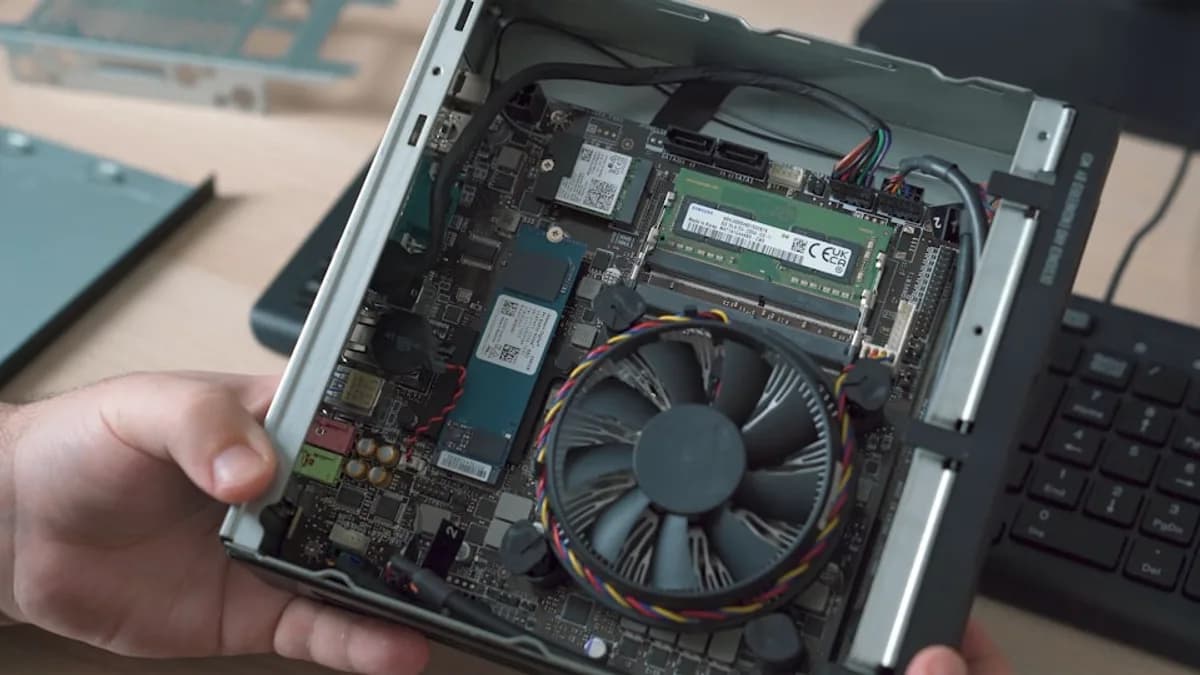
128GB of RAM in a mini PC is the number that reframes GMKtec’s EVO-X3 from a compact desktop into a serious workstation candidate.
The GMKtec EVO-X3 will launch globally on June 29, 2026, with “early access registration” opening on June 22, 2026 and a $20 discount coupon attached, according to Notebookcheck. GMKtec has not disclosed the retail price yet, which makes the specs easier to admire than the product is to judge.
The thesis is simple: the EVO-X3 shows how far high-end mini PCs like the Asus ROG NUC RTX 5090 are pushing into territory once reserved for towers. But the unanswered question is harder. Can a box this small sustain the performance, thermals, and reliability that creators, developers, local AI users, and power users expect from a primary machine?
128GB RAM and 16TB storage push the EVO-X3 beyond a desk accessory
GMKtec says the EVO-X3 will support up to 128GB of RAM and 16TB of PCIe 4.0 storage. Those two ceilings matter more than the chassis size. They suggest the company is aiming at memory-heavy workloads rather than just office work, media playback, or casual gaming.
MLXIO analysis: The obvious buyers are not everyone. They are users who hit memory limits before they hit CPU limits: developers running multiple containers or virtual machines, creators juggling large project files, analysts working with local datasets, and local AI experimenters who want more headroom without moving to a full desktop tower.
The processor story starts with AMD Ryzen AI Max+ 395. GMKtec also plans to add a Ryzen AI Max+ 495 configuration later in 2026. That matters because the first version is not a clean generational break from the GMKtec EVO-X2, which also uses the Ryzen AI Max+ 395.
| Feature | GMKtec EVO-X3 | GMKtec EVO-X2 |
|---|---|---|
| Launch APU | Ryzen AI Max+ 395 | Ryzen AI Max+ 395 |
| Later configuration | Ryzen AI Max+ 495 planned later in 2026 | Not stated in source |
| OCuLink Gen 4 | Yes | No |
| Maximum RAM | 128GB | Not stated in source |
| Maximum storage | 16TB PCIe 4.0 | Not stated in source |
That table shows the tension. At launch, the EVO-X3 looks like a targeted refinement, not a full reset. The missing EVO-X2 feature that GMKtec adds here is OCuLink Gen 4, a direct PCIe expansion port often used for external GPU setups and other high-bandwidth add-ons.
Readers focused on that expansion angle can pair this announcement with our separate breakdown of how OCuLink turns the GMKtec EVO-X3 into a tiny GPU workstation.
June 22 registration and June 29 launch put price in the spotlight
The confirmed launch math is narrow but useful:
- June 22, 2026: Early access registration opens
- June 29, 2026: Global launch date
- $20: Discount coupon for registered buyers
- 128GB: Maximum RAM support
- 16TB: Maximum PCIe 4.0 storage support
- 140W: Claimed peak performance from the AMD APU with triple-fan cooling
The $20 coupon is not the story. Without a retail price, it is impossible to know whether that discount is meaningful. On a premium mini PC with this spec sheet, $20 is more likely a launch funnel than a real affordability lever.
MLXIO analysis: GMKtec appears to be using early access to measure buyer intent before the global listing goes live. That is common sense for a configuration-heavy machine. The company needs to know whether buyers care most about the barebones price, RAM and SSD bundles, or the later Ryzen AI Max+ 495 option.
The final product page will matter more than the teaser. Buyers should check:
- Base configuration: CPU, RAM, and storage included at entry price
- Upgrade premiums: Cost of moving toward 128GB RAM or higher SSD capacity
- Warranty terms: Especially for global buyers
- Regional availability: Shipping, local power adapter, and return handling
- Launch bundles: Whether the coupon applies broadly or only to specific configs
For a broader memory-density comparison in compact PCs, see our coverage of the 128GB MSI Cubi NUC AI+ 3MG.
OCuLink, USB4, and 140W peak power show where the design gets serious
The EVO-X3 includes one OCuLink Gen 4 port and a 40Gbps USB4 port. Notebookcheck notes that a USB4 v2 port would have been better, but the existing USB4 connection still gives the machine modern high-speed I/O.
Display support is narrower than some buyers may expect. GMKtec confirms dual-display output through USB4 and HDMI 2.1. That is enough for many desks, but buyers running larger multi-monitor setups should not assume support beyond what GMKtec has stated.
The graphics claim is also important. The Radeon 8060S iGPU is said to deliver RTX 4070 Laptop-level performance. If that holds up in independent testing, the EVO-X3 may not need an external GPU for many users.
Still, the presence of OCuLink is useful. It gives the EVO-X3 a path beyond its internal graphics. That matters for buyers who want a small machine today but may want PCIe expansion later.
Thermals are the harder test. GMKtec says the triple-fan setup will allow the AMD APU inside to deliver up to 140W of peak performance. Peak is not sustained. The real question is how long the machine can hold high power before noise, heat, or throttling changes the experience.
Ryzen AI Max+ 395 at launch makes EVO-X3 a refresh before it becomes a leap
The EVO-X3’s launch configuration creates an unusual positioning problem. Because the EVO-X2 also uses the Ryzen AI Max+ 395, the new machine’s first wave depends heavily on platform changes around that chip.
That puts pressure on everything around the APU:
- Expansion: OCuLink Gen 4 gives the EVO-X3 a clear hardware difference
- Cooling: Triple fans and the 140W claim need real validation
- Memory ceiling: 128GB RAM gives the product workstation appeal
- Storage ceiling: 16TB PCIe 4.0 makes it viable for large local workloads
- Connectivity: WiFi 7, USB4, and HDMI 2.1 help position it as a premium compact PC
The later Ryzen AI Max+ 495 configuration may be the more interesting version, but GMKtec has only said it is planned for later in 2026. No price, performance delta, or exact timing is available from the supplied material.
MLXIO analysis: That makes launch-day buying a trade-off. Early buyers get the new chassis, OCuLink, high memory ceiling, and global availability. More patient buyers may wait to see whether the Ryzen AI Max+ 495 version changes the value equation.
Buyers should judge the box by sustained behavior, not the launch sheet
The EVO-X3 could make sense for users who need high memory capacity and compact size but do not require extensive internal expansion or a large desktop GPU. Its appeal is strongest where desk space, RAM capacity, and modern I/O matter at the same time.
It is less clear for buyers who need predictable sustained performance under long workloads. GMKtec’s 140W peak figure is promising, but independent reviews need to show fan noise, surface temperatures, BIOS stability, driver behavior, and performance after extended load.
The launch-day checklist should be strict:
- CPU: Confirm whether the listing is Ryzen AI Max+ 395 or a later 495 variant
- Memory: Verify type, speed, and whether 128GB is user-upgradable or sold as a config
- Storage: Confirm slot count and how 16TB PCIe 4.0 support is achieved
- Ports: Check exact OCuLink, USB4, HDMI, and networking layout
- Displays: Do not assume beyond confirmed dual-display support
- Support: Read warranty, return, and regional service terms before ordering
The practical takeaway: the EVO-X3 is not automatically a desktop replacement because it has workstation-class numbers. It becomes one only if cooling, firmware, support, and pricing match the spec sheet.
The June 29 reviews will decide whether 128GB mini PCs earn workstation trust
The EVO-X3 points toward a plausible future for compact PCs: more RAM, stronger integrated graphics, external PCIe expansion, and smaller chassis designs aimed at serious workloads.
But the evidence is not complete yet. The case for the EVO-X3 strengthens if independent reviews confirm sustained performance near GMKtec’s claims, reasonable acoustics, stable firmware, and pricing that makes sense against its configuration options.
It weakens if the 140W peak proves brief, if fan noise becomes intrusive, if the 128GB configuration carries a steep premium, or if global support trails the ambition of the hardware.
For now, GMKtec has built the right spec-sheet argument. On June 29, 2026, buyers will find out whether the EVO-X3 is merely a high-end mini PC launch — or a credible step toward workstation-class computing in a much smaller box.
The Bottom Line
- The EVO-X3 shows mini PCs moving into workstation territory with 128GB RAM and 16TB storage support.
- Its unchanged launch APU versus the EVO-X2 makes thermals, pricing, and sustained performance critical to its value.
- Power users, developers, creators, and local AI experimenters may get tower-class capacity in a much smaller system.