Bosgame’s VTA-439 mini PC claims 86 TOPS of local AI compute in a chassis built for OpenClaw, large models, and eGPU expansion. The system pairs AMD’s Ryzen AI 9 HX 470 with up to 256 GB of memory, triple NVMe storage, and a sale price of $1,049, according to Notebookcheck.
The pitch is direct: run AI assistants and local AI apps on your own desk instead of paying for cloud inference or AI tokens. Bosgame is positioning the VTA-439 less as a basic mini PC and more as a compact workstation for users who want on-device AI without a full tower.
Bosgame puts Ryzen AI 9 HX 470 at the center of its local AI pitch
The VTA-439 runs on a 12-core, 24-thread AMD Ryzen AI 9 HX 470. Its headline figure is 86 TOPS of total AI compute, split between a 55 TOPS NPU and another 31 TOPS from the CPU/GPU side.
That split matters because local AI performance is not one number in practice. Some workloads will hit the NPU, others will lean on the integrated GPU or CPU, and many apps still depend heavily on software support.
Bosgame says the system is built for local AI services such as OpenClaw, large AI models, and AI apps for image and video generation. In a separate company release, Bosgame also names Llama 3 8B via Ollama, ComfyUI, and OpenAI Whisper as examples of local workloads that can run without cloud access or API keys.
“We are seeing a fundamental shift in how people think about AI, from something you access through a browser to something that runs on your desk, on your terms,” said James Cao, General Manager of BOSGAME, in the company’s PRNewswire release.
The listed configuration with 32 GB RAM and a 1 TB SSD has an MSRP of $1,599.00, but Notebookcheck reports it is currently on sale for $1,049 on Bosgame’s website.
MLXIO has been tracking the same hardware marketing shift in PCs, including the way a 45 TOPS spec became central to the Asus Zenbook 14 AI pitch. The VTA-439 pushes that spec race into mini PC territory, with a much higher claimed total AI figure and more memory headroom.
256 GB RAM and three NVMe slots aim at bigger local models
The most useful spec may not be the TOPS number. It may be the memory ceiling.
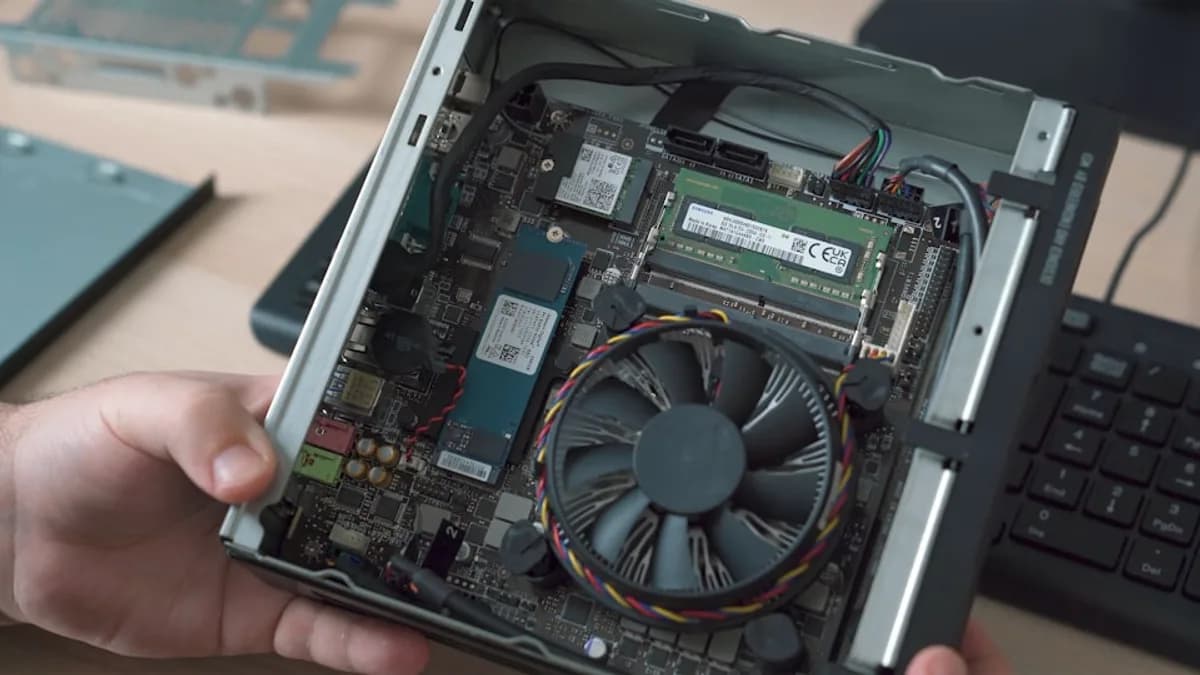
The VTA-439 supports up to 256 GB of DDR5 SO-DIMM 5600MT/s RAM across two slots. For local AI work, that gives the system more room for large models, multitasking, coding environments, and data-heavy workflows than typical compact desktops with fixed or lower memory limits.
Storage is also unusually aggressive for a mini PC. Bosgame includes three M.2 2280 NVMe PCIe 4.0 x4 slots, allowing up to 6 TB of storage based on currently available 2 TB SSDs, according to the source material.
That configuration fits the workloads Bosgame is chasing:
- Local assistants: Running OpenClaw-style tools without sending every request to a cloud service.
- Model storage: Keeping model files, datasets, and checkpoints on fast local drives.
- Creative AI: Running image and video generation tools that can eat memory and storage quickly.
- Development: Testing local AI apps, coding assistants, and edge AI prototypes on one compact box.
Analysis: the hardware mix is more compelling than the headline TOPS number alone. 256 GB RAM and three PCIe 4.0 NVMe slots give users room to experiment with models and toolchains, while the NPU gives Windows AI and supported local runtimes another acceleration path. The catch is that real performance will depend on model size, quantization, drivers, and whether the app actually uses the NPU.
OCuLink gives the mini PC an external GPU escape hatch
The AMD Radeon 890M integrated graphics handles Windows 11 apps and games. Notebookcheck says its performance “hovers around an Nvidia 1650,” giving the VTA-439 enough graphics muscle for mainstream desktop use and lighter gaming.
Bosgame also added an OCuLink PCIe 4.0 x4 port for external GPU expansion. That gives the mini PC a path to much stronger graphics or compute hardware, including cards as powerful as the Nvidia RTX 5090, according to the source material.
| VTA-439 path | Hardware involved | Practical role |
|---|---|---|
| Integrated mode | Radeon 890M | Windows 11 apps, media work, lighter games |
| Local AI mode | Ryzen AI 9 HX 470 NPU/CPU/GPU | OpenClaw, local models, image/video AI apps |
| Expanded mode | OCuLink eGPU | More GPU power for games, rendering, AI compute experiments |
OCuLink is notable here because it is not just another peripheral port. In this design, it exposes a PCIe 4.0 x4 route for an external GPU dock, which gives buyers a way to start with a small desktop and add graphics power later.
The caveat is practical, not theoretical. eGPU results will depend on the dock, cable, GPU, power supply, drivers, and how well the workload scales across an external card.
Benchmarks and software support will decide whether 86 TOPS translates
The next test is independent performance data. Bosgame’s specs are strong on paper, but sustained AI loads in a compact chassis raise questions about thermals, fan noise, power limits, and how long the Ryzen AI 9 HX 470 can hold its performance.
Software support is the other pressure point. The 55 TOPS NPU only matters if local AI frameworks, drivers, model runtimes, and apps such as OpenClaw can make good use of it. Otherwise, users may fall back to CPU, integrated GPU, or an external GPU.
That software uncertainty echoes the broader AI assistant race MLXIO covered in ‘Addiction’ Tops Microsoft Scout AI’s Leaked Roadmap: the hardware can be ready before the everyday user experience is settled. For the VTA-439, the gap to watch is between claimed AI compute and the number of local workflows that feel fast, stable, and easy to run.
Buyers should look for reviews that test the VTA-439 against other Ryzen AI mini PCs, Intel Core Ultra systems, Apple silicon desktops, and DIY small-form-factor builds. The useful comparisons will not stop at peak TOPS; they should cover memory bandwidth, NPU utilization, eGPU behavior, storage thermals, and real local model performance.
For now, Bosgame has made a clear bet: mini PCs are no longer being sold only as quiet productivity boxes. With 86 TOPS, 256 GB RAM support, triple NVMe, and OCuLink, the VTA-439 is being aimed at the desk where local AI work actually happens.
The Bottom Line
- The VTA-439 targets users who want local AI apps without relying on cloud inference or API keys.
- Its 86 TOPS AI compute and 256 GB memory ceiling make it unusually workstation-like for a mini PC.
- The $1,049 sale price undercuts its $1,599 MSRP, making the hardware more accessible for local AI experimentation.