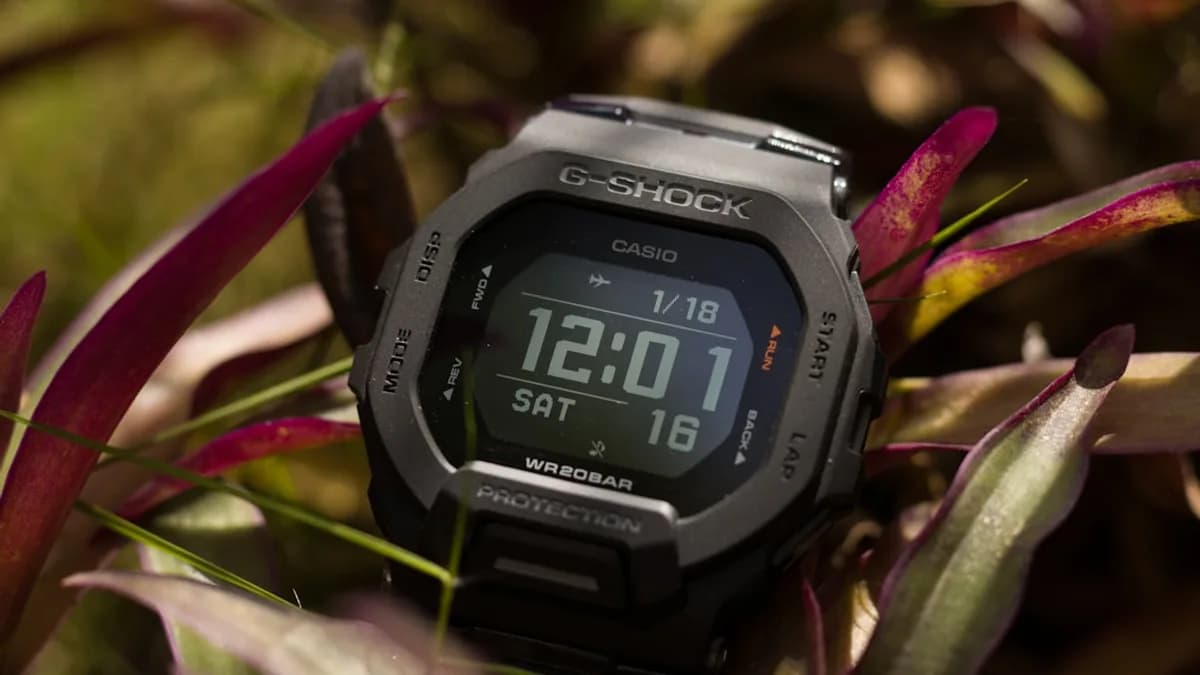
Casio is using Kanoa Igarashi’s fourth signature G-Shock to test whether a surf watch can carry real fitness-watch expectations without losing its G-Lide identity. The GBX-H5600KI-5 is not just another athlete colorway: it brings heart rate monitoring, blood oxygen measurement, sleep tracking, Polar-powered training analysis, tide graphs, moon phases, and a MIP LCD into one Igarashi-branded square.
The model was revealed by Casio and detailed by Notebookcheck, which reports a Japanese price of 50,600 JPY, or roughly $310, with release timing still not fully pinned down beyond July.
Casio Turns a Surf Collab Into a Fitness-Watch Trial
The important shift is not the collaboration itself. Casio has already done three Kanoa Igarashi models: GLX-5600KI-7, GBX-100KI-1, and GLX-5600KB-1. The shift is the platform underneath this one.
The GBX-H5600KI-5 is based on the GBX-H5600, which Notebookcheck describes as the point where G-Lide meets G-Squad. That matters because G-Lide has long been the surf-coded side of G-Shock: tides, moon data, beach durability, and lifestyle credibility. G-Squad pushes closer to training and health tracking.
MLXIO analysis: that creates a useful tension. G-Shock’s appeal comes from toughness, shape, and cultural memory. Fitness watches are judged on sensors, analytics, and daily behavior change. The GBX-H5600KI-5 sits directly between those expectations.
The strongest counterpoint is simple: Casio has not turned this into a full smartwatch story in the source material, a restraint that also shows up in its analog Pro Trek PRJ-01. There is no confirmed international release date, no detailed app claim, and no evidence here about sensor accuracy. So the thesis is not that Casio has already won performance wearables. It is that Casio is probing how far the G-Lide formula can stretch.
The 50,600 JPY Spec Sheet Adds More Than Surf Timing
The confirmed feature set makes the GBX-H5600KI-5 a more serious device than a typical cosmetic collaboration. Notebookcheck cites:
- Health tracking: heart rate monitoring, blood oxygen measurement, and sleep tracking.
- Training analysis: Polar-powered training features.
- Surf data: tide graphs and moon phases.
- Display: MIP LCD, as noted in the launch coverage.
- Price: 50,600 JPY, expected outside Japan at around $310 based on that Japanese price.
- Release timing: unconfirmed, beyond an expected July launch window.
The Polar-powered training analysis is the most strategically interesting piece. Casio is not only adding sensors; it is attaching those sensors to an outside training-intelligence layer. MLXIO analysis: that suggests Casio sees software interpretation as a credibility gap it cannot solve with hardware alone.
The MIP LCD also signals that Casio is prioritizing a watch-like interface rather than a phone-on-wrist experience. The source confirms the display type but does not provide battery, brightness, or visibility claims, so those should not be assumed. The safer reading is that Casio is keeping the physical G-Shock language intact while adding more measurable training data behind it.
This is a different Casio story than pure release tracking or collector materials. For comparison within MLXIO’s Casio coverage, No Price Yet: Casio G-Shock DW-5600 Drops Worldwide centers on availability, while $5K G-Shock Leak Reveals Casio’s Blue Sapphire Flex points toward high-end collector appeal. The GBX-H5600KI-5 is trying to make the square useful in training, not just desirable on a shelf.
From Tide Graphs to Training Load, G-Lide Gets a New Job
The earlier Igarashi collaborations were described by Notebookcheck as “solid G-Lide surf watches.” That phrasing matters. They were tied to surf culture, timing tools, and G-Shock identity. The GBX-H5600KI-5 changes the center of gravity.
| Model | Role in the Igarashi line | Source-supported distinction |
|---|---|---|
| GLX-5600KI-7 | Earlier collaboration | Part of Igarashi’s first three G-Shock collaborations |
| GBX-100KI-1 | Earlier collaboration | Listed among the prior G-Lide surf watches |
| GLX-5600KB-1 | Earlier collaboration | Listed among the prior G-Lide surf watches |
| GBX-H5600KI-5 | Fourth collaboration | Adds heart rate, blood oxygen, sleep tracking, Polar-powered training, tide graphs, and moon phases |
MLXIO analysis: Casio’s move is incremental rather than radical. The company is not abandoning the square G-Shock form or the surf identity. It is layering biometric and training functions onto a familiar frame.
That approach has an advantage and a risk. The advantage is continuity: existing G-Shock buyers can understand the watch immediately. The risk is expectation creep. Once a watch includes heart rate and training analysis, users may judge it less like a nostalgic G-Shock and more like a dedicated training device.
Kanoa Igarashi Gives the Watch More Than a Signature
Kanoa Igarashi is not a random ambassador in this story. Notebookcheck describes him as an Olympic silver medalist, a four-time G-Shock collaborator, and “one of the most recognizable surfers alive.” That gives Casio a credible bridge between surfing, Japanese brand identity, and global sports culture.
The design leans into that story. The watch is inspired by Ericeira, the Portuguese surf town where Igarashi trains regularly. Its dark brown marbled casing references the town’s rocky cliffs, while purple accent text points to the local “magic hour” before dawn.
The personal details are also unusually specific:
- Signature: Igarashi’s signature appears below the display.
- Number 50: His WSL bib number “50” is printed on the lower strap.
- Name reference: Notebookcheck notes that “Igarashi” in Japanese roughly translates to “a storm that strikes once in 50 years.”
- Packaging: The watch ships in special ocean-themed packaging.
- Weight change: The carbon-reinforced case back shaves 18 grams off the predecessor’s weight, according to the source.
MLXIO analysis: the collaboration makes the technical upgrade easier to sell emotionally. A heart rate sensor is functional. A surf-town color story, bib number, and athlete signature make the device collectible. Casio is trying to make both arguments at once.
Different Buyers Will Test Different Claims
Surfers will likely care first about the G-Lide basics that remain: tide graphs, moon phases, and a watch built for ocean use. The source does not provide water-resistance specifications, so the safer claim is that this remains positioned as a surf-focused G-Shock rather than detailing performance Casio has not stated in the supplied material.
Training-focused users will look elsewhere on the spec sheet. Heart rate, blood oxygen, sleep tracking, and Polar-powered analysis give the GBX-H5600KI-5 a stronger claim than earlier Igarashi models. But the source does not confirm advanced metrics, GPS details, mapping, or deeper app behavior. That leaves a real evaluation gap.
Collectors will see a fourth Igarashi model with a specific design story and special packaging. That alone may be enough for some G-Shock fans. For others, the question will be whether the added sensors justify the higher-tech platform rather than simply making the watch more complicated.
MLXIO analysis: this is where Casio’s positioning gets tricky. The broader the audience — surfers, runners, collectors, casual fitness users — the harder it becomes to satisfy everyone with one product. The GBX-H5600KI-5 works best on paper for buyers who want a rugged surf-watch identity with training features added, not for anyone expecting a fully app-centric wearable.
The Next Test Is Whether Fitness Feels Native to G-Shock
The GBX-H5600KI-5 suggests Casio wants health and training features to live inside recognizable G-Shock formats instead of replacing them. That is a coherent strategy. It preserves the square case, surf cues, athlete storytelling, and tide/moon utility while adding data that makes the watch more relevant beyond the beach.
The evidence that would strengthen this thesis is straightforward: confirmed international availability, clear details on the connected experience, and user confidence in the heart rate and training features during repeated use. The evidence that would weaken it would be equally clear: if buyers treat the model mainly as a collectible colorway and ignore the fitness layer, the technical upgrade becomes secondary.
For now, the GBX-H5600KI-5 is best read as Casio’s most capable Kanoa Igarashi collaboration yet — and a useful test of whether G-Lide can become more than a surf-timing line without losing the reason people wanted it in the first place.
Key Takeaways
- Casio is testing whether a surf-focused G-Shock can credibly expand into fitness tracking.
- The GBX-H5600KI-5 combines tide and moon data with heart rate, SpO2, sleep tracking, and Polar-powered training analysis.
- At 50,600 JPY, or roughly $310, it targets buyers who want rugged G-Shock design with more health features.