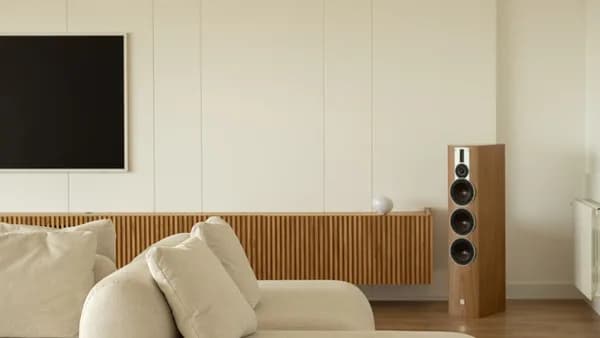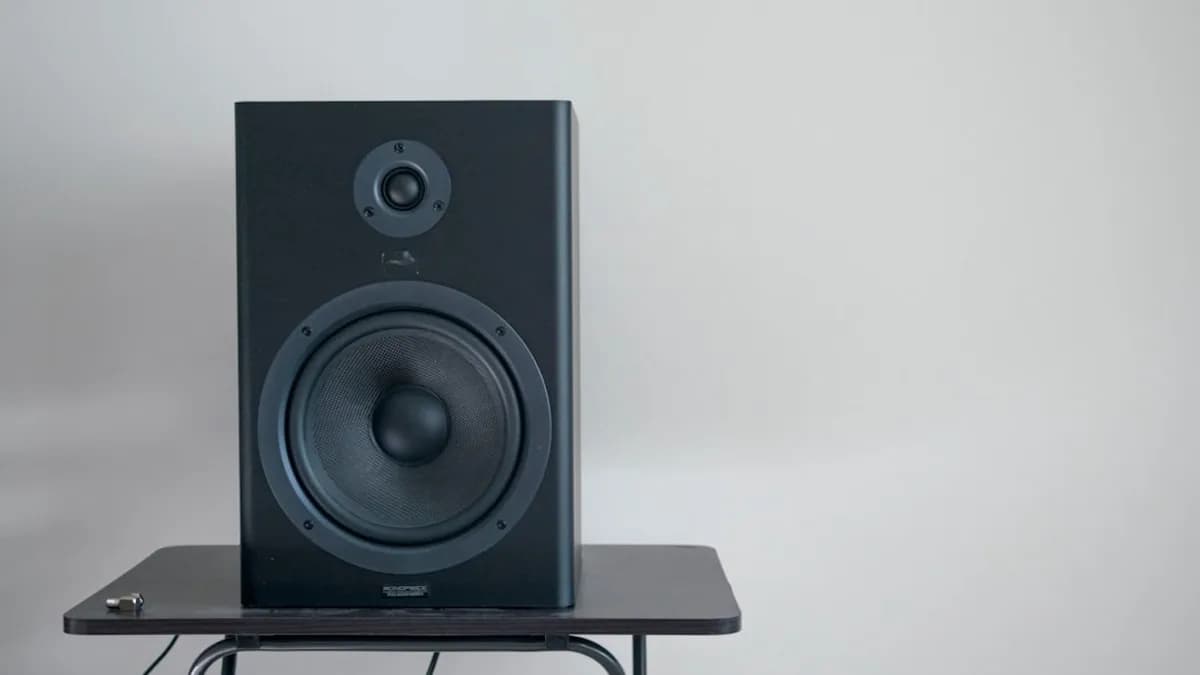
If a 43.9-centimetre-tall compact speaker now costs $15,000 per pair, is Bowers & Wilkins selling smaller hi-fi — or redefining what a flagship can look like?
That is the real question behind the B&W 805 D5, the new compact model in the relaunched 800 Diamond series, according to Notebookcheck. The speaker replaces the 805 D4 after almost five years, keeps the familiar visual language, and pushes the price far above the prior generation’s launch level.
The sharper read: Bowers & Wilkins is treating compact size as a premium format, not a compromise.
Is the 805 D5 Still an Entry Point When the Entry Price Is $15,000?
The 805 D5 is the smallest stereo speaker in the new 800 Diamond lineup, but its positioning is not modest. It is a standmount model with flagship materials, flagship branding, and flagship pricing.
Notebookcheck reports that the B&W 805 D5 compact loudspeakers will sell for $15,000 per pair, with deliveries expected to begin “in the next few months.” The prior 805 D4 launched in 2021 for $8,500. That is a $6,500 increase, or about 76.5% by MLXIO’s calculation.
That price jump matters more than the size of the cabinet. The 805 D5 measures 43.9 x 24.1 x 32.2 centimetres, barely changed from the prior model, yet it now sits in a very different economic frame.
Bowers & Wilkins is asking buyers to separate physical scale from product status. A compact speaker can be aspirational. A bookshelf form can carry luxury pricing. A smaller cabinet can still be sold as a reference object.
That strategy fits the wider 800 Series Diamond D5 relaunch. What Hi-Fi? reports that the new range arrives during Bowers & Wilkins’ 60th anniversary year and includes seven models: the 805 D5, 804 D5, 803 D5, 802 D5, 801 D5, HTM81 D5, and HTM82 D5.
The smallest stereo model may be the most revealing one. The larger floorstanders can justify themselves through sheer scale. The 805 D5 has to make the argument that compact precision, materials, and brand equity can carry a five-figure price on their own.
Do the Diamond Tweeter and Cabinet Changes Explain the Price Jump?
The 805 D5’s core technical story is evolutionary, not disruptive.
The headline feature remains the 25 millimeter synthetic diamond tweeter. It sits in a robust aluminum chassis at the top of the cabinet and is decoupled from the bass-midrange driver. That separation is central to Bowers & Wilkins’ pitch: keep the high-frequency driver away from cabinet and midrange vibration so treble detail is less masked by mechanical energy moving through the enclosure.
In a compact speaker, that matters. Smaller cabinets have less physical volume to absorb and manage internal energy. If the enclosure stores vibration and releases it back into the drivers, the result can blur imaging and soften transients. The decoupled tweeter is meant to protect the part of the spectrum where listeners often hear air, edge, and spatial cues.
The bass-midrange unit stays familiar. Bowers & Wilkins again uses a 165 millimeter Continuum Cone bass-midrange driver. The source material does not give a new material breakthrough here; it describes continuity with the previous model. That is important. The 805 D5 is not being positioned as a clean-sheet speaker. It is a refinement of an established platform.
The cabinet, though, gets a more aggressive materials story.
Notebookcheck says the 805 D3 was still made almost entirely of wood, while the 805 D4 added aluminum reinforcement. The 805 D5 continues that shift. It adds aluminum frame reinforcement and a newly developed aluminum top, paired with improved Matrix wood construction.
Bowers & Wilkins’ claim, as reported by Notebookcheck, is that this should cut resonance and support a more spacious sound. What Hi-Fi? describes the broader D5 range as using Space Frame Bracing, with parallel aluminum bracing rails bolted onto the rear of the Matrix inside the cabinet to stiffen the enclosure and reduce unwanted vibration.
Bowers & Wilkins says the D5 changes are meant to deliver “more openness, lower distortion, heightened resolution and superior dynamics.”
That quote captures the commercial logic. The 805 D5 does not need to look radically different. It needs to persuade buyers that lower cabinet noise and tighter mechanical control can be heard.
The trade-off is still physics. The 805 D5 is a compact two-way speaker. Bowers & Wilkins advertises a frequency range of 34 Hz to 35 kHz and 88 dB sensitivity, but buyers should not confuse that with the effortless scale of a larger multi-driver floorstander. The likely appeal is imaging, speed, treble clarity, and finish — not maximum room pressurization.
What Do the Numbers Say About the 805 D5’s Place in the New 800 Diamond Range?
The 805 D5 looks less shocking when placed inside the full D5 lineup. It is expensive, but it is still the lowest-priced stereo model in the new family.
| Model | Type | Price |
|---|---|---|
| 805 D5 | Standmount | £10,000 / $15,000 |
| 804 D5 | Floorstander | £16,000 / $25,000 |
| 803 D5 | Floorstander | £25,500 / $35,000 |
| 802 D5 | Floorstander | £32,500 / $45,000 |
| 801 D5 | Flagship floorstander | £43,000 / $65,000 |
| HTM81 D5 | Centre channel | £10,000 / $15,000 |
| HTM82 D5 | Centre channel | £8000 / $12,000 |
| FS-805 D5 | Stand for 805 D5 | £1600 / $2000 |
The stand price is not a footnote. If a buyer wants the matching FS-805 D5 stands, What Hi-Fi? lists them at $2,000. That takes the speaker-and-stand package to $17,000, before amplification, source components, setup, or room work.
The supplied sources do not provide prices for electronics, cables, installation, or room treatment, so any full system cost would be speculation. But the structural point is clear: the 805 D5 is not a self-contained purchase. It is a passive high-end speaker designed to sit inside a larger system.
That is where diminishing returns enter the discussion.
At $15,000, improvements can be real and still hard to value. Lower distortion, better bracing, more transparent tweeter mesh, upgraded crossovers, and tighter manufacturing tolerances may matter deeply to committed listeners. They may also sound incremental to buyers used to convenience-first audio products.
The numbers do not answer that dispute. They sharpen it.
Why Is the Smallest Stereo Model the Cleanest Test of Bowers & Wilkins’ Strategy?
The 800 Diamond identity has long rested on visible engineering. The tweeter-on-top form, premium cabinet work, and diamond tweeter branding tell buyers where the money went before a track plays.
The D5 range doubles down on that. What Hi-Fi? reports new top plates, spines, plinths, revised drive unit pods, tweeter bodies, trim rings, grilles, new finishes, hidden fixings, reduced panel gaps, upgraded crossovers, and higher-quality cabling and terminal post links.
That list matters because luxury hi-fi is sold through touchpoints as much as measurements. The 805 D5’s engineering has to be heard, but its price also has to be seen. Aluminum, leather trim, tighter tolerances, and visible separation between tweeter and cabinet all help create that signal.
This is where the compact model becomes strategically useful.
A large 801 D5 at $65,000 can justify itself as the top of the range. The 805 D5 has to justify why the smallest stereo speaker belongs in the same family. It does that by carrying the same design codes into a more room-friendly object.
For readers tracking other premium hardware categories, the pattern is familiar: physical design is increasingly part of the pricing argument. MLXIO has covered similar status-heavy product signals in White iPhone Ultra Dummy Reveals Apple’s $2,000 Bet and the niche-hardware logic behind 3-Camera Canon PowerShot Bet Tests Compact Comeback. The categories differ, but the question is the same: how much will buyers pay when industrial design and brand identity become part of the product’s core value?
The 805 D5 is Bowers & Wilkins’ answer in hi-fi form.
Who Hears Value in a $15,000 Compact Speaker — and Who Hears Risk?
The audiophile case is straightforward.
A compact reference speaker can be easier to place than a large floorstander. It may image more precisely in smaller rooms. It can focus budget on cabinet stiffness, driver integration, and treble refinement instead of sheer bass output. For listeners who value soundstage, tonal polish, and craftsmanship, the 805 D5 has a coherent argument.
The dealer and installer case is also strong, based on the product’s positioning. A flagship compact speaker can fit luxury interiors more easily than a physically imposing floorstander while still anchoring a high-value system sale. The matching FS-805 D5 stand gives Bowers & Wilkins a controlled presentation and a clear upsell path.
The skeptic’s case is just as rational.
$15,000 for compact speakers asks a lot from the buyer. The sources do not provide independent listening tests, distortion measurements, in-room bass data, or direct comparisons with the 805 D4. Bowers & Wilkins’ claims about resonance, openness, and resolution are plausible within the engineering story, but they still need audition-room proof.
There is also a broader model question, though the supplied sources do not quantify it: traditional passive hi-fi depends on the buyer accepting separate boxes, careful matching, and setup discipline. That can be a strength for enthusiasts. It can be friction for everyone else.
That tension is not new, but the 805 D5 makes it harder to ignore because the price is no longer merely premium. It is luxury-tier for a compact passive speaker.
How Should Buyers Judge the 805 D5 Before Reviews and Deliveries Begin?
The right first step is to ignore the spec sheet as a verdict.
The published numbers — 34 Hz to 35 kHz, 88 dB, 16.4 kilograms, 43.9 x 24.1 x 32.2 centimetres — describe the product. They do not settle whether it is worth $15,000. At this tier, setup quality can dominate the experience.
Room size, listening distance, amplifier matching, stand choice, and placement will decide whether the 805 D5 sounds like a compact flagship or an expensive mismatch. A speaker built around cabinet control and treble precision needs the room to stay out of the way.
Buyers should also treat the 805 D4 comparison seriously. The D5 is almost a kilogram heavier and adds the new aluminum top and cabinet refinements, but the basic architecture remains familiar: diamond tweeter, decoupled top-mounted tweeter housing, Continuum bass-midrange driver, and compact two-way layout.
That does not make the upgrade minor. It does mean the value case depends on execution, not novelty.
Practical read:
- Best fit: committed listeners with high-end electronics who want flagship voicing in a smaller form.
- Strong fit: design-conscious buyers who want an 800 Diamond product without a large floorstanding cabinet.
- Riskier fit: buyers expecting deep-bass authority or full-room scale from the smallest stereo model in the range.
- Necessary step: audition with familiar amplification and, if possible, in a room similar to the buyer’s own.
The 805 D5 should not be bought as a status shortcut. It should be bought only if its compact strengths match the room and the listener.
Which Signals Would Prove the 805 D5 Is a New Compact-Flagship Template?
The 805 D5 points toward a clear scenario: smaller flagship speakers with higher prices, more visible materials, and tighter links between audio engineering and luxury design.
That scenario is not proven yet. It will be tested after deliveries begin and independent listening impressions arrive.
The confirming evidence would be specific. Reviews would need to show that the D5’s cabinet and crossover changes audibly improve openness, resolution, dynamics, and distortion behavior over the 805 D4. Dealer demos would need to show that buyers accept $15,000 compact speakers as serious endgame products, not merely the least expensive way into the 800 Diamond badge.
The weakening evidence would be just as clear. If listeners hear only marginal gains over the prior model, the 76.5% launch-price increase becomes harder to defend. If the matching stands and system demands push total ownership into territory where buyers prefer larger models, the compact argument gets squeezed from above.
For now, the 805 D5 is best read as a statement of intent. Bowers & Wilkins is not apologizing for a small flagship. It is pricing one as if size is no longer the measure of ambition.
The Bottom Line
- Bowers & Wilkins is positioning compact standmount speakers as luxury flagship products rather than entry-level compromises.
- The 805 D5’s $15,000 price is $6,500 higher than the 805 D4’s launch price, signaling a major shift in premium hi-fi pricing.
- The launch shows how high-end audio brands are tying smaller form factors to aspirational design, materials, and branding.