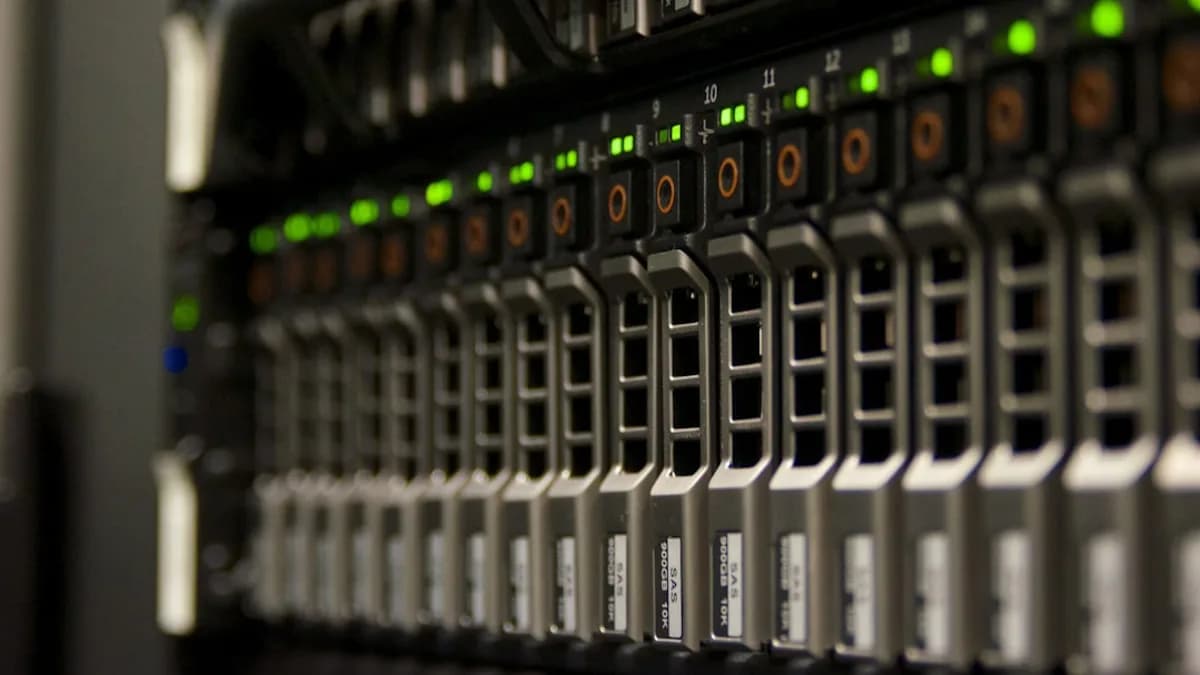
Beelink just put a Ryzen AI 9 HX 370 and up to 132TB of storage support into a four-bay NAS starting at CNY 4,299 in China, turning a home storage box into something closer to a compact compute-focused storage system.
The Beelink ME Pro 370 four-bay model launched alongside a two-bay version, according to Notebookcheck. The confirmed headline is the combination of a Ryzen AI 9 HX 370, up to 132TB of storage support, and a starting price of roughly $634 in China.
That combination creates a clearer problem for buyers: if a NAS now ships with high-end AMD mobile chips, judging it only by drive bays and maximum terabytes is no longer enough.
Beelink ME Pro 370 Pushes the NAS Past Plain Storage
The four-bay ME Pro 370 is being positioned as more than a simple storage expansion over the two-bay model. The supplied source material confirms the China launch, the presence of a four-bay version alongside a two-bay version, the Ryzen AI 9 HX 370, and support for up to 132TB of storage.
That matters because the device is not being pitched only as a larger storage enclosure. The more important signal is the pairing of high storage capacity with a processor normally associated with far more capable compact systems than a basic home NAS.
The deeper signal is compute. Beelink is pairing NAS capacity with the Ryzen AI 9 HX 370, which gives the ME Pro 370 a much stronger processing story than a traditional drive-first box. The supplied material does not confirm every platform detail around memory, internal expansion, graphics, AI acceleration blocks, or port layout, so those parts should not be treated as settled from the available source text alone.
MLXIO analysis: that is the real positioning shift. Beelink is not merely scaling from two bays to four. It is testing whether a NAS buyer wants more compute headroom inside the same box that stores the data.
That makes the ME Pro 370 part of a broader compact-hardware trend where the argument starts with performance and expandability rather than brand software alone. The difference here is that the confirmed storage ceiling and CPU choice put more pressure on the rest of the product experience to keep up.
Ryzen AI 9 HX 370 Makes the CPU the Story, Not the Drive Bays
Most of the source-supported differentiation sits in the processor. The Ryzen AI 9 HX 370 is the part that makes the ME Pro 370 stand out from a conventional small NAS, because it suggests Beelink wants the system to be judged as a compute-capable storage device rather than only a place to park disks.
That does not mean every performance claim should be assumed. The supplied source material does not confirm the detailed memory ceiling, slot layout, specific graphics configuration, NPU details, networking setup, wireless specifications, or cooling behavior. Those details may matter a lot in practice, especially for buyers who want to run demanding services, but they need confirmation from complete specifications or reviews.
The same caution applies to local AI positioning. The processor name clearly gives Beelink a stronger AI-adjacent story than a low-power NAS chip would, but practical usefulness depends on software support, memory configuration, thermal limits, and workload compatibility. None of those should be inferred from the CPU name alone.
MLXIO analysis: the important point is not that the ME Pro 370 automatically becomes a finished local-AI appliance. The important point is that Beelink is putting a processor into a NAS category where buyers usually expect much more modest compute. That changes what buyers should ask next.
The trade-off is also not yet visible from the supplied material. More compute can raise questions about heat, fan behavior, power draw, and sustained performance. Until those are tested, the processor should be treated as a promising foundation rather than proof of the whole system’s behavior.
CNY 4,299 and 132TB Give Beelink a Sharp Spec Sheet
The four-bay Beelink ME Pro 370 starts at CNY 4,299, or about $634, in China. That is the clearest pricing figure supported by the supplied source material.
The four-bay model’s confirmed storage headline is also straightforward at the top level: Beelink is advertising support for up to 132TB. The available source text does not confirm the detailed breakdown behind that number, such as per-bay drive limits or additional internal storage slots, so the safest reading is to treat 132TB as the stated maximum rather than reverse-engineer the configuration.
| Model | Confirmed launch detail | Confirmed storage support | Confirmed processor detail |
|---|---|---|---|
| ME Pro 370 two-bay | Launched alongside four-bay model in China | Not specified in supplied material | ME Pro 370 line includes Ryzen AI 9 HX 370 |
| ME Pro 370 four-bay | China launch confirmed | Up to 132TB | Ryzen AI 9 HX 370 |
The important caveat: maximum supported storage is not the same as protected usable storage. Buyers still need to know how the system handles redundancy, drive management, file systems, backup workflows, and recovery. Those details decide how much of the headline capacity can be treated as practical day-to-day storage.
The China price is useful, but it should not be treated as a final answer for every market. The supplied source material confirms the China launch and starting price, but it does not provide enough supported detail here to make firm claims about international timing, regional configurations, taxes, warranty terms, or distribution.
Modular Motherboard Design Is the Most Unusual Long-Term Bet
The most interesting long-term question is whether the ME Pro 370 is only a high-spec launch product or the beginning of a more upgrade-minded NAS platform. The supplied source material used for this correction does not confirm a modular motherboard design, so that idea should be treated cautiously unless verified from full product documentation.
That distinction matters. A four-bay NAS usually ages along two lines: drive capacity and platform capability. Drive capacity can improve as larger disks become available, but the CPU, memory ceiling, I/O, and platform features usually remain fixed.
If Beelink does offer a more modular internal design, it could change that equation. It could, in theory, let the company refresh compute without forcing buyers to replace the whole enclosure. But without confirmed details on upgrade paths, board availability, compatibility, and pricing, that remains a question rather than a conclusion.
MLXIO analysis: this is exactly the kind of claim buyers should verify before treating it as a purchase reason. Modular hardware only matters if replacement parts are available, documented, and supported after launch.
For now, the confirmed story is simpler but still notable: Beelink has introduced a four-bay NAS in China with Ryzen AI 9 HX 370, up to 132TB of storage support, and a starting price of CNY 4,299.
Buyers Should Judge the ME Pro 370 by Software Discipline, Not Specs Alone
The ME Pro 370’s confirmed spec story is strong enough that the next questions sit outside the raw headline numbers.
Buyers should verify the operating system, update cadence, drive compatibility, remote access model, backup tooling, security response process, and recovery options before treating the hardware as a complete NAS solution. Those details are especially important because a NAS is not only a computer; it is where users place data they may not be able to easily replace.
That gap should shape how different buyers read the launch.
- Technically confident users: The ME Pro 370 may look attractive if they want a compact storage system with a much stronger CPU story than typical entry NAS hardware.
- Less hands-on buyers: The missing software, support, and recovery details may matter more than the 132TB headline.
- Buyers outside China: Regional availability, documentation, warranty coverage, and final local pricing need confirmation before the China launch price can be treated as a real purchase comparison.
The product solves one problem clearly: Beelink has shown that a four-bay NAS can be announced with serious AMD compute and aggressive launch pricing. It creates another problem just as clearly: buyers now need proof that the software, thermals, and long-term support match the hardware ambition.
The Next Test Is Whether Reviews Validate the Spec Sheet
The Beelink ME Pro 370 does not need to dethrone established NAS categories to matter. It only needs to prove that a NAS with Ryzen AI 9 HX 370 and 132TB of stated capacity can stay stable, perform consistently, and provide credible software support.
The evidence that would strengthen the thesis: real-world testing showing controlled noise, sustained performance, stable storage behavior, useful compute features, and clear pricing beyond the confirmed China launch.
The evidence that would weaken it: unclear software support, thermal throttling, limited warranty coverage, or pricing that rises sharply once configurations and regional availability are fully known.
For now, Beelink has made the NAS buying decision more complicated in a useful way. Capacity still matters. But with this launch, compute capability has moved much closer to the center of the conversation.
The Bottom Line
- Beelink is pushing NAS devices beyond basic storage by pairing high capacity with a powerful AMD Ryzen AI processor.
- The ME Pro 370’s 132TB support and roughly $634 starting price could pressure rivals in the home and prosumer NAS market.
- Buyers may need to evaluate NAS systems by compute performance, not just drive bays and storage capacity.