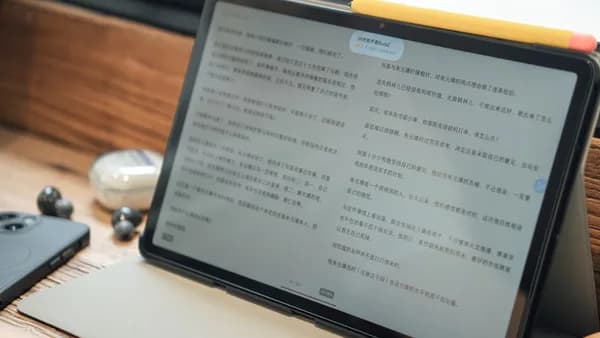
Boox Note X6 doubles onboard storage to 128GB and adds split-screen multitasking, pushing Boox’s China-only e-note line further away from “digital paper” and closer to a low-power Android productivity tablet.
The new 10.3-inch monochrome E Ink tablet was announced in China with a slimmer body, lighter chassis, newer Android-based software, and a Qualcomm Dragonwing Q6690, according to Notebookcheck. The headline is not just storage. It is Boox’s bet that serious e-note users want local files, side-by-side work, and AI-assisted reading tools more than a stripped-down writing slate.
Boox Note X6 pushes e-note tablets beyond digital paper and into Android productivity
The Note X6 keeps the same 10.3-inch monochrome display as the prior generation, but the product direction has changed. Boox is not selling only a better notebook. It is selling a more capable workspace.
Split-screen multitasking is the signal. On an E Ink tablet, side-by-side apps are not about video calls or rapid app switching. They are about slow, document-heavy work: reading a PDF while writing notes, comparing two files, keeping reference material open beside a draft, or marking up a document without constantly jumping between screens.
That matters because e-note tablets have always carried a tradeoff. Devices built for simplicity reduce distractions, but they can feel cramped when users need real document workflows. Android-based Boox devices go the other way: more flexibility, more settings, more file handling, and more potential complexity.
Boox says the Qualcomm Dragonwing Q6690, also known as the Snapdragon 6690, delivers a 78% improvement in performance compared with the previous generation.
That claim, if reflected in real use, would matter most in exactly the places E Ink tablets tend to feel slow: opening large files, switching views, running Android apps, and rendering note-heavy documents.
The catch is availability. The Boox Note X6 is only confirmed for China, and there is no announced international release. That keeps the device in a different category from global Boox models and from competitors already sold more broadly.
The Note X6 spec story: 128GB storage, redesigned hardware, and a newer Boox OS
The most visible upgrade is storage. The Note X6 ships with 128GB of internal storage, double the Note X5, and includes a microSD card slot that supports up to an additional 2TB.
That is unusually generous for a monochrome E Ink note-taking tablet. It gives Boox room to pitch the device to users who keep large offline libraries: PDFs, textbooks, scanned documents, work files, templates, handwritten notebooks, and EPUB collections.
The hardware also gets a cleaner physical redesign. The Note X6 is 5.2mm thick and weighs 365g, compared with the Note X5 at 5.8mm and 405g. The corners are now rounded rather than squared off, which should help handheld comfort.
| Device | Storage | Thickness | Weight | Price / availability |
|---|---|---|---|---|
| Boox Note X6 | 128GB, plus microSD up to 2TB | 5.2mm | 365g | CNY 3,299 ($487/€418), China from May 31 |
| Boox Note X5 | 64GB | 5.8mm | 405g | Previous generation |
| reMarkable Paper Pure | 32GB | Not stated in source | Not stated in source | $399 |
The software may be just as important as the hardware. The new tablet runs updated Boox OS based on Android 16, with split-screen multitasking, AI summary, and an AI feature that can explain circled text or charts inside a document.
MLXIO analysis: the likely buyer is not the person who only wants a blank page and a pen. The Note X6 makes more sense for heavy PDF readers, students, researchers, and professionals who value storage and side-by-side document work over maximum simplicity.
The numbers behind Boox Note X6’s storage advantage over rival e-note devices
The storage gap is clear. The Boox Note X6 has 128GB, while the reMarkable Paper Pure has 32GB. That gives Boox four times the onboard capacity of that named rival, before the microSD slot enters the picture.
The 2TB microSD ceiling also changes the argument. Even if most users never fill that much space, expandable storage gives Boox a strong answer to buyers who dislike cloud dependence or who manage large offline document sets.
Price complicates the advantage. The Note X6 is listed at CNY 3,299 ($487/€418) in China, with early buyers eligible for a discount of up to 10% at purchase. Notebookcheck notes that the reMarkable Paper Pure is cheaper at $399, though it has only 32GB of storage.
Storage alone does not decide this category. RAM is not mentioned for the Note X6, and real-world experience will depend on processor behavior, Boox OS tuning, stylus response, battery life, display refresh handling, and app compatibility. The spec sheet points in a clear direction, but it does not prove the device will feel better in long writing sessions.
One omission is also notable: unlike the iFlytek Air 3 series, the Note X6 has no camera, so users cannot scan documents with it. Boox appears to be prioritizing files already on the device over capture from the device itself.
From Kindle Scribe to reMarkable: where Boox is choosing complexity over restraint
The Note X6 sits in the part of the E Ink market where reading, writing, and Android productivity overlap. Android Authority previously framed the device as an Android-powered rival to the Kindle Scribe, while Notebookcheck highlights the reMarkable Paper Pure as a likely challenger if the Note X6 leaves China.
That comparison is useful because these products are not chasing the same ideal user. Boox emphasizes app flexibility, expandable storage, multitasking, and system features. reMarkable’s appeal, based on the comparison supplied, rests more on price and focused writing hardware.
Boox’s approach carries a cost. Android flexibility can make an E Ink tablet more useful, but it can also make the interface feel busier than a dedicated writing device. TechRadar’s review of the smaller Boox Go 7 praised Android app access and file support, but also criticized a complicated menu system and battery drain. That does not prove the Note X6 will have the same issues, but it shows the tradeoff Boox often accepts.
For readers following China technology hardware beyond e-readers, MLXIO has also covered separate China-linked tech stories including $15M Nvidia Chip Haul Exposes China Smuggling Route and Volvo Dodges US China-Tech Ban on Connected Cars — For Now. Those are different markets, but they underline why product availability, geography, and hardware positioning deserve careful separation.
Who benefits from Boox Note X6 multitasking — and who may find it too busy
The winners are users with document-heavy workflows. Split-screen can reduce friction for annotation, research, and comparison tasks. The 128GB base storage and expandable slot make the Note X6 more attractive for people who do not want to constantly prune files.
Minimalist note-takers may see the same feature list as a warning. More storage, AI tools, Android apps, and multitasking do not automatically improve handwriting. They can also add menus, decisions, and maintenance.
Competitors face a narrower but real pressure point. If Boox can sell 128GB, expandable storage, and split-screen at this China price, rival e-note makers may need stronger answers on storage tiers, document management, or side-by-side workflows. That does not mean every device should become an Android tablet. It means “paper-like” alone may not be enough for users with large file libraries.
Developers and app users still face E Ink limits. Android compatibility expands what the Note X6 can attempt, but E Ink refresh behavior will shape what actually feels good. Reading, writing, and static reference apps fit the medium better than fast-changing interfaces.
Boox Note X6 signals the next phase of E Ink productivity hardware
The Note X6 gives buyers a sharper test: choose based on workflow, not just screen size or brand. If the job is long-form handwriting with minimal distraction, a simpler device may still win. If the job is managing files, reading PDFs, annotating, and working across two panes, Boox’s feature-heavy strategy looks more persuasive.
For the industry, the competitive battleground is widening. Display quality and stylus feel still matter, but storage, multitasking, and OS capability are becoming harder to ignore.
The next evidence to watch is practical, not promotional: whether the 78% performance improvement shows up in large PDFs, whether split-screen feels natural on a 10.3-inch monochrome panel, whether Boox OS based on Android 16 stays manageable, and whether Boox announces an international release. If those pieces hold, the Note X6 will look less like a storage bump and more like Boox’s clearest argument for E Ink as a productivity platform.
Key Takeaways
- The Note X6 moves Boox’s e-note line closer to a productivity tablet than a simple digital notebook.
- Split-screen support could make document-heavy work easier on an E Ink device.
- More storage and claimed performance gains may appeal to users who keep large files locally.