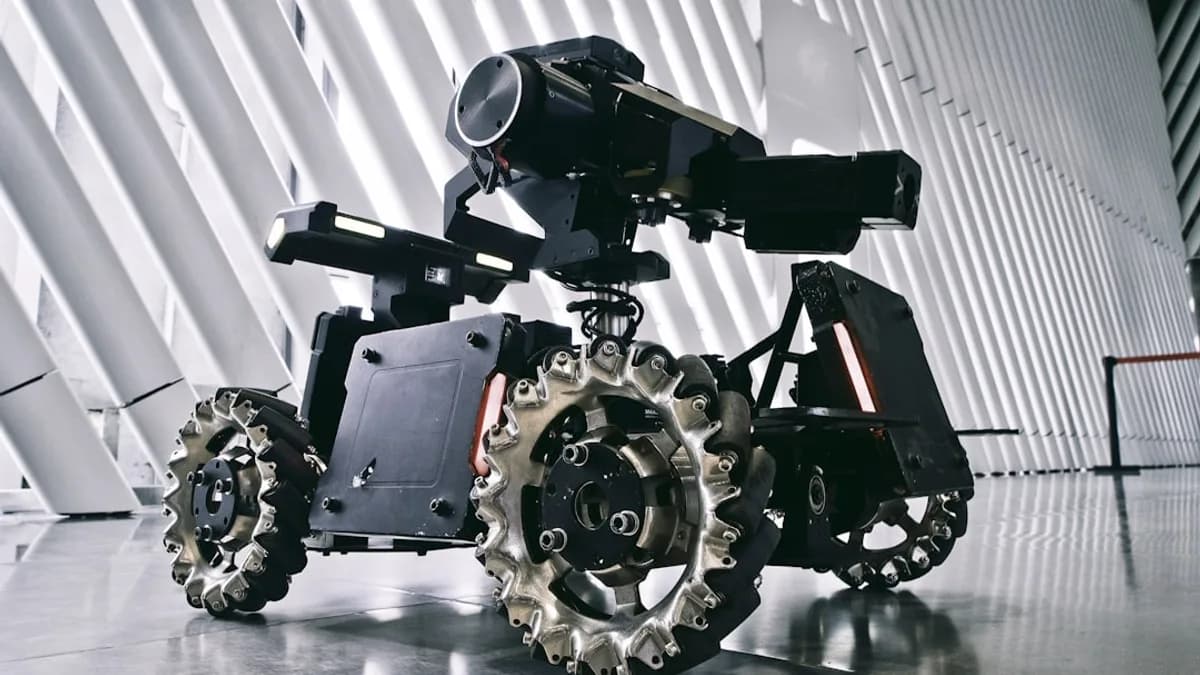
17.9 mph is the number that makes Beni more than a novelty: this is a 3.86 lb ground robot with a 4K/30 fps camera, autonomous follow mode, and a claimed ability to jump 10 inches over obstacles.
That pitch matters because drones are often the default tool for solo motion footage, but they can be legally awkward or unusable in places where flight is restricted. Beni takes the camera off the aircraft and puts it on two wheels instead, according to Notebookcheck. The result is not a drone replacement in the cinematic sense. It is a bet that many creators do not always need altitude. Sometimes they need a moving 4K camera that can follow without taking off.
Why could Beni’s 4K jumping robot be useful when a drone is impractical?
Beni’s strongest case starts where drones run into restrictions. Notebookcheck points to areas near airports, helicopter landing pads, many hospitals, and nature reserves as examples where drone use can be heavily limited. That does not automatically make a ground robot problem-free. The legal situation around robots such as Beni in Germany is described as “highly complex,” and Notebookcheck explicitly advises against using it in public traffic areas.
So the appeal is narrower but real: a camera that tracks from the ground could be useful when aerial capture is not allowed, not desired, or not needed. Instead of overhead shots, Beni aims at low-angle motion footage: a person moving, a pet running, or side-view tracking from close range.
Analysis: This is the same broader tension showing up across consumer camera hardware: people want more automated shots without adding another operator. MLXIO has covered that from a different angle in Weird Pixel Art Invades Your iPhone Camera With NeoCam, where the camera itself becomes the product hook. Beni pushes the hook into mobility.
The catch is obvious. Beni cannot give you the wide aerial view that made drones famous. Its promise is more specific: 4K follow footage without flight.
What is the Beni robot and how does its 4K camera follow people?
Beni is a two-wheeled, ground-based robot with a swivel camera. The manufacturer says it can record 4K video at 30 frames per second to 32GB of internal memory or to a microSD card. It is designed to follow the user, avoid obstacles, right itself, and accept joystick control.
The “jumping robot” part is what separates it from a basic rolling camera dolly. Beni is advertised as being able to jump over obstacles 10 inch (25.4 centimeters) high. For a compact consumer robot, that is the feature meant to keep it moving when a small curb, threshold, or object would stop a normal wheeled camera platform.
Notebookcheck also flags the safety trade-off. At 3.86 lbs (1.75 kg) and a claimed top speed of 17.9 mph, or 28.8 km/h, Beni is not weightless. At speed, it carries enough kinetic energy to pose a risk to bystanders if it misjudges space or the operator uses it carelessly.
The tracking stack is not detailed in the supplied source. So buyers should not assume too much about the sophistication of its autonomy. “Follows the user” is the headline. How well it handles occlusion, low light, crowded scenes, pets, sudden direction changes, or fast lateral movement remains an open product question.
How does a jumping camera robot compare with a drone for everyday video?
A drone wins altitude. Beni wins proximity. That is the cleanest split.
| Feature | Beni jumping robot | 4K drone |
|---|---|---|
| Camera angle | Ground-level tracking and side-view motion | Aerial views and high-angle shots |
| Claimed capture | 4K/30 fps | Depends on drone model |
| Movement | Two wheels, jumping over 10-inch obstacles | Flight |
| Main constraint | Ground obstacles, crowds, traffic areas | Flight restrictions and no-fly zones |
| Safety concern | 3.86 lb robot moving up to 17.9 mph | Aircraft operation and propellers |
| Best fit | Low-altitude autonomous follow footage | Height, distance, and wide establishing shots |
Beni’s advantage is not that it moves more freely than a drone. It does not. It cannot fly over water, cross big gaps, or rise above trees and buildings. Its advantage is that it changes the regulatory and practical question from “Can I fly here?” to “Can I safely operate a ground robot here?”
That distinction matters, but it does not erase legal risk. Notebookcheck’s warning about Germany is a useful reminder: ground-based does not mean regulation-free. Public traffic areas are especially problematic, and the source explicitly warns against using Beni there.
Analysis: For solo creators, the reduced skill requirement may be part of the appeal. A following robot could remove some manual piloting burden. But that remains conditional on how accurately Beni tracks and avoids obstacles in real use, which the supplied material does not independently verify.
Where could Beni’s 4K autonomous follow mode beat a drone in real life?
A grounded example: a user wants a side-view clip of themselves or a pet in motion. The manufacturer specifically advertises Beni’s swivel camera for side-view shots of moving people or pets. In that setup, Beni does not need to climb into the sky. It needs to keep pace, keep the subject framed, and avoid obstacles.
The numbers show the intended envelope:
- Speed: Claimed maximum of 17.9 mph, fast enough on paper for many moving-subject shots.
- Obstacle handling: Claimed jump capability of 10 inch (25.4 centimeters).
- Video: 4K/30 fps recording to internal storage or microSD.
- Control: Autonomous following plus joystick support.
That combination could be more useful than a drone when the desired shot is close, low, and lateral. The user gains a tracking camera and avoids sending an aircraft into restricted airspace. They give up height, long-distance flight, and dramatic overhead composition.
There is also a wider robotics point here. MIT researchers recently described a tiny hopping robot that uses far less energy than a comparable flying robot and can carry about 10 times more payload than a similar-sized aerial robot, according to MIT News. That MIT machine is not Beni; it is an insect-scale research robot. But the shared idea is important: hopping can solve some mobility problems without paying the full energy cost of flight.
“Being able to put batteries, circuits, and sensors on board has become much more feasible with a hopping robot than a flying one,” MIT graduate student Yi-Hsuan (Nemo) Hsiao said.
That research context also connects to the broader autonomy debate MLXIO has tracked in Anduril’s $100B Bet Turns War AI Into VC’s New Prize: robots are increasingly judged not just by sensors, but by where they can safely operate.
What should buyers check before choosing Beni instead of a 4K drone?
The crowdfunding price is currently listed at a minimum of $549, or about 477 euros, with shipping costs extra. Notebookcheck also stresses that crowdfunding carries “considerable financial risk.” That should frame every buying decision.
Before treating Beni as a drone alternative, buyers should ask for specifics the source does not provide:
- Battery life: How long can it record while following at speed?
- Tracking accuracy: What happens when the subject turns, stops, or passes behind another object?
- Stabilization: Does the 4K footage stay usable while the robot jumps?
- Camera quality: Sensor size, lens quality, bitrate, dynamic range, and low-light performance matter as much as resolution.
- Terrain limits: The source gives a 10-inch jump claim, but not detailed performance on grass, gravel, stairs, mud, or crowded spaces.
- Durability: Repeated jumps can stress wheels, camera mounts, and the chassis.
- Repairs and parts: Crowdfunded hardware can be harder to service if production changes.
- Safety controls: At 3.86 lb and up to 17.9 mph, braking and obstacle detection are not minor features.
The practical buying frame is simple. Choose Beni if the shot you need is low, close, autonomous, and grounded. Choose a drone if the shot depends on height, distance, and open-air movement.
The next thing to watch is not just whether Beni ships. It is whether its autonomy, stabilization, and obstacle handling match the specs well enough to make “4K without flight” feel like a real category rather than a clever crowdfunding demo.
Key Takeaways
- Beni targets creators who want automated motion footage without dealing with drone flight restrictions.
- Its 17.9 mph speed, 3.86 lb weight, and 10-inch jumping ability make it more capable than a simple camera toy.
- It is not a full drone replacement, but it could fill a practical niche for low-angle 4K tracking shots.