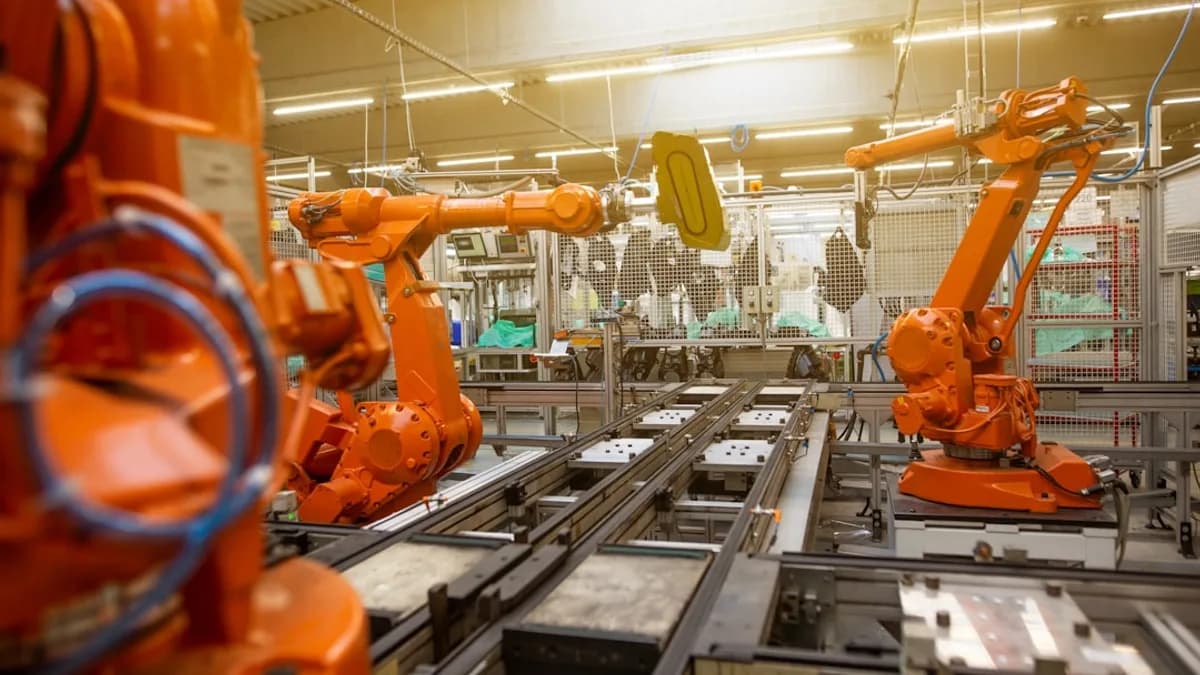
LeRobot v0.6.0 adds three world-model policies, six simulation benchmarks, and a deployment CLI that turns real robot failures into new training data.
That is the core shift in Hugging Face’s latest robotics release: not just another model drop, but a tighter loop for training, testing, correcting, and retraining robot policies. The release, published July 7, 2026, is framed around “Imagine, Evaluate, Improve,” according to the Hugging Face Blog.
“This new release is about closing the robot learning loop: policies that imagine the future before acting, reward models that tell you when your robot succeeds, a deployment CLI that turns failures into training data, and six new simulation benchmarks to measure it all.”
The practical promise is simple. Robot learning gets expensive when a policy looks fine in training, then fails on a physical arm, robot boats, another mobile platform, or lab setup. LeRobot v0.6.0 tries to compress that pain cycle: preview behavior where possible, evaluate it more consistently, capture failures, then feed them back into the next training run.
Why could LeRobot v0.6.0 make robot AI cheaper to test before real hardware runs?
The release matters because physical robot mistakes are not just software bugs. A bad action can drop an object, miss a grasp, collide with a fixture, waste lab time, or damage hardware. The source does not give cost figures, so the economic case here is MLXIO analysis: fewer blind real-world trials can reduce wasted iteration for teams that already have compatible robots, datasets, and compute.
Hugging Face’s release theme — “Imagine, Evaluate, Improve” — maps to a full robot-learning workflow:
- Imagine: train policies with world-model-style signals or generated future trajectories.
- Evaluate: test policies across shared simulation benchmarks and reward models.
- Improve: deploy policies, capture corrections, and fine-tune on the failures.
That loop is more useful than a single impressive demo. A robot policy that succeeds once on camera may still break under a lighting change, a shifted object, or a slightly different instruction.
The caveat is just as important. LeRobot v0.6.0 is not a finished general-purpose robot brain. Its value depends on task design, dataset quality, hardware support, simulator setup, and whether the chosen model fits available compute.
What is LeRobot v0.6.0 inside open-source robot learning?
LeRobot is Hugging Face’s open-source stack for real-world robot learning in PyTorch. Its GitHub page describes the project as providing models, datasets, and tools for robotics, with a hardware-agnostic interface that standardizes control across platforms from SO-100 arms to Unitree G1 and other supported devices.
Version 0.6.0 is organized around the full training cycle rather than one narrow component. It adds new vision-language-action models, world models, reward models, dataset tooling, benchmarks, deployment workflows, FSDP training, and cloud training through HF Jobs.
That makes the release relevant to several groups:
- ML researchers testing imitation learning, reward modeling, and VLAs.
- Robotics engineers trying to compare policies across repeatable tasks.
- AI startups building task-specific robot behavior.
- Universities and labs that need shared datasets and reproducible evaluation.
It is infrastructure, not a boxed commercial robot. LeRobot helps users build, train, evaluate, deploy, and share robot policies. It does not remove the hard parts of robotics: sensors, calibration, task design, safety, and real-world variance.
How does the “Imagine” step preview robot behavior without overclaiming?
In robotics, “imagination” means a policy or companion model learns something about likely future states. That can include predicted frames, future action chunks, or generated rollouts. The point is to give training a signal about consequences, not only immediate actions.
LeRobot v0.6.0 adds three world-model policies:
| Model | What it adds | Important limit |
|---|---|---|
| VLA-JEPA | Uses a JEPA world model during training to predict upcoming frames in latent space from the model’s own actions | The world model disappears at inference, so there is no extra inference cost |
| LingBot-VA | Predicts future video and actions together, chunk by chunk | Can save predicted video with --policy.save_predicted_video=true |
| FastWAM | Pairs a roughly 5B video-generation expert with a compact action expert | Skips “dreaming” at inference and directly denoises action chunks |
The closest analogy is a chess engine considering future moves before choosing one. In robot learning, the future being considered is physical: where the gripper moves, how an object might shift, or how an action sequence could unfold.
But this is not clairvoyance. Imagined outcomes can be wrong when the simulator, dataset, or world model misses friction, object variation, lighting, sensor noise, or human interaction. For VLA-JEPA and FastWAM, the release specifically says the world-model component is used to improve training but not to add test-time future simulation.
That nuance matters. “Imagine” improves the learning loop, but it does not guarantee a robot can safely reason through every real-world scenario before acting.
Why lerobot-eval is a cleaner test than a polished demo clip
Robotics needs standardized evaluation because demo videos compress reality. They rarely show failed trials, reset counts, edge cases, or whether a policy only works in one carefully staged room.
LeRobot v0.6.0 expands lerobot-eval with six new simulation benchmark families:
- LIBERO-plus: roughly 10,000 perturbed variants across seven axes.
- RoboTwin 2.0: 50 bimanual manipulation tasks on SAPIEN, with more than 100k trajectories on the Hub.
- RoboCasa365: 365 kitchen tasks in 2,500 procedurally generated kitchens.
- RoboCerebra: long-horizon episodes chaining 3 to 6 sub-goals, plus a 6,660-episode dataset.
- RoboMME: 16 memory tasks across 4 memory suites.
- VLABench: manipulation tasks involving knowledge and reasoning.
Together with LIBERO, Meta-World, and NVIDIA IsaacLab-Arena, Hugging Face says LeRobot now has nine benchmark families under one roof.
Evaluation is the bridge between imagination and improvement. Reward models such as Robometer and TOPReward add another layer by scoring progress and success from video plus task instructions. Robometer is built on Qwen3-VL-4B and trained via trajectory comparisons over more than one million robot trajectories. TOPReward uses an off-the-shelf Qwen3-VL setup and reads the log-probability of the token “True” for a trajectory and instruction.
How could a small robotics team improve a pick-and-place arm?
Consider a hypothetical two-person team training a low-cost arm to pick parts from a bin and place them into trays. The narrow task matters. “Build a general home robot” is too broad; “pick up the red cube” is measurable.
A practical LeRobot-style loop could look like this:
- Collect demonstrations using a supported setup such as SO-100/101.
- Train an initial policy with
lerobot-train. - Run deployment using lerobot-rollout.
- Evaluate across object positions, lighting conditions, and task variations.
- Capture corrections when the policy fails.
- Fine-tune on those correction frames.
The release’s DAgger-style rollout strategy is the key here. A user watches the policy run, hits a key or USB foot pedal when it goes wrong, takes over with a leader arm, records the correction, then hands control back. Each correction frame is tagged with an intervention flag.
For a concrete deployment anchor, Hugging Face says MolmoAct2 can run zero-shot on an SO-100/101 with ready-made checkpoints, fits inference in about 12 GB at bf16, and supports LoRA fine-tuning on a single 24 GB GPU.
The failures this loop targets are ordinary but costly: the gripper approaches at the wrong angle, shiny objects slip, or overlapping items confuse the policy. The business relevance is MLXIO analysis: faster failure capture can help a small team decide earlier whether the task is technically and commercially worth pursuing.
For a broader AI planning lens outside this specific robotics release, see MLXIO’s Key Trends Reveal the Next Tech and Finance Shake-Up.
Adoption checklist before developers bet experiments on v0.6.0
Teams should treat LeRobot v0.6.0 as a serious toolkit, not a shortcut. Before adopting it, check six things:
- Hardware: Is your robot or teleoperation device supported, or can you implement the LeRobot robot interface?
- Data: Can your recordings fit the LeRobotDataset format with synchronized video and state/action data?
- Compute: Does your chosen policy fit your GPUs? Some models are designed for modest hardware; others need more.
- Simulation: Do the benchmark dependencies match your system, or will you use the provided Docker images?
- Deployment: Can your team safely run
lerobot-rolloutand intervene when policies fail? - Evaluation: Are you measuring repeatable task success and progress, not just collecting videos?
The forward watch item is whether users can turn these pieces into repeatable gains on real hardware. If the loop works in practice, LeRobot v0.6.0 gives robotics teams a clearer operating model: imagine likely outcomes during training, evaluate behavior across harder tests, and improve from the failures instead of burying them.
The Bottom Line
- LeRobot v0.6.0 tightens the loop between training, simulation, deployment, and retraining.
- Shared benchmarks and reward models could make robot policy evaluation more consistent.
- Capturing real robot failures as training data may reduce wasted hardware trials for compatible teams.