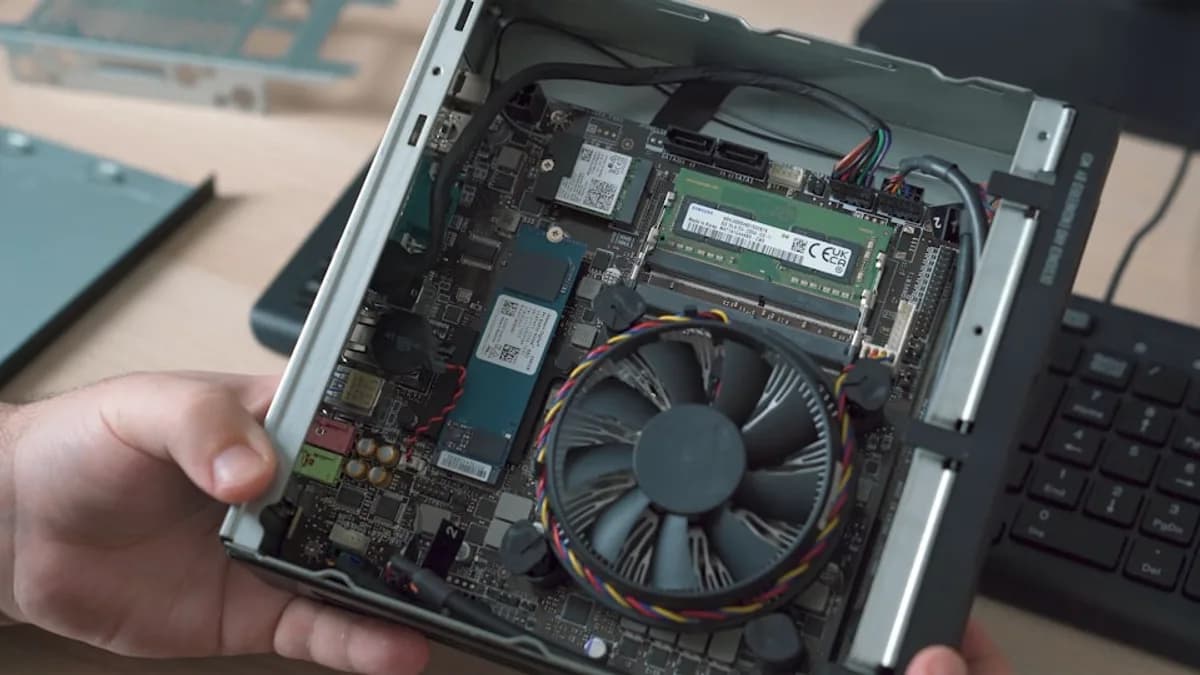
CNY 999, or about $147, now buys a barebone Beelink ME Pro NAS chassis with support for up to 68TB of storage — a price that pushes network storage closer to mini PC territory than traditional NAS appliance pricing.
The new 2-bay Beelink ME Pro configuration pairs an Intel Pentium Silver J5005 board with two SATA slots and two M.2 slots, according to Notebookcheck. That combination is the story. Beelink is not pitching a flagship processor. It is selling a compact storage box where the headline value sits in capacity, expandability, and price.
Beelink’s $147 NAS turns storage hardware into a mini PC-style purchase
The cheaper ME Pro configuration matters because it changes the buying question. Instead of asking whether a home NAS is worth several hundred dollars before drives, buyers can now ask whether a low-cost barebone box is good enough to become local storage, a backup target, or a small personal server.
That does not mean the CNY 999 price is the full ownership cost. It is the barebone option. Drives, memory, and setup decisions still sit with the buyer, and regional package details may vary.
The practical split is clear even without treating the entry price as a complete system price: pay less for the chassis-led starting point, then decide how much capacity, memory, and software configuration the final build actually needs.
The compact design is central to the pitch. The ME Pro is not trying to be a rack unit. It is closer to the small-form-factor PC logic MLXIO has tracked in adjacent hardware coverage, from Core 7 350 benchmarks exposing Intel’s budget-laptop bet to portable machines built around tight space and component trade-offs such as the 990g Lenovo ThinkBook 14x with OLED and dual SSD slots.
Two SATA bays and two M.2 slots create the 68TB headline
The Intel Pentium Silver J5005 is the processor listed for this lower-cost ME Pro configuration. It is not the kind of chip that turns a NAS into a workstation-class server, but that is not the main point of this model.
Storage is the stronger spec. The system is described with four internal storage positions:
| Slot type | Count | Role in the system |
|---|---|---|
| M.2 | 2 | SSD expansion or service/OS storage, depending on setup |
| SATA | 2 | Higher-capacity drive bays for bulk storage |
| Combined | 4 | Up to 68TB of supported storage |
That mix gives the ME Pro a useful structure. The two SATA bays handle the familiar NAS role of bulk capacity. The two M.2 slots add flexibility for solid-state storage or system use, depending on how the owner configures the box and what software stack is installed.
The source does not provide benchmarks, cooling data, or workload tests for this J5005 version. So the safe analysis is narrower: this looks like a storage-first configuration, not a performance-first one. The processor choice fits the low-power, low-cost positioning, while the storage layout does most of the selling.
The same caution applies to connectivity and real-world throughput. The headline hardware story is the CPU, two SATA slots, two M.2 slots, launch price, and 68TB support. Network behavior, transfer rates, OS handling, and expansion limits still need confirmation from fuller specifications or independent testing before buyers treat the box as proven for a specific workload.
The 68TB number is capacity support, not what buyers get in the box
The most important caveat is simple: 68TB is maximum supported storage, not included storage.
To approach that number, a buyer would need to populate the system with high-capacity drives and SSDs that match the device’s supported limits. That likely changes the total cost profile sharply, though the supplied source does not give drive pricing or a detailed capacity breakdown by slot. The barebone chassis is cheap. A filled NAS is not the same purchase.
Redundancy also changes the math. The source does not specify RAID modes or bundled NAS software behavior, so users should not assume a particular data-protection setup from the hardware spec alone. In practical terms, anyone buying this for important data needs to verify the software stack, backup plan, and recovery process before treating headline capacity as usable capacity.
This is where the ME Pro’s value becomes conditional. The CNY 999 entry price is attractive for buyers who already understand storage configuration. It is less decisive for buyers who need the entire system — drives, OS, remote access, permissions, backup schedules, and recovery tooling — to work with minimal intervention.
Modular boards are Beelink’s bigger bet
The cheaper ME Pro also sits inside a broader Beelink ME family story, where different models and processor options point to a more PC-like approach to NAS hardware. That broader direction matters, even if the available source material does not establish a user-swappable mainboard program for this specific low-cost configuration.
That distinction is important. Beelink appears to be treating NAS hardware less like a sealed appliance category and more like a small computer platform with multiple configurations. But buyers should be careful not to assume that means every ME Pro chassis can be upgraded by simply replacing the board later.
There is still a clear hardware-first philosophy here:
| Beelink ME Pro choice | What it signals |
|---|---|
| Multiple ME-family configurations | A broader lineup rather than one fixed NAS appliance |
| 2x SATA + 2x M.2 | Hybrid bulk storage and SSD expansion |
| Low-power J5005 option | Lower-cost entry point rather than maximum performance |
| Compact chassis | Space-saving design as a core selling point |
The unresolved issue is software. The source confirms the central hardware specifications and pricing, but it does not establish the user experience: bundled OS, update cadence, app quality, data-recovery tools, mobile access, or support process. For storage hardware, those details can matter as much as ports.
That is the same broader hardware-value tension seen across PCs: a spec sheet can look aggressive while the ownership experience depends on integration. MLXIO readers comparing component value across categories may recognize the same question raised by €450 cheaper ThinkBook Beats ThinkPad—So Why Pay Up?: when cheaper hardware closes the gap on specs, the premium case has to come from support, polish, or reliability.
Who benefits from this cheaper Beelink ME Pro configuration
The best fit is a technical home user who wants compact storage hardware and is comfortable making configuration choices.
Good fits include:
- Local backups: The 2-bay SATA layout gives room for high-capacity drives.
- Media storage: The storage ceiling is the appeal, not the CPU.
- Photo archives: The compact chassis suits desk or shelf placement.
- Self-hosted experiments: The M.2 slots give users room to test setups, subject to OS support.
- Hardware tinkering: The low entry price and PC-like configuration will appeal to users who prefer building around barebone hardware.
The weaker fit is a buyer who wants an appliance with no ambiguity. If setup, remote access, permissions, updates, and support need to be simple from day one, the ME Pro’s low price should not be the only decision point.
Small offices should be especially cautious. The source supports the hardware value story, not an enterprise reliability claim. A low upfront price does not remove the need for tested backups, access controls, encryption choices, and a clear recovery path.
The next test is not the chassis — it is the software and board roadmap
The Beelink ME Pro with Pentium Silver J5005 does not need to be the fastest NAS to be consequential. At CNY 999, it pressures the entry point for compact storage hardware and makes small NAS design feel less exotic.
The confirmation to watch is practical: whether Beelink’s broader ME-family approach turns into clear long-term configuration options, whether the software experience is usable enough for non-hobbyists, and whether independent testing shows the compact chassis can sustain expected storage workloads.
If those pieces hold, this ME Pro configuration becomes more than a cheap NAS. It becomes evidence that personal storage boxes are moving toward the same economics as mini PCs: compact, aggressively priced, flexible in layout, and increasingly dependent on software to separate the good buys from the false bargains.
The Bottom Line
- A $147 barebone NAS lowers the entry cost for home storage and backup setups.
- Support for up to 68TB makes the compact chassis relevant beyond basic file sharing.
- Buyers still need to budget for drives, memory, and configuration before it becomes a complete system.