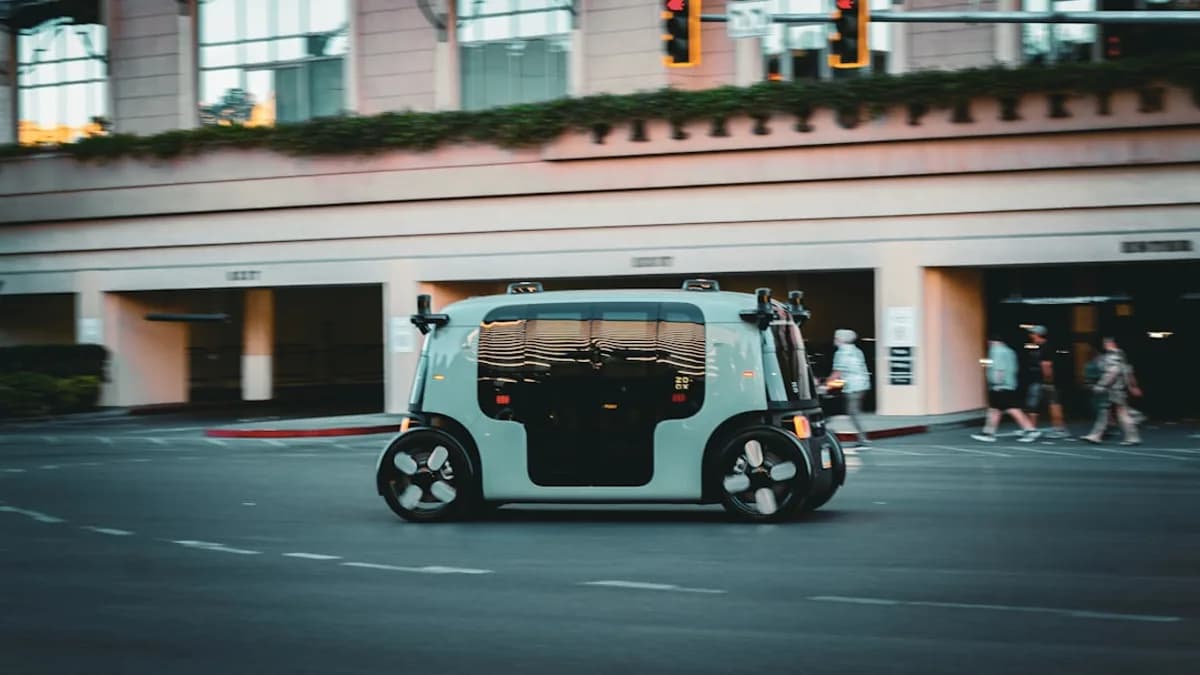
If Tesla can get roughly 300 miles of practical range from a 48 kWh Cybercab battery, the sharper question is not “how far can it drive?” but “how much idle time can Tesla cut out of a driverless fleet?”
That is the commercial signal inside the leaked specs reported by Notebookcheck. The filing pegs the Cybercab at a 48 kWh usable battery, 219 hp FWD motor, 3,113 lbs curb weight, 3,730 lbs GVWR, and 326V powertrain voltage. The eye-catching figure is the 418-mile Equivalent All-Electric Range, with 375 miles listed for highway range.
The number needs handling carefully. Notebookcheck says the actual EPA estimate on the dedicated EV range test is usually 25% lower than the Equivalent All-Electric Range entry. On that basis, the Cybercab would land around 300 miles on a charge — still far above the about 200 miles that Tesla chief engineer Lars Moravy had previously described.
That is where the “50% range increase” claim starts to matter. Not as consumer bragging rights. As fleet math.
Does the 418-mile figure really mean Tesla built a 400-mile robotaxi?
No. At least not in the practical sense.
The leaked 418-mile Equivalent All-Electric Range is not the same as a normal real-world robotaxi duty cycle. Notebookcheck explicitly flags that the dedicated EPA range estimate is usually 25% lower than the Equivalent All-Electric Range entry. That points to roughly 300 miles as the more useful working figure.
Still, that is a major jump from the prior about 200 miles target Moravy discussed. The surprise is not that Tesla found range through a giant pack. It is that the reported pack is only 48 kWh.
That keeps the Cybercab close to the battery concept Tesla floated three years ago in Master Plan 3, where a then-theoretical “compact” vehicle was listed with an LFP battery of 53 kWh. At that stage, Tesla was still associated with a smaller mass-market car concept often described as Model 2. The leaked Cybercab specs suggest Tesla redirected that compact-vehicle battery logic into a driverless, pedal-less two-seater instead.
For readers tracking how pre-release hardware leaks shape expectations before launch, this fits a broader pattern we have covered across consumer tech, from the 5,000mAh Galaxy S27 Pro leak to the Xiaomi 18 Pro LOFIC camera leak. The difference here is that a Tesla range leak does not just move product chatter. It changes assumptions about operating economics.
Can a 48 kWh pack and two-hour wireless charging work for a robotaxi?
The reported charging setup is just as important as the range.
Notebookcheck says the Cybercab wireless charging system would take about two hours for a full charge at this battery size. Tesla also kept the vehicle closer to the 400V architecture used by the Model 3 and Model Y, rather than the more modern 800V powertrain of the Cybertruck.
That choice makes sense only if Tesla does not expect Cybercab to depend on ultrafast public-style charging. A robotaxi designed without pedals or a driver also benefits from avoiding plug-in charging rituals. Wireless charging fits the concept better.
But the two-hour figure cuts both ways.
| Cybercab spec | What it suggests | What it does not prove |
|---|---|---|
| 48 kWh usable battery | Tesla is targeting efficiency over pack size | Final cost, chemistry, cycle life |
| 418-mile Equivalent All-Electric Range | Very high lab-style efficiency signal | 400 miles in real robotaxi service |
| ~300-mile implied EPA-style range | About 50% above the earlier 200-mile discussion | Actual fleet range in heat, cold, traffic, or high-mileage use |
| Two-hour wireless full charge | Charging can be automated around vehicle downtime | Peak-hour availability or depot capacity |
| 219 hp FWD motor | Strong output for a small two-seater | Acceleration tuning, durability, or ride profile |
MLXIO analysis: the key is not whether two hours is “fast.” It is whether Tesla can schedule those two hours when the vehicle would otherwise be idle. The source material does not provide utilization data, charging-pad density, or depot plans. So any claim that this automatically means fewer Cybercabs are needed would be too strong.
What the leak does support is narrower: more range gives Tesla more scheduling slack.
Is the real breakthrough range, aerodynamics, or the two-seat constraint?
The source points toward efficiency, not battery brute force.
Notebookcheck says the Cybercab would deliver more than six miles per kWh if the roughly 300-mile practical range estimate holds against a 48 kWh pack. For a U.S.-market EV, that would be an unusually high efficiency figure by the source’s framing.
The related executive comments explain how Tesla appears to be chasing that number. Moravy and Franz von Holzhausen have described the Cybercab’s shape and wheel treatment as central to the vehicle’s range target.
“This car is actually really unique in terms of its teardrop shape,” von Holzhausen said. “It’s actually quite narrow in the rear compared to the front. Obviously, you covered the discs, but the aero efficiency is a huge factor in getting to higher range with a smaller battery pack.”
Moravy also singled out the wheel-tire area:
“As much as Franz hates door handles, I hate the wheel-tire interaction, and this is really the best way for us to get the most aerodynamic wheel-tire we could get,” Moravy explains.
The two-seat layout matters here. A narrower rear, covered wheel areas, and a minimalist cabin are easier to justify when the vehicle is not trying to be a family car, airport shuttle, or general-purpose crossover.
That is the strategic shift. Tesla is not optimizing Cybercab around consumer reassurance. It is optimizing around a narrower job: move one or two people with as little energy and mechanical complexity as possible.
Does longer range make Tesla’s robotaxi business case credible?
It helps. It does not settle the case.
MLXIO analysis: if Tesla can combine roughly 300 miles of usable range, automated wireless charging, and reliable unsupervised driving, the Cybercab becomes easier to model as a high-throughput asset. More range can reduce the frequency of charging stops. Wireless charging can reduce manual handling. A small battery can protect vehicle cost versus a larger-pack design.
Each “if” is doing work.
The leak does not answer:
- Cost: No production cost, margin target, or retail economics are disclosed.
- Chemistry: Master Plan 3 referenced LFP, but the leaked specs cited by Notebookcheck do not settle all battery details.
- Degradation: Robotaxi use could mean heavy cycling, but the source gives no cycle-life or warranty assumptions.
- Charging losses: Wireless charging time is reported, but real operating efficiency is not fully established in the leak.
- Autonomy readiness: Battery specs do not prove driverless regulatory approval, safety performance, or remote-support requirements.
This is why the range number is best read as an enabler, not the breakthrough itself.
A 418-mile Equivalent All-Electric Range makes the Cybercab look more technically credible than a 200-mile expectation. A 48 kWh pack makes that credibility more interesting because it points to efficiency rather than battery excess. A two-hour wireless charge reinforces the driverless concept, but also raises practical questions about when and where those charges happen.
The next evidence that would strengthen the thesis is straightforward: confirmed EPA dedicated EV range, verified battery chemistry, wireless charging efficiency, production-ready pack durability, and a clear timeline for unsupervised operation. Evidence that would weaken it would be equally clear: a much lower final EPA range, slow or inefficient wireless charging in practice, or autonomy delays that leave the Cybercab as impressive hardware without the service model it was built to serve.
The Bottom Line
- A roughly 300-mile practical range would be a major improvement over Tesla’s earlier 200-mile Cybercab target.
- The leaked 48 kWh battery suggests Tesla may be targeting high efficiency rather than simply using a larger pack.
- Longer range could reduce charging downtime, which is critical for the economics of a driverless robotaxi fleet.