Can Microsoft justify turning the consumer Surface Pro 12 into a $1,499 starting-price machine before buyers have independent proof that Snapdragon X2 performance and battery life hold up outside Microsoft’s own claims?
That is the real question beneath this launch. The new Surface Pro 12 keeps the familiar detachable shape, but raises the ceiling hard: up to 64 GB of LPDDR5X RAM, up to 1 TB of M.2 2230 storage, 120 Hz OLED, and Qualcomm’s new Snapdragon X2 Plus or Snapdragon X2 Elite platform, according to Notebookcheck.
Microsoft is not just refreshing a tablet. It is asking buyers to treat a thin Windows detachable as a premium primary PC — and to pay accordingly.
Does the Surface Pro 12 Upgrade the Device, or Reprice the Category?
The most telling number is not the RAM ceiling. It is the base price.
The Surface Pro 12 starts at $1,499 with 16 GB of RAM, 256 GB of storage, a Snapdragon X2 Plus chipset, and an IPS display. Notebookcheck says that is 50% more than its predecessor. That changes the product’s burden of proof.
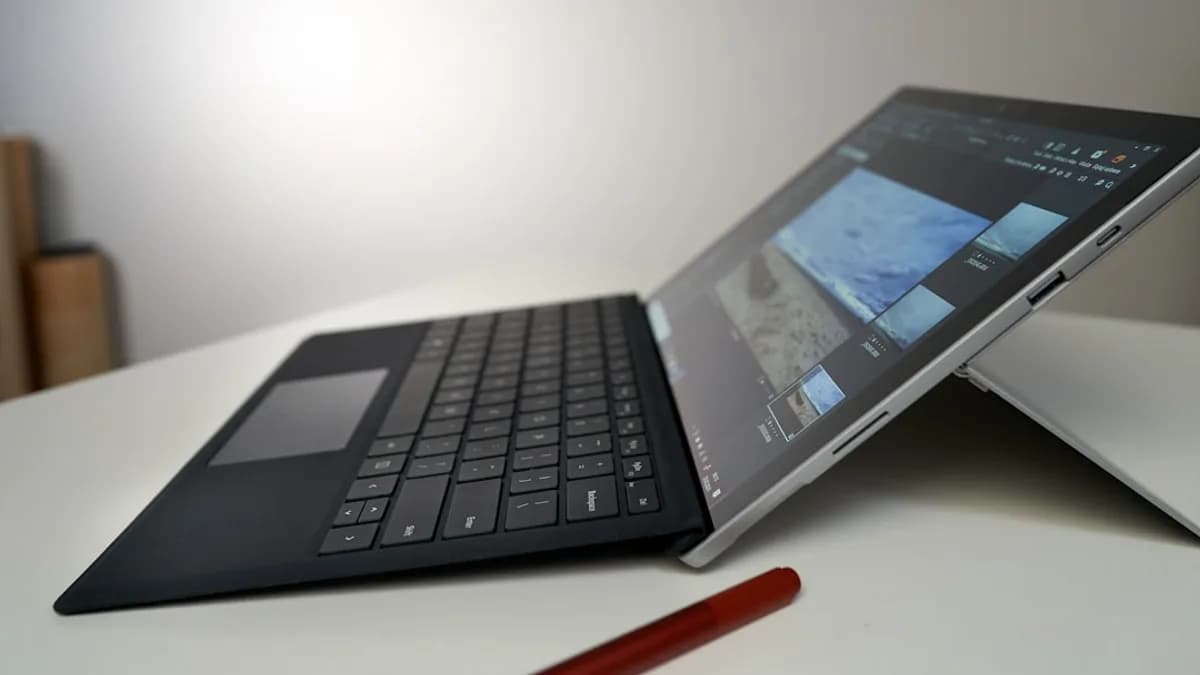
The physical device is not a major redesign. Microsoft keeps the broad Surface Pro 11 form factor, including a 13-inch screen, 2,880 x 1,920 resolution, 267 PPI, and a 3:2 aspect ratio. The chassis measures 287 x 209 x 9.3 mm and weighs 895 g, excluding the Type Cover or Flex Keyboard.
That matters because the pitch is not “new shape.” The pitch is “more capable internals in the same detachable idea.”
Microsoft claims up to 11.5 hours of “active web usage”, equal to a 15% battery life improvement over the Surface Pro 11.
That battery claim is meaningful, but narrow. “Active web usage” is not a full workday stress test. It does not answer how the device behaves when paired with high brightness, an OLED panel, background sync, heavier browser sessions, or Windows apps that are not equally optimized for Arm.
Why Does 64 GB of RAM Matter More Than the OLED Headline?
The 64 GB RAM option is the clearest signal that Microsoft wants the Surface Pro 12 judged against premium laptops, not casual tablets.
The available memory tiers are 16 GB, 24 GB, 32 GB, and 64 GB. Storage options are 256 GB, 512 GB, and 1 TB. On paper, that gives the Surface Pro line far more headroom than a basic productivity detachable needs.
MLXIO analysis: the high-memory configuration changes the conversation from “Can this run Office and a browser?” to “Can this replace a serious Windows laptop for buyers who value touch, pen input, and portability?” That does not mean the answer is yes. It means Microsoft has moved the spec sheet into that debate.
The display story is also stronger than a routine panel refresh. Both IPS and OLED options return, and both are 120 Hz panels with 600 nits peak brightness in SDR mode. The OLED option reaches up to 900 nits peak brightness in HDR mode, giving it the premium display advantage inside the lineup.
| Surface Pro 12 choice | What Microsoft is offering | Practical implication |
|---|---|---|
| IPS display | 120 Hz, 600 nits SDR | Lower-entry configuration, still high refresh |
| OLED display | 120 Hz, 600 nits SDR, 900 nits HDR | Premium screen option for buyers prioritizing contrast and HDR |
| RAM | 16 GB to 64 GB LPDDR5X | Wider range from mainstream productivity to heavier multitasking |
| Storage | 256 GB to 1 TB M.2 2230 | Configurable, but base storage remains modest for the price |
The missing piece is performance evidence. Microsoft is still vague on exact processor details beyond a 10-core Snapdragon X2 Plus and a 12-core Snapdragon X2 Elite. Until reviews test real workloads, the spec sheet cannot prove the Surface Pro 12 behaves like its price tag suggests.
How Does the Qualcomm Model Compare With Microsoft’s Intel Business Surface Pro 12?
The consumer Snapdragon launch lands after Microsoft’s Intel-based business Surface update.
In May, Microsoft launched the Surface Pro for Business 13-inch (12th Edition) with Intel Core Ultra Series 3 processors, as reported by The Verge. That model starts at $1,949.99 with an Intel Core Ultra 5, 16 GB of RAM, 256 GB of storage, and the regular 13-inch PixelSense LCD display.
The business model can climb to $4,399.99 with Core Ultra 7, 64 GB of RAM, and 1 TB of storage. It also offers OLED and 5G configurations. The Verge reported that Microsoft kept the same design as the prior model, including two USB-C ports with Thunderbolt 4 support, Surface Connect, Wi-Fi 7, Bluetooth 5.4, a 1440p Quad HD front-facing camera, and a 10-megapixel 4K rear-facing camera.
The Snapdragon consumer model starts lower than the Intel business version. But it is still expensive relative to the Surface Pro 11 starting point cited by Notebookcheck.
For readers tracking Microsoft’s broader premium Surface positioning, MLXIO has also covered adjacent Surface speculation in Surface Laptop Ultra Bets 128GB on MacBook Pro Fight and the pricing debate around €2,299 Surface Laptop 8 Leak Puts Microsoft on Trial. The common thread is clear: Microsoft’s high-end Surface hardware is moving toward bigger memory ceilings and higher entry prices.
Is This a Better Laptop Replacement, or Just a More Expensive Detachable?
The Surface Pro 12’s biggest risk is that the old Surface trade-off still applies.
The device weighs 895 g without its keyboard. That figure is attractive for a 13-inch Windows machine, but the keyboard remains outside the quoted weight and, in many buying decisions, outside the mental base price. Notebookcheck notes that the Surface Pro 12 comes in Black, Dune, and Platinum, with color-matching Flex Keyboard accessories.
That accessory dependency is not a footnote. A Surface Pro without a keyboard is not equivalent to a laptop for most buyers. A Surface Pro with a keyboard is closer to the laptop-replacement promise Microsoft has pursued for years, but the total package depends on configuration and accessory pricing not fully captured by the $1,499 starting point.
MLXIO analysis: the Surface Pro 12 looks strongest for buyers who specifically need the overlap — Windows, touch, pen support, a detachable screen, premium display options, and unusually high RAM for the form factor. It looks weaker for anyone who mainly wants the cheapest high-performance clamshell.
The 15% battery improvement also needs context. It is a claim against the Surface Pro 11, not an independent test. If real-world reviews show the gain holds across mixed usage, the Snapdragon X2 model becomes much more credible. If the gain appears only in narrow web scenarios, the higher price becomes harder to defend.
What Evidence Will Decide Whether Surface Pro 12 Resets Windows Detachables?
The Surface Pro 12 is a more ambitious device than its unchanged shell suggests. Microsoft has paired a familiar design with a much more premium configuration ladder: Snapdragon X2, 64 GB RAM, 120 Hz OLED, and a higher base price.
That combination gives Microsoft a cleaner story for a premium Windows detachable. It does not yet give buyers the final answer.
The decisive evidence will come from four areas:
- Battery testing: whether the claimed 11.5 hours of active web usage translates into convincing mixed-use results.
- Performance data: whether the 10-core Snapdragon X2 Plus and 12-core Snapdragon X2 Elite justify the premium configurations.
- Display trade-offs: whether the OLED option’s 900 nits HDR advantage is worth the likely higher configuration cost.
- Total cost: whether the device, keyboard, and preferred specs land at a price that still makes sense against Microsoft’s own Intel business models.
For now, the Surface Pro 12 signals a sharper Microsoft bet: the detachable Windows PC can move upmarket if battery life, memory, and display quality rise together. The watch item is whether independent reviews confirm that this is a better machine in daily use — not just a more expensive Surface with a stronger spec sheet.
The Bottom Line
- Microsoft is positioning the Surface Pro 12 as a premium primary PC, not just a detachable tablet.
- The $1,499 starting price raises expectations for Snapdragon X2 performance and battery life.
- Buyers may want independent reviews before trusting Microsoft’s 11.5-hour battery claim.