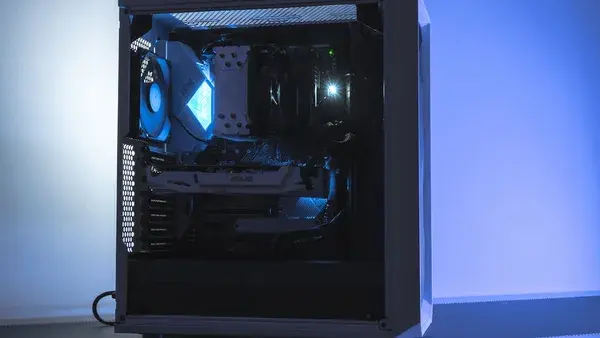
Valve did not just soften a spec claim; it quietly admitted that the new Steam Machine cannot carry the weight of its own living-room promise.
According to Notebookcheck, Valve changed the Steam Machine store-page language from “4K gaming at 60 fps” to “up to 4K gaming with FSR 4.1” after reviews questioned whether the mini PC could consistently hit that target in demanding games. That is not a harmless wording tweak. It changes the product from a clean console alternative into a caveat machine.
The problem is not that every game must run at native 4K/60. Serious buyers know performance varies by title, engine, settings, RAM configuration, and upscaling. The problem is that Valve is asking buyers to accept PC-style uncertainty while paying a price that invites console comparisons. The 512GB model costs $1049 without a controller. At that number, “up to” does a lot of uncomfortable work.
For readers tracking how this price became the center of the debate, MLXIO’s earlier context on Steam Machine Hits $1,049 — Valve Ditches Console Pricing now looks even more relevant. The performance claim changed. The pricing problem did not.
Valve’s 4K Steam Machine retreat exposes a pricing problem, not just a performance problem
The original pitch sounded simple: put a Steam-powered box under the TV and get 4K gaming at 60 fps. That is the kind of phrase that sells hardware to people who do not want to manage presets before they play.
The revised pitch is narrower:
Valve originally advertised “4K gaming at 60 fps.” Now, it reads “up to 4K gaming with FSR 4.1.”
That small edit matters because it moves the Steam Machine from promise to possibility. “Up to” means the best-case scenario. FSR 4.1 means the path to 4K may depend on AMD’s upscaling technology, where a game renders at a lower internal resolution before being reconstructed for a 4K output.
That can be useful. It can also be overused as marketing cover.
Valve’s real challenge is expectation control. If the Steam Machine is mostly a 1080p or 1440p machine for current AAA games, that is not a technical failure by itself. But it is a strategic problem when the hardware sits near PC pricing while chasing console convenience.
The revised 4K/60 fps claim weakens the Steam Machine’s core living-room pitch
4K/60 fps has become a shorthand for modern couch gaming. It is not always literal. Console games use tricks, dynamic resolution, and carefully tuned performance modes. But the buyer-facing promise is still clear: plug it into a big TV and get a polished result.
Valve’s new language makes that promise foggier.
The Steam Machine now comes with implied conditions: game compatibility, graphics settings, upscaling quality, target frame rate, and whether FSR 4.1 is ready in time for release. Notebookcheck says it is unclear whether FSR 4.1 will be ready for the hardware’s release date, even though it produces cleaner images.
That uncertainty cuts against the whole point of a living-room box. PC players may accept settings management. Some enjoy it. Console buyers generally do not want a performance negotiation before every game.
The before-and-after is stark:
- Before: “4K gaming at 60 fps” suggested a firm target.
- After: “up to 4K gaming with FSR 4.1” signals conditional performance.
- Before: the Steam Machine sounded like a console-style answer.
- After: it sounds more like an entry-level gaming PC with better couch manners.
That is a very different product story.
Reviews made clear that 1080p and 1440p are the realistic Steam Machine targets
The reported review pattern is not that the Steam Machine is useless. It is that the box appears capable within limits, and those limits show up fast when modern AAA games are pushed toward 4K/60.
Notebookcheck says reviews found the system struggles with many AAA games at that setting. Less demanding or older titles may run at 4K without frequent frame rate drops. For newer or heavier games, 1080p-1440p is described as the more reasonable goal.
That should have been the pitch from the start.
There is nothing shameful about a compact SteamOS machine that targets 1440p with sensible settings. Many buyers could live happily there. But when the marketing atmosphere points higher, buyers judge the hardware against the claim, not against the more modest truth revealed later.
FSR can help. Lower settings can help. Game-by-game tuning can help. But those are tools, not replacements for clear performance claims. If the experience depends on upscaling and compromise, Valve should say that plainly instead of letting “4K” do the emotional selling.
This also reframes the earlier uncertainty around the product’s rollout captured in MLXIO’s Steam Machine Hype Hits a Wall: No Price, No Date Yet. The missing piece was never just a date. It was whether Valve could make the value case once reviewers tested the claim.
The PS5 comparison is brutal because Sony sells consistency, not configuration menus
The most damaging comparison is not a custom-built gaming PC. It is the PS5.
Notebookcheck says that, for many hundreds of dollars less, the PS5 delivers similar or better frame rates in examples like Forza Horizon 5. That is the sentence Valve should worry about. Not because Sony’s machine is more flexible. It is not. Not because it offers Steam libraries, modding potential, or the PC catalog. It does not.
The PS5 wins the comparison because it sells confidence.
A console buyer expects games to arrive with tuned settings, clear modes, and a predictable baseline. The hardware may use optimization tricks, but the user does not have to think about them. That is part of the purchase.
The Steam Machine is exposed when its output lands near console performance but its price lands closer to PC territory. Valve wants credit for PC freedom and console simplicity. At $1049 without a controller, it cannot afford to look weaker than either side of that hybrid pitch.
There is a partial defense here. Notebookcheck notes that console prices are also under pressure, with the Xbox Series X starting at $749 after Microsoft raised MSRP again. The report also says Sony may follow with another price increase. That could make Valve’s price look less isolated.
But “less isolated” is not the same as compelling. A buyer staring at the Steam Machine still has to ask what the extra money buys if the practical target is 1080p or 1440p.
Valve is asking mainstream buyers to pay a premium for SteamOS flexibility
The Steam Machine’s best argument is not raw performance. It is access.
For existing Steam users, the appeal is obvious. A living-room SteamOS box can pull from an existing library, preserve the comfort of a familiar storefront, and potentially make PC gaming feel less like desktop maintenance. That matters for people already invested in Steam.
Valve also has credibility in hardware. The company describes its devices as ways to “expand and improve gaming on the PC,” and its modern hardware push includes products like the Steam Deck, Valve Index, Steam Controller, and Steam Link. The Steam Machine fits that pattern: bring PC gaming to places where Windows towers do not belong.
Still, this is where the sales pitch narrows. Steam loyalists may accept the premium because the box serves their library. Mainstream TV gamers may not. If the main use case is high-resolution plug-and-play gaming, Valve has to compete against machines built exactly for that job.
Notebookcheck also points to a hardware compromise that complicates the value story. Valve acknowledged it was not well-positioned to stockpile RAM and storage. It chose against a dual-channel DDR5 configuration so it could source more available 16GB modules. Reviews say that decision has a slight impact on Steam Machine performance, especially in CPU-intensive titles.
That is understandable. It is also not the buyer’s problem.
The strongest defense of the Steam Machine is that specs are only part of Valve’s strategy
The fair counterargument is that Valve is not trying to beat PlayStation in a spec-sheet knife fight. It is trying to put Steam in the living room with a smaller, quieter, more console-like PC.
That strategy has merit. A Steam Machine that runs many games well, wakes quickly, feels polished, and makes a large Steam library comfortable on a TV could still find an audience. For players who already own a deep PC catalog, the value calculation is different from someone starting fresh.
There is also room for the experience to improve after launch. The supplied reporting does not prove which fixes will arrive or how much they will help, so Valve should not get free credit for future gains. But software-driven devices are not frozen on day one in the same way a static benchmark chart suggests.
The stronger defense, then, is not “4K/60 was always fine.” It is that the Steam Machine may be judged by convenience, library access, acoustics, design, and SteamOS polish as much as by peak resolution.
That defense only works if Valve stops implying more than the hardware can reliably deliver.
Valve should reset Steam Machine marketing around honest resolutions and real value
Valve’s best move now is not to fight reviewers over semantics. It should reset the pitch around the product the Steam Machine appears to be: a premium, compact 1080p/1440p Steam console alternative with selective 4K capability through upscaling and lighter games.
That would be more honest. It might even be more persuasive.
Valve should give buyers clearer game-by-game expectations. Show recommended settings. Label FSR-dependent 4K results as such. Separate native performance from upscaled output. Stop letting one headline number carry the burden of a complicated device.
The next thing to watch is whether Valve treats this store-page edit as the end of the correction or the start of a cleaner marketing strategy. If it keeps selling “up to 4K” while reviewers keep steering buyers toward 1440p, the trust gap will widen.
Valve can still make a credible living-room PC. But at $1049, credibility has to come before ambition. If Valve wants the Steam Machine under the TV, it must sell trust before it sells teraflops.
The Bottom Line
- Valve’s wording change weakens the Steam Machine’s pitch as a simple living-room gaming box.
- At $1049 without a controller, buyers may expect more reliable 4K/60 performance.
- The shift highlights the tension between PC flexibility and console-style consumer expectations.