Why is Oppo building an iPhone accessory that makes Apple’s rear cameras easier to use for selfies?
The short answer: Oppo’s upgraded Bubble Trendy Selfie Screen turns the back of an iPhone into a previewable shooting surface. The longer answer is more interesting. The accessory, now compatible with every iPhone from the iPhone X onward, gives users a small magnetic circular AMOLED touchscreen for framing photos with the phone’s rear cameras, according to Notebookcheck.
That matters because the Bubble is no longer just a quirky add-on for Oppo phones. It is now aimed at iPhone users too — at the same CNY 499 (~$73) China preorder price as the original Oppo version.
Why would iPhone users want a magnetic selfie screen on the back?
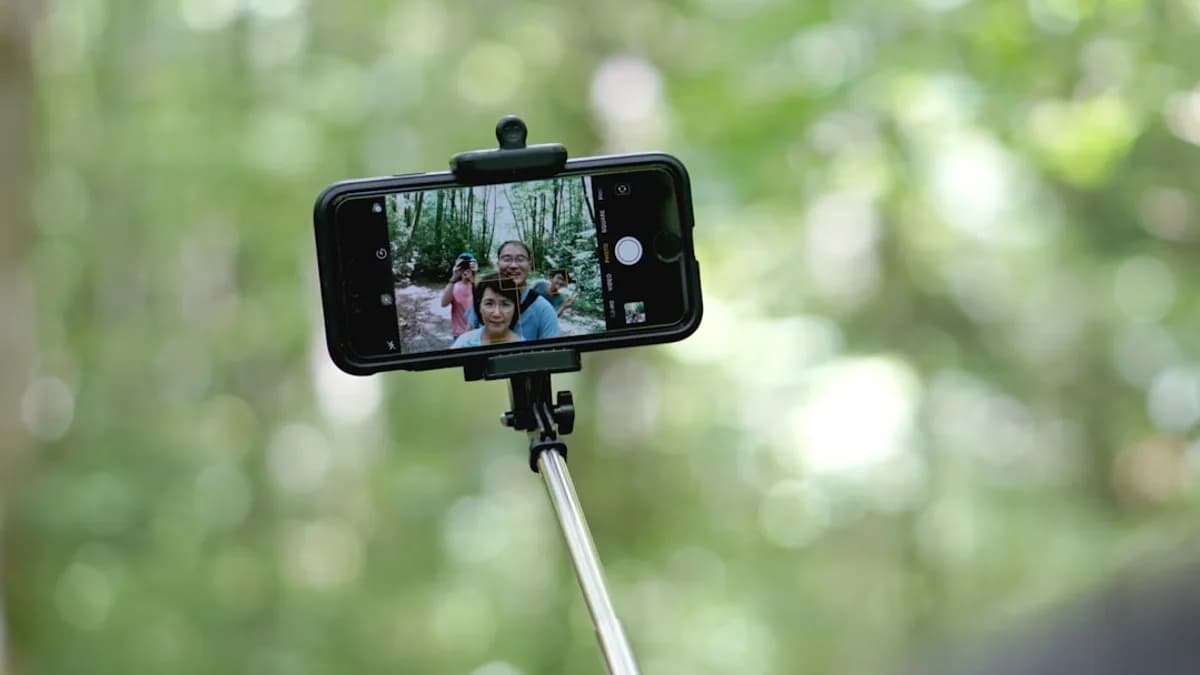
The obvious reason is framing. Rear-camera selfies are awkward because the person holding the phone cannot see the main display. That makes composition a guess: faces get cropped, backgrounds miss the point, and group shots turn into trial-and-error.
The Bubble attacks that problem directly. It attaches magnetically to the back of the phone and gives users a small screen for checking the shot while using the rear cameras. The original Oppo model was built around that idea for select Oppo phones, including the Reno 16 and Find X9 series. The new version extends the concept to iPhones.
There is also a second, stranger appeal: the Bubble is not only a camera accessory. It can display photos or videos and can be clipped to a backpack or key ring as a decorative pendant. That makes it part shooting tool, part wearable trinket.
For Oppo, the iPhone compatibility is the move that changes the story. A phone accessory that only works with select Oppo models is a niche product. A version that supports iPhone X and newer reaches a much larger iPhone installed base, even if Oppo has not announced a global release.
For more Oppo device context, MLXIO has recently covered the company’s broader phone lineup in Reno 16 Global Launch Signals Oppo Is Done Waiting and Oppo Find X9s Pro Beats iPhone, Trips on Key Basics.
What exactly is Oppo’s Bubble for iPhones?
The Oppo Bubble Trendy Selfie Screen is a small secondary display, not a second phone screen in the productivity sense. It is not meant to become an external monitor for spreadsheets, apps like Pages, Keynote, and Numbers, or multitasking.
Its core job is simpler: help users preview and trigger camera shots.
The iPhone-compatible Bubble:
- Display: Uses a circular AMOLED touchscreen
- Attachment: Connects magnetically to the back of the phone
- Camera use: Lets users take photos with either the front or rear cameras once paired
- Remote use: Works as a standalone remote shutter from up to 10 meters away
- Battery: Packs a 550 mAh rechargeable battery
- Size: Measures 7 mm thick
- Weight: Comes in at 27.5 grams
- Extras: Ships with a protective case and key ring
- Price: Costs CNY 499 (~$73) in China
- Shipping: Begins July 6
- Availability: Oppo has not announced a global release
That mix explains the product’s odd charm. It is practical enough to solve a real camera-framing problem, but deliberately playful enough to be worn or displayed when it is not attached to a phone.
How does the Bubble help iPhone owners take rear-camera selfies?
The workflow is straightforward. Attach the Bubble magnetically to the iPhone, pair it, and use the tiny rear display to check framing while taking a photo. Notebookcheck says users can take photos with either the front or rear cameras once the accessory is paired.
That matters because rear-camera selfies usually force a compromise. Use the front camera and you can see yourself. Use the rear cameras and you get the benefit of the main camera system, but you lose the screen.
The Bubble gives back that missing preview.
A practical example: a user sets an iPhone on a small stand, steps back, and uses the Bubble as a remote shutter from up to 10 meters away. Instead of relying only on a timer, they can trigger the shot remotely. For group photos, that could reduce the usual cycle of setting the timer, running into frame, checking the result, and trying again.
But there are caveats. Oppo’s disclosed details do not answer every operational question for iPhone owners.
- App support: The source does not specify which iPhone camera app flow is required.
- Latency: Oppo has not detailed preview delay.
- Battery life: The battery capacity is listed as 550 mAh, but runtime is not provided.
- Magnetic fit: The accessory attaches magnetically, but real-world alignment across iPhone models and cases still needs hands-on testing.
- Video use: The supplied source supports photo-taking with front or rear cameras on iPhone, but does not clearly confirm rear-camera video preview for iPhones.
That last point matters. The Bubble looks like a creator tool, but based on the available source material, its confirmed iPhone camera function should be treated as photo-focused until Oppo says more.
What could an iPhone user actually do with it day to day?
A concrete use case: someone traveling alone wants a photo in front of a landmark without handing the phone to a stranger. They attach the 27.5-gram Bubble, position the iPhone, step back within the 10-meter remote range, and use the accessory to trigger the shot.
That is the cleanest case for the product. It solves a narrow but common problem without requiring a bulky monitor or a second device.
Another scenario is a group selfie. Instead of using the front camera and hoping the framing works, the user can point the rear cameras toward the group and use the Bubble to check whether everyone is inside the frame. The source does not specify lens-level behavior, so it is safer to describe this as rear-camera framing rather than assuming a specific iPhone lens.
The pendant mode gives the accessory a second life. When not attached to the phone, it can be clipped onto a backpack or key ring and used as a decorative display. That does not make it essential. It does make it less likely to sit unused in a drawer after the novelty wears off.
The limitation is just as clear: a tiny screen helps with framing, but it does not replace a tripod, lighting, audio gear, or a larger monitor. Its value is convenience, not production control.
How does Oppo’s Bubble compare with simpler iPhone selfie tools?
The Bubble sits between a phone feature and a creator accessory. It is more specialized than just flipping to the front camera, but less expansive than a full external monitor setup.
| Option | Strength | Trade-off |
|---|---|---|
| iPhone front camera | Easiest way to see yourself | Does not use the rear-camera framing workflow the Bubble is built for |
| Rear camera without preview | Uses rear cameras | Framing is mostly guesswork |
| Timer or remote shutter alone | Simple and cheap | Does not solve previewing the shot |
| Oppo Bubble for iPhone | Adds rear-side preview and remote shutter use up to 10 meters | China-only preorder for now; unanswered app, latency, and runtime details |
| Full external monitor-style setup | Better for controlled shooting | Bulkier and outside the Bubble’s playful design goal |
The Bubble’s strongest argument is compactness. At 7 mm thick and 27.5 grams, it is not trying to become a rig. It is trying to make rear-camera self-shooting less annoying while doubling as a cute object.
That also defines its ceiling. This is not a must-have iPhone accessory for everyone. It is a niche device for people who regularly take self-framed photos, like small magnetic gadgets, or want something that works as both a tool and a visual accessory.
Which questions will decide whether the iPhone Bubble matters beyond China?
The first question is availability. Oppo says the iPhone-compatible Bubble is available to preorder in China for CNY 499 (~$73), with shipping starting July 6, but there is no announced global release.
The second is execution. The spec sheet is promising, but the day-to-day experience will depend on pairing reliability, camera-app behavior, magnetic fit with cases, preview quality, and battery life. Those details are not settled by the launch information.
The third is whether Oppo treats iPhone support as an experiment or a broader accessory strategy. The source only confirms this product. Anything beyond that is still inference.
For now, the practical takeaway is simple: if the Bubble ships outside China with smooth iPhone pairing and reliable rear-camera preview, it could become a clever small accessory for self-framed photos. If not, it remains what it already is on paper — a charming, inexpensive China-market gadget with one very specific job.
Key Takeaways
- The accessory lets iPhone users frame selfies with higher-quality rear cameras instead of guessing composition.
- Oppo is expanding a niche phone accessory beyond its own devices to reach a much larger iPhone user base.
- The Bubble blends camera utility with decorative wearable features, making it both a gadget and a style accessory.