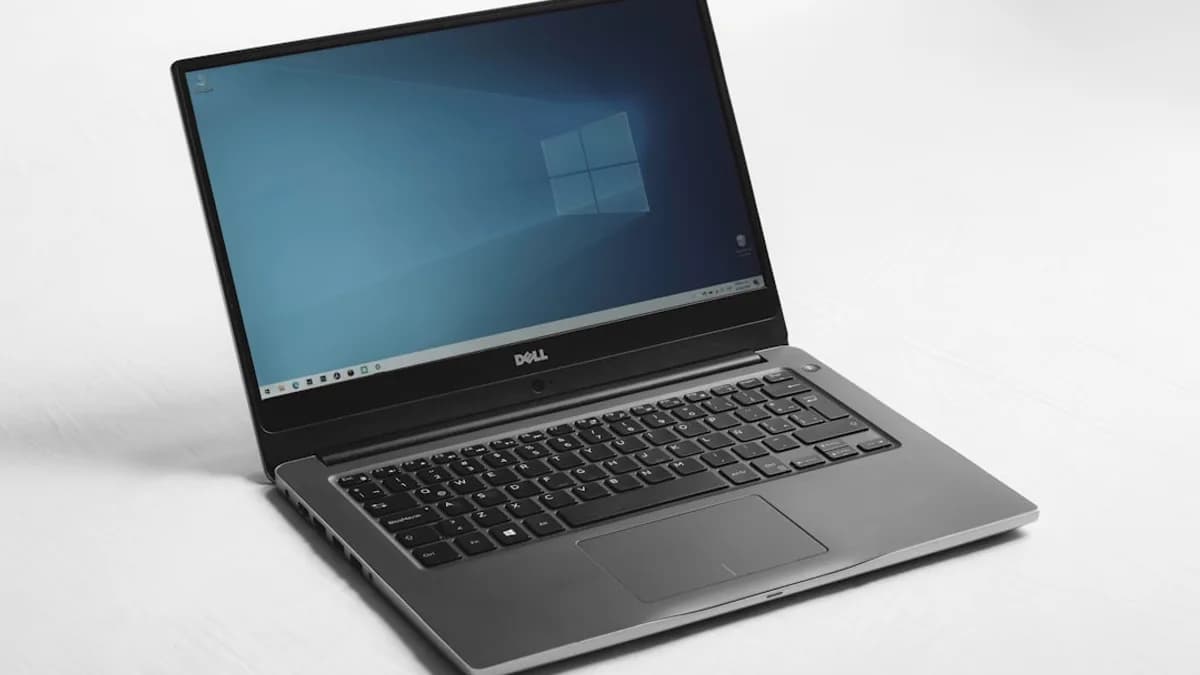
MSI’s Prestige 13 AI+ weighs around 900 grams yet still posts roughly 12 hours in Notebookcheck’s Wi-Fi test, which makes it a direct challenge to the idea that a serious work laptop has to start at 14 inches. That matters most to mobile professionals who want a primary machine, not a travel backup with a premium shell and tablet-class compromises.
The MSI Prestige 13 AI+ A3MG review shows a 13-inch subnotebook with two Thunderbolt 4 ports, an Intel Core Ultra 9 386H, Graphics 4 Xe3, and a battery just under 54 Wh, according to Notebookcheck. The more interesting part is not any single spec. It is the balance: low weight, usable battery life, modern ports, and CPU/GPU results that do not collapse just because the chassis is tiny.
Notebookcheck describes the machine as an “exceptionally good 13-inch subnotebook” with “virtually zero compromises.”
Mobile professionals get a 900-gram laptop that does not read like a stripped-down travel machine
The core claim around the Prestige 13 AI+ is simple: MSI has made a very small notebook feel less like a second device. For buyers who fly, commute, or move between desks all day, the weight matters before the benchmark chart does. At roughly 900 grams, this is far below many premium 13- and 14-inch machines, while still retaining features Notebookcheck says could “easily be mistaken for those of a larger laptop.”
Where does the old ultralight trade-off usually appear first? Ports, battery, or sustained performance. MSI appears to have attacked at least two of those pressure points. The presence of two Thunderbolt 4 ports keeps the machine viable for docks and modern peripherals, while the Wi-Fi battery result of around 12 hours suggests the small battery does not automatically make the laptop fragile away from an outlet.
That said, the battery is the clearest compromise. Notebookcheck says the capacity is just under 54 Wh, while competitors range from 60 to 92 Wh. The Prestige 13 AI+ gets its mobility partly by carrying less battery mass. The achievement is that it still turns that smaller pack into respectable runtime.
Buyers should read the benchmark spread, not the AI badge
The Core Ultra 9 386H gives the Prestige 13 AI+ real CPU credibility, but it does not win every table. Notebookcheck’s aggregate CPU Performance rating puts the MSI at 72 pt. That is ahead of the Asus ZenBook 14 OLED UM3406K with Ryzen AI 7 350 at 68.8 pt, but behind the Honor MagicBook Pro 14 2026 with Core Ultra 5 338H at 81.8 pt and the Asus Zenbook A14 UX3704NA with Snapdragon X2 Elite X2E-88-100 at 76.6 pt.
So what should a buyer actually take from the numbers? Not that the MSI is the fastest machine in the comparison set. Rather, it lands in the performance band of larger or heavier rivals while staying dramatically portable.
| Test / rating | MSI Prestige 13 AI+ A3MG | Relevant comparison from source |
|---|---|---|
| CPU Performance rating | 72 pt | Ryzen AI 7 350 model: 68.8 pt |
| Cinebench R23 Multi Core | 12144 Points | Ryzen AI 7 350 model: 12647 Points |
| Cinebench R23 Single Core | 2077 Points | Honor Core Ultra 5 338H: 2044 Points |
| Geekbench 6.6 Multi-Core | 13776 Points | Ryzen AI 7 350 model: 13350 Points |
| Geekbench 5.5 Single-Core | 2104 Points | Ryzen AI 7 350 model: 2077 Points |
The graphics story is similar. Notebookcheck says the integrated Graphics 4 Xe3 performs at around the level of the Radeon 860M. In Cyberpunk 2077 at 1920x1080 Low Preset, the MSI reaches 37.3 fps, close to the Ryzen AI 7 350/Radeon 860M system at 37 fps. At 1920x1080 Medium Preset, it posts 28.8 fps.
That is not a gaming-laptop result. It is evidence that integrated graphics in a sub-1kg work machine can handle more than display output and video calls.
MSI’s engineering bet is redistribution, not magic
Small laptops succeed when the compromises are placed where users feel them least. MSI cannot escape physics. A compact chassis has less room for cooling, battery, speakers, service access, and high-power components. But the Prestige 13 AI+ shows a smarter version of the ultralight formula: cut weight, keep modern connectivity, use a power-efficient chip, and avoid turning the port layout into a dongle tax.
Is this more impressive than simply making a thin laptop? Yes, because thinness alone often makes a device worse. The useful part is that Notebookcheck points to both portability and functionality. The machine weighs significantly less than rivals in some cases, yet the reviewer still highlights the ports and processor rather than apologizing for them.
The battery decision shows the trade clearly. A larger pack could have delivered more endurance, but it would also have pushed against the weight target. MSI chose mobility first, then relied on the Panther Lake chip’s moderate power consumption to preserve good runtime.
For readers tracking MSI’s broader small-form-factor push, this fits the same design tension we covered in 128GB MSI Cubi NUC AI+ 3MG Squeezes More Into Less: shrinking hardware is easy to market, but hard to do without cutting the wrong corners.
Small-laptop makers are no longer trapped in the netbook bargain
The Prestige 13 AI+ is not a return to the old small-laptop bargain, where buyers accepted cramped performance for a lighter bag. The Notebookcheck data points to a different phase: compact machines can now sit close to mainstream productivity performance if the chip, cooling, and battery strategy line up.
What changed in practical terms? The CPU can deliver strong single-core results, integrated graphics can approach lower-end gaming viability in selected settings, and battery life can stay credible even with a sub-54 Wh pack. The result is a 13-inch laptop that no longer needs to be framed as a compromise device for email and browser tabs only.
The “AI” branding should still be treated carefully. The supplied data supports the Prestige 13 AI+ as a capable compact Windows laptop. It does not, by itself, prove that AI features are the main reason to buy it. Conventional CPU, GPU, battery, weight, and port results are doing the heavy lifting in this review.
Travelers, creators, IT teams, and students will value different compromises
Frequent travelers will see the cleanest case. Around 900 grams, around 12 hours in Wi-Fi testing, and Thunderbolt 4 are enough to make the Prestige 13 AI+ credible as a daily carry machine. If the laptop spends more time in airports, trains, meeting rooms, and hotel desks than on one fixed workstation, the weight saving is not cosmetic.
Creators should be more selective. The source supports strong CPU results and integrated GPU performance near Radeon 860M territory, but it does not show that this is a workstation substitute. Anyone working with sustained rendering, heavy video timelines, or GPU-bound tasks should care about thermals and long-duration performance more than peak convenience.
Can IT buyers treat this as a fleet machine? The supplied material does not give enough detail on manageability, warranty support, repairability, or security configuration. That leaves an open question for business deployments, even if the hardware profile looks attractive for executives and mobile staff.
Students and hybrid workers may sit in the middle. The Prestige 13 AI+ looks strong for writing, research, calls, multitasking, and light creative work. Skeptics will still ask whether a slightly larger machine with a bigger battery and more thermal headroom is a better value. That same premium-device tension is showing up across the Windows laptop category, including our coverage of the €2,299 Surface Laptop 8 Leak Puts Microsoft on Trial.
Rival ultraportables now have to defend efficiency, not just horsepower
The Prestige 13 AI+ does not eliminate every ultralight compromise. The battery is smaller than the 60 to 92 Wh range Notebookcheck cites for competitors. The Core Ultra 9 386H also performs better in some competing models, which suggests MSI’s tiny chassis may not extract the absolute maximum from the silicon.
But the signal is still important. Premium ultraportables are increasingly judged on performance-per-gram and performance-per-watt, not just benchmark rank. MSI’s machine makes the case that a 13-inch, sub-1kg laptop can be a primary productivity device for many users if the workload fits.
The next evidence to watch is not a louder AI claim. It is whether future 13-inch systems can pair this weight class with larger effective battery life, steadier sustained performance, and fewer unresolved trade-offs in cooling and ergonomics. If that happens, “ultralight” will stop sounding like a warning label.
Key Takeaways
- The MSI Prestige 13 AI+ challenges the idea that a capable work laptop needs a 14-inch or larger chassis.
- Its roughly 900-gram weight and around 12-hour Wi-Fi battery result make it appealing for frequent travelers and commuters.
- Two Thunderbolt 4 ports and Intel Core Ultra 9 hardware help it avoid the usual ultralight compromises.