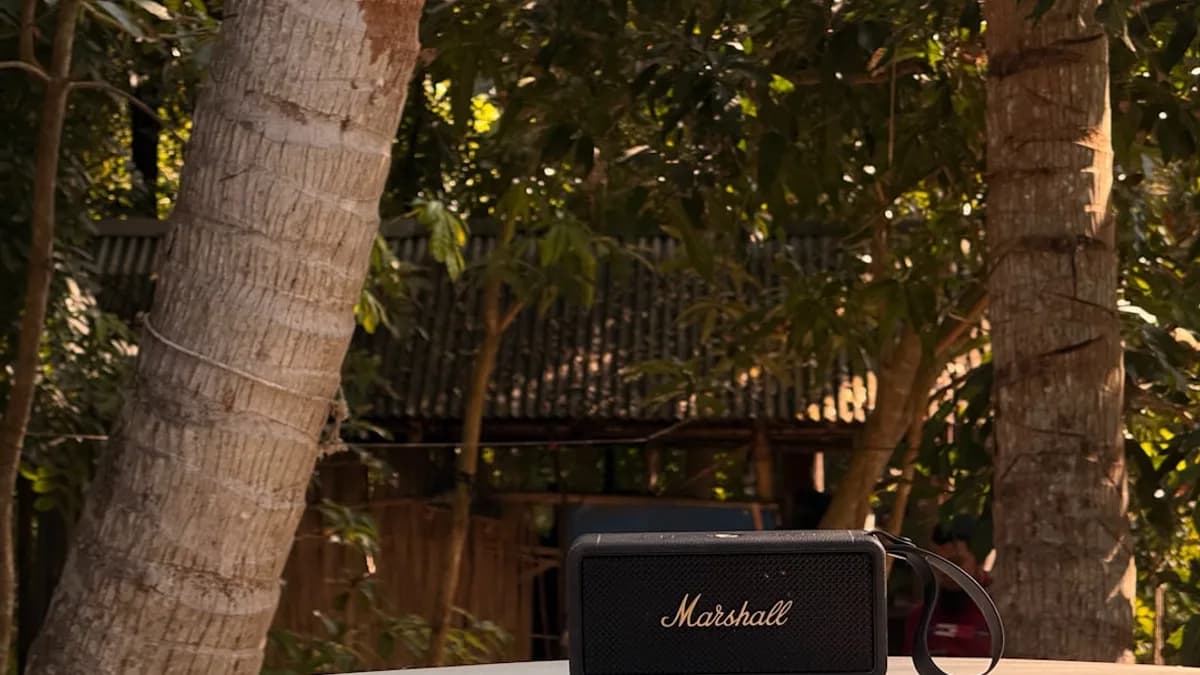
Marshall is asking buyers to treat a seven-year gap as patience, not neglect.
The Stockwell III arrives as the successor to the Stockwell II, a compact upright Bluetooth speaker that dates back to 2019, according to Notebookcheck. That timing matters. A portable speaker refresh after seven years is not just a spec update. It is a test of whether Marshall’s amp-style identity still carries premium weight in a category now judged by battery life, durability, USB-C, spatial audio claims, and repairability.
The headline changes are not cosmetic. Marshall has added true 360-degree omnidirectional sound, rated battery life of over 40 hours, IP55 dust and water resistance, a new driver setup, and USB-C power-bank-style phone charging from the speaker’s battery. The company has kept the retro hardware language too: brass dials, grille-heavy styling, and physical controls that look closer to stage gear than consumer electronics.
That combination is the whole bet. Marshall is not trying to disappear into the same rounded Bluetooth speaker template as everyone else. It is trying to make design part of the performance argument again.
A seven-year silence turns Stockwell III into a test of Marshall’s premium speaker discipline
The Stockwell III is not arriving into the same buying environment the Stockwell II left behind. In 2019, Marshall could lean heavily on its guitar-amp-inspired design, portable form factor, and battery life. In 2026, the question is sharper: does the speaker solve enough practical problems to justify its premium position?
Notebookcheck describes the old Stockwell II as a 1.3 kg upright Bluetooth speaker in Marshall’s iconic amp-style design. Mashable lists the new model at 2.9 pounds, which is broadly in the same portable class. This is still a carry-around speaker, not a party box.
The upgrade thesis is clear:
- Endurance: Battery life rises from 20 hours on Stockwell II to 40 hours on Stockwell III, according to Mashable.
- Durability: The rating moves from IPX4 to IP55, adding meaningful dust resistance alongside stronger water protection.
- Sound coverage: Marshall adds True Stereophonic 360-degree all-around audio, per Mashable, aligning the smaller Stockwell with the more flexible placement logic Notebookcheck says is also seen in Marshall’s larger Bromley lineup.
- Longevity: Mashable reports modular and replaceable parts, including the battery, grilles, silicone sleeve, and carrying case.
That last point may be the most strategically interesting. Battery life sells the first purchase. Replaceable parts help defend the second year of ownership.
For comparison, MLXIO recently looked at a very different audio value play in £79 Xiaomi Desktop Speaker Pro Ditches the Cheap Upgrade. Marshall is operating at another tier, but the tension is similar: design and pricing only work if the hardware makes the case.
The rebuild is practical: 40+ hours, 360-degree sound and IP55
The Stockwell III spec sheet reads less like a moonshot and more like a correction. Marshall took the obvious weak points of an aging portable speaker and brought them closer to current expectations.
The most visible upgrade is battery life. Marshall says the Stockwell III carries 40+ hours of playtime on its own site, while Notebookcheck says battery life is rated at over 40 hours of playback. Mashable frames that as a doubling from the Stockwell II’s 20 hours.
“Made to follow you and then take the lead. Carry 40+ hours of playtime and powerful 360° sound everywhere you go.” — Marshall
That matters because battery life changes how people use a portable speaker. A 20-hour rating is already workable. A 40-hour-plus rating changes the charging cadence. It is the difference between planning around a charger and forgetting about one for a weekend.
The second big shift is 360-degree sound. Notebookcheck says the Stockwell III can be positioned more flexibly because of true omnidirectional output. That is a practical fix for patios, parks, kitchens, and shared tables, where a speaker often gets placed wherever there is space rather than where the stereo image is perfect.
The third fix is protection. IP55 is a stronger claim than IPX4 because it covers dust as well as water resistance. Notebookcheck says this makes the speaker “far more suitable for outdoor use.” That is not marketing fluff if the rating holds up in reviews. Dust is not a corner case for a portable product used on patios, campsites, beaches, and worksurfaces.
Marshall also added a useful secondary role: the speaker can charge a smartphone through USB-C using its own battery. That turns the Stockwell III into a backup power source while streaming, though the supplied material does not specify charging speed or how much phone charging affects playback time.
Marshall’s spec sheet shows where it chose endurance over novelty
The Stockwell III does not appear to be chasing every possible feature. It is built around a few obvious upgrades: battery, durability, driver architecture, and controls.
Notebookcheck lists the audio hardware as:
| Stockwell III area | Confirmed detail |
|---|---|
| Woofer | 3-inch woofer |
| Full-range drivers | Two 1.75-inch full-range drivers |
| Woofer amplifier | 65 W Class D amp |
| Full-range amplifiers | Two 31 W Class D amps |
| Frequency response | 54 Hz – 20 kHz |
| Max SPL | 86 dB at 1 meter |
| Battery life | Over 40 hours |
| Protection | IP55 |
| Price in Europe | €229 |
| Availability via marshall.com | August 18 |
| Selected retailers | August 25 |
Those numbers tell a more restrained story than the product’s styling. The 54 Hz – 20 kHz frequency response suggests Marshall is aiming for respectable low-end extension in a compact body, but not pretending this is a subwoofer replacement. The 86 dB at 1 meter maximum SPL gives reviewers a clear test point: whether the speaker stays controlled near its ceiling.
The controls are more distinctive. Marshall kept tactile hardware central to the experience. Notebookcheck says the Stockwell III uses larger brass dials that rotate, a likely configurable M button for presets, and a dedicated media control button for skipping tracks and managing playback.
That is not a minor design choice. Many portable speakers flatten interaction into rubberized buttons and app menus. Marshall is betting that physical controls still feel premium, especially for buyers who already like the brand’s amp heritage.
One area remains unresolved: wireless feature depth. The supplied material does not confirm Bluetooth multipoint, stereo pairing, codec support, Bluetooth version, charging time, or app controls. Those omissions do not mean the features are absent. They mean buyers should not assume them from the launch coverage.
That matters because Bluetooth hardware has become a certification-driven category in other wearables and devices too. As we noted in Bluetooth-Only Garmin CIRQA Leak Rattles Whoop Fans, wireless details can shape expectations long before a product reaches shelves.
A 2019 speaker returns to a tougher buying checklist
The seven-year gap is the shadow over this launch. The Stockwell II dates back to 2019, and Mashable notes the Stockwell III keeps the U.S. price at $249.99, the same as the older model’s launch price.
That is a strong pricing move if the comparison holds for the relevant market. Keeping the same dollar price while doubling the battery rating, improving durability, adding 360-degree sound, and introducing replaceable parts gives Marshall a cleaner value story than a simple “new year, higher price” launch.
There is a regional wrinkle. Notebookcheck reports the Stockwell III will be available from August 18 for €229 on marshall.com, with selected retailers following from August 25. Mashable reports availability on Aug. 4 on Marshall’s website and at Costco for $249.99. The supplied sources do not explain the difference, so the safest read is that launch timing and retail channels may vary by market.
Mashable also lists dimensions of 7.1 x 5.9 x 2.8 inches, with materials including a silicone sleeve, PU leather strap with velvet lining, brass control panel, and metal front and back grilles. It lists colors as black, brass and cream.
This is where Marshall’s strategy becomes clearer. The Stockwell III is not only competing on sound. It is competing on object value: how it looks on a shelf, how it feels in the hand, how long it can stay useful, and whether it feels less disposable than a typical portable speaker.
Design loyalists and feature-first buyers will grade different papers
The Stockwell III has at least two audiences, and they will judge it differently.
Marshall loyalists will likely start with the design. The upright stance, amp-style face, brass dials, and tactile controls are not generic. They are the product. For that buyer, the practical upgrades make the design easier to justify: longer runtime, better outdoor protection, and less fuss around placement.
Feature-first buyers will be colder. They will want to know whether 360-degree sound holds up outdoors, whether bass stays controlled at higher volume, whether the 86 dB at 1 meter ceiling feels limiting, and whether missing or unconfirmed wireless features matter at this price.
Audiophile-minded buyers may be split. Omnidirectional sound improves convenience, but it is not the same thing as precise directional stereo imaging. A speaker that fills space evenly can be better for groups and worse for listeners who care about left-right placement. The supplied material does not mention codec support, so any claims about high-resolution Bluetooth performance would be premature.
Retailers have a simpler test. A recognizable Marshall speaker photographs well, stands out in listings, and carries brand memory. But the shelf advantage only matters if reviews validate the performance claims. If the 40-hour battery rating, IP55 durability, and 360-degree output survive testing, the design becomes a bonus. If not, it becomes decoration.
Replaceable parts could become the quiet premium feature
Mashable’s most interesting addition is not the launch price. It is the report that the Stockwell III includes modular and replaceable parts, including the battery, grilles, silicone sleeve, and carrying case.
That changes the ownership story. Portable speakers often fail the long-term test through worn batteries, damaged grilles, torn straps, or cosmetic aging. If Marshall actually makes those parts easy to buy and replace, the Stockwell III could justify its premium tag through lifespan rather than specs alone.
The risk is execution. “Replaceable” can mean many things. It could mean user-swappable with basic instructions. It could mean serviceable through official channels. It could mean theoretically modular but annoying in practice. The supplied material does not specify repair process, parts pricing, warranty handling, or regional availability.
For buyers, that means repairability should move from nice-to-have to checklist item. Ask concrete questions before treating it as a sustainability win:
- Battery access: Can owners replace it themselves, or only through service?
- Parts pricing: How much do replacement batteries, grilles, straps, and sleeves cost?
- Availability: Will parts be sold in every launch market?
- Documentation: Will Marshall publish clear replacement instructions?
- Warranty: Does self-replacement affect coverage?
If Marshall answers those clearly, Stockwell III becomes more than a retro refresh. It becomes a product designed for a longer ownership cycle.
The next proof point is not nostalgia — it is review data
The Stockwell III already solves the obvious aging problems of the Stockwell II on paper. Battery life doubles to 40 hours by Mashable’s comparison. Outdoor protection rises to IP55. The driver architecture is specified. USB-C handles charging and can top up a phone. The design remains unmistakably Marshall.
That is enough to make the revival credible. It is not enough to declare it a winner.
The next tests are practical and measurable. Reviewers should focus on battery life at real listening volumes, sound balance across the full 360-degree field, bass control near maximum output, dust and splash resilience, USB-C charging behavior, and how useful the M button and media controls feel without reaching for a phone.
The thesis to watch: Marshall may have found a better premium argument by combining distinctive design with endurance and repairable parts, rather than chasing every software feature. Evidence that would support that thesis includes strong independent battery results, consistent outdoor sound, easy part replacement, and clear retail availability at the stated prices.
Evidence that would weaken it is just as clear: vague repair logistics, weak bass at volume, missing wireless features buyers expect, or reviews that find the 360-degree claim more convenient than convincing.
For now, the Stockwell III looks like a serious correction after a long pause. Whether it becomes a broader portable audio comeback depends on whether Marshall can turn heritage into measurable ownership value, not just a better-looking spec sheet.
Key Takeaways
- The Stockwell III shows Marshall trying to justify premium pricing with practical upgrades, not just retro styling.
- Its 360-degree sound, over 40-hour battery life, IP55 rating, and USB-C charging address modern portable speaker expectations.
- The launch tests whether Marshall’s amp-inspired identity still stands out in a crowded Bluetooth speaker market.