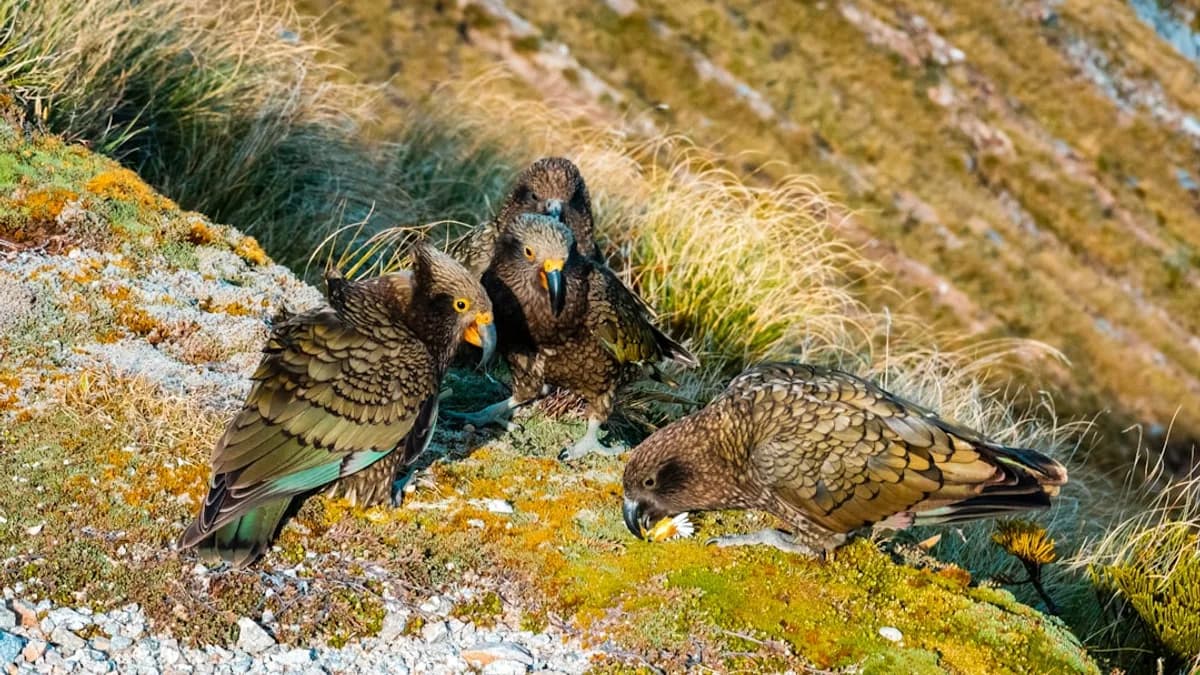
Introduction to Bruce the Kea: The Parrot Defying Nature’s Odds
In the rugged wilds of New Zealand’s South Island, a parrot named Bruce is quietly rewriting the rules of survival. Bruce is a kea—a species celebrated for its intelligence and mischief—but what sets him apart is not his mental acumen alone. Bruce is missing his upper beak, a catastrophic disability for a bird whose beak is central to feeding, socializing, and self-defense. Yet, against every expectation, Bruce has not only survived—he has climbed to the top of his flock’s social ladder. His journey from apparent disadvantage to dominance has captured the fascination of scientists and animal lovers alike, sparking a wave of media coverage and new questions about what animal resilience truly means [Source: Source].
Bruce’s Remarkable Adaptation: How He Uses His Partial Beak as a Weapon
To appreciate Bruce’s story, it’s crucial to understand just how significant his impairment is. The kea’s beak is a Swiss Army knife—used to pry open tough native fruits, dig for insects, and, perhaps most importantly, to assert social rank through "beak-jousting." This ritualized combat is the kea’s way of settling disputes, establishing hierarchy, and vying for mates. A missing upper beak should, by all logic, render a parrot like Bruce an outcast.
Yet, Bruce has flipped this logic on its head. Instead of being sidelined, he’s become a master of adaptation. Observers have documented Bruce using his remaining lower beak in creative ways, compensating for the absent upper half. He wields his truncated beak with surprising dexterity, manipulating objects and engaging in beak-jousting matches with rivals. In these contests, Bruce has not only held his own—he’s emerged as a dominant force, leveraging agility, timing, and perhaps an unconventional fighting style that catches opponents off guard [Source: Source].
Bruce’s story is a vivid case study in behavioral plasticity: the ability of animals to modify their behavior in response to physical limitations. Rather than being defined by what he lacks, Bruce has discovered new methods to participate—and prevail—in the kea’s complex social games. His success in beak-jousting suggests that social intelligence and adaptability can sometimes trump physical perfection, a compelling reminder that evolution is as much about flexibility as it is about form.
Media Spotlight: Diverse Perspectives on Bruce’s Story
Bruce’s rise has not gone unnoticed by the global press, each outlet bringing its own lens to his tale of triumph over adversity. The New York Times paints Bruce as a charismatic underdog, a leader who commands respect in spite of—if not because of—his visible impairment. Their coverage frames his ascent as a testament to the unpredictable ways in which animals can overcome the odds [Source: Source].
Ars Technica, meanwhile, zeroes in on the mechanics of Bruce’s beak-jousting prowess. Their reporting delves into how Bruce has redefined the rules of engagement, using his unique anatomy not as a handicap but as a strategic asset. In their view, Bruce exemplifies the principle that “form follows function”—and sometimes, function can be reinvented altogether [Source: Source].
IFLScience takes a broader view, using Bruce’s story as a springboard to discuss how severe impairments don’t necessarily spell the end for wild animals. They highlight Bruce as a “ringmaster” of his flock, challenging the persistent myth that disabled animals are inevitably marginalized. This angle resonates with current conversations about inclusivity and ability, extending the implications far beyond the avian world [Source: Source].
Scientific American offers a behavioral focus, detailing how Bruce’s beak, though broken, is still a formidable weapon. Their analysis underscores the ingenuity of animal problem-solving, drawing parallels to other documented cases where wildlife have adapted to injury or loss [Source: Source].
Yahoo, rounding out the media chorus, underscores Bruce’s social dominance. Their reporting emphasizes that it is not just survival, but leadership, that defines Bruce’s place in the flock—a narrative that reframes disability as a potential source of strength rather than weakness [Source: Source].
Taken together, these diverse perspectives create a multi-faceted portrait of Bruce as both a scientific marvel and an emblem of resilience, reminding us that nature’s stories are rarely as simple—or as deterministic—as they first appear.
Biological and Behavioral Insights: What Bruce Teaches Us About Animal Resilience
Kea parrots are no strangers to adversity. These alpine birds are renowned for their intelligence, curiosity, and adaptability—a reputation earned through centuries of surviving in some of New Zealand’s harshest environments. In kea society, social status isn’t just a matter of brute strength; it depends on a complex interplay of wit, resourcefulness, and social maneuvering. Bruce’s ascendancy, therefore, is not merely an anomaly—it’s a window into the kea’s evolutionary toolkit.
Bruce’s condition challenges longstanding assumptions about the role of physical perfection in wildlife survival. Traditionally, it was believed that visible impairments—especially those affecting critical tools like beaks—would relegate an animal to the fringes of its social group, severely reducing its chances of thriving or reproducing. Bruce’s experience, however, suggests that social animals may possess a previously underestimated capacity for compensatory behavior.
Scientific commentary on Bruce’s case has pointed to the broader phenomenon of behavioral compensation, where animals develop new ways to overcome physical setbacks. Similar cases have been observed in elephants with broken tusks who learn to use their trunks differently, or dolphins with damaged fins who adjust their swimming techniques. What makes Bruce’s story particularly compelling is the social dimension: his ability to not only survive but maintain a position of dominance within a competitive group [Source: Source].
This phenomenon invites a reassessment of how we define “fitness” in evolutionary terms. While classic Darwinian theory emphasizes survival of the fittest, Bruce’s success demonstrates that “fit” can be as much about adaptation and ingenuity as about physical health. For researchers, Bruce represents a living laboratory for studying the limits—and possibilities—of animal resilience.
Broader Implications: Lessons from Bruce for Conservation and Animal Welfare
Bruce’s journey holds powerful lessons for wildlife conservation and rehabilitation efforts. Too often, animals with visible impairments are written off as lost causes, deemed unfit for reintroduction or long-term care. Bruce’s story disrupts this narrative, suggesting that individuals can—and do—find novel pathways to success even after serious injury.
This has practical implications for conservation policy. Rehabilitation centers and wildlife managers might reconsider their criteria for release or euthanasia, taking into account not just the severity of an injury but the animal’s demonstrated ability to adapt. Bruce’s example argues for a more nuanced, case-by-case approach, one that recognizes the hidden capacities of individual animals [Source: Source].
Moreover, Bruce’s story can help shift public perceptions around disabled wildlife. Rather than viewing impairment as synonymous with suffering or inevitable decline, his life invites us to see such animals as potential success stories—capable of thriving, leading, and even redefining the norms of their species.
Finally, Bruce’s resilience may influence the way we think about conservation strategies for endangered species. In a rapidly changing world, adaptability is perhaps the most valuable trait an animal can possess. By studying individuals like Bruce, biologists can gain new insights into the kinds of behavioral flexibility that will be essential for species survival in the face of habitat loss, climate change, and other modern pressures.
Conclusion: Celebrating Bruce’s Triumph and the Power of Adaptation
Bruce the kea has done more than defy the odds—he has redefined them. From a parrot with a seemingly crippling impairment to a leader in his flock, Bruce’s journey is a testament to the power of adaptation, ingenuity, and resilience in nature. His story challenges us to look beyond surface-level judgments, to recognize the complexity of animal minds and the hidden strengths within every creature [Source: Source].
As we grapple with new challenges in conservation and animal welfare, Bruce’s example serves as a beacon. He reminds us that success in nature isn’t always about perfection—it’s about finding new ways to thrive, no matter the obstacles. We would do well to carry that lesson forward, both for the animals in our care and for the wild world we seek to understand and protect.