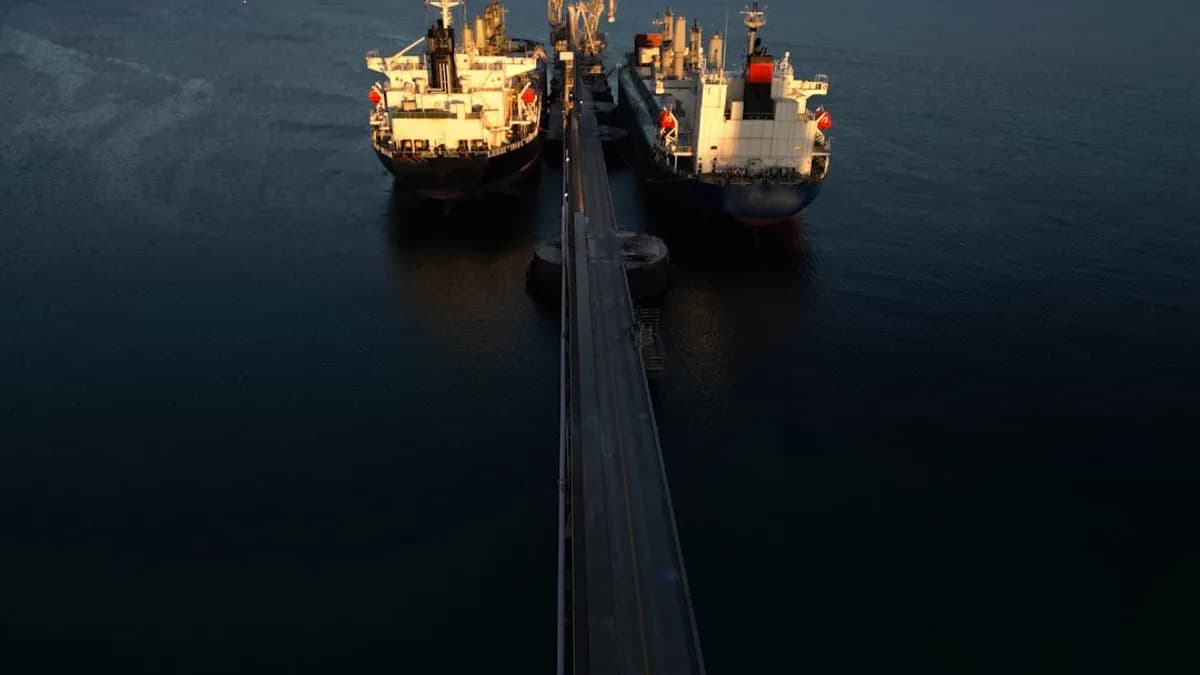
Gulf Escalation Rewrites the Risk Premium for Oil, Trade, and Regional Alliances
Iran’s drone and missile barrage against the UAE just vaporized weeks of fragile optimism in Gulf markets. In a 72-hour window, Google Trends saw “Hormuz” and “Iran attack UAE” queries spike over 800%, while oil futures surged 7.2% in intraday trading, topping $91/bbl before retreating on whispers of a possible diplomatic breakthrough. The real shock: these attacks occurred even as Washington and Tehran publicly maintained that a ceasefire was technically “still in effect” — underscoring how perception and reality in the Gulf can diverge with devastating speed.
This crisis is hitting a nerve because the Strait of Hormuz — which handles about 21% of the world’s daily oil supply — has operated on an uneasy status quo since 2020. The latest incident, which saw at least four UAVs and two cruise missiles intercepted over Fujairah, not only threatened the UAE’s most critical port but also exposed the volatility underlying energy supply chains, insurance rates, and defense procurement cycles. The incident’s timing — coinciding with a US federal court striking down Trump-era global tariffs — signals a perfect storm for commodities, shipping, and trade policy, driving search and headline volume across financial and policy news according to Reuters.
Gulf Airspace Is Now a Live-Fire Zone: What the Data Shows
The UAE’s air defenses intercepted over 90% of inbound projectiles, but the attack’s messaging hit its target. Fujairah, the world’s third-largest bunkering port, saw insurance premiums on tanker calls jump 28% overnight. Brent crude futures swung from $85.90 to $91.80 in less than six hours, the steepest single-day range since the 2022 Ukraine escalation. The effect radiated: shares of ADNOC and DP World fell 4.1% and 2.8%, respectively, on the Abu Dhabi bourse, erasing $6.2 billion in combined market cap.
Risk Premiums and Broken Assumptions
The narrative that a “de-risked” Gulf is investable at scale is unraveling. Since 2019, the UAE spent over $25 billion on missile defense upgrades, including THAAD and Barak-8 systems. Yet, the attack revealed gaps in early warning and drone swarming response. Lloyd’s of London estimates that annual insurance costs for Gulf tanker fleets will rise from $320 million to $410 million if attacks persist for just one quarter.
The attack also scrambled the oil curve: backwardation widened, with the three-month Brent spread hitting $3.25 — a 10-month high. Meanwhile, the average daily volume for Oman crude swaps doubled week-over-week, as Asian refiners rushed to hedge against further escalation according to WSJ.
The Tech and Trade Crosscurrents
While the world focused on missiles, a US trade court struck down Trump’s 10% global tariff regime. This verdict, which affects $340 billion in annual imports, collides with Gulf supply disruptions, forcing manufacturers and traders to reprice supply chain risk in real time according to NYT. The result: a scramble to secure alternative routing, with Jebel Ali port reporting a 13% increase in emergency bookings.
The Real Powerbrokers: UAE, Iran, and the US in a Three-Way Chess Match
The UAE, long perceived as a “Switzerland of the Gulf,” now finds its neutrality tested. President Sheikh Mohamed bin Zayed’s direct call with Israeli PM Netanyahu — a first in months — signals a recalibration: the UAE wants deeper defense integration with Israel, especially around AI-enabled early warning and loitering munition countermeasures. Israel, for its part, sees an opening to expand its $3.5 billion annual defense tech exports into the Gulf, especially as Saudi normalization talks stall according to Bloomberg.
Iran, meanwhile, is deploying its missile arsenal as a pressure valve — not just against the UAE, but to warn Gulf monarchies against deeper US/Israeli presence. Tehran’s calculus is clear: keep the threat level high enough to extract sanctions relief, but below a threshold that triggers direct US intervention. The Revolutionary Guard’s latest Quds-2 missile test, with a 1,100 km range, was timed to coincide with the Fujairah incident.
The US, caught between election-year optics and Gulf security guarantees, is hedging: while deploying two additional Aegis destroyers to the Arabian Sea, the White House continues backchannel talks with Iran. Trump’s public statements downplaying the “Hormuz clash” as a “trifle” reflect a reluctance to escalate before November, but also signal to allies that Washington’s appetite for another Gulf war is limited.
The Secondary Players: Energy Majors and Insurers
ADNOC, BP, and TotalEnergies are quietly activating contingency plans, including rerouting VLCCs via the Red Sea. Insurers like Chubb and Munich Re are already repricing policies, with war risk surcharges projected to hit $0.80/bbl by next quarter. Asian refiners (PetroChina, Reliance) are negotiating short-term supply swaps to avoid spot market price spikes.
Energy, Trade, and Markets: What’s Vulnerable and What’s Resilient
The Hormuz disruption is not just an oil story; it’s a multi-asset, multi-region risk event. Here’s why:
- Energy: With 18.4 million bbl/day passing through Hormuz, every 1% disruption translates to a $1.8 billion/day loss in physical flows. The UAE’s ability to reroute via its East Coast pipelines caps the immediate downside, but 50% of its crude still transits via Hormuz.
- Shipping: Global container rates on Gulf routes have spiked 16% since the attack, and the Shanghai Containerized Freight Index is pricing in a further 10-12% jump if hostilities persist.
- Equities: GCC banks with exposure to oil and trade finance are under pressure. Emirates NBD and Qatar National Bank saw 2-3% single-day drawdowns, while US-listed tanker stocks (Frontline, DHT) rallied 7-9% on higher day rates.
- Currencies: The dirham and riyal, both dollar-pegged, remain stable. But forward points have widened, reflecting growing hedging costs.
The Tech Layer: AI, Drones, and Cyber
The attack is accelerating adoption of AI-powered air defense and maritime surveillance. Israeli and US firms are field-testing machine learning algorithms for drone swarming detection. At least one intercepted drone used frequency-hopping protocols, requiring dynamic jamming — a capability the UAE only recently acquired. Cyber risk is also up: after the physical attacks, at least three major Gulf banks reported attempted DDoS attacks, likely from Iranian-affiliated groups.
What’s Next: Volatility, Fragmentation, and Arms Deals
Expect the Gulf risk premium to persist — and possibly widen. Here’s the 12-month outlook, grounded in current data:
- Oil: Brent will struggle to hold below $90 unless a formal US-Iran de-escalation framework emerges. Citi and Goldman Sachs both raised their 2024 average Brent targets by $5-7/bbl post-attack according to Bloomberg.
- Defense Tech: UAE-Israel arms deals will top $4.5 billion in 2024, with a focus on AI-enabled C4ISR and counter-drone systems. Expect at least one major US-Israeli joint venture announced for Gulf missile defense.
- Trade: The court’s tariff reversal, combined with Gulf volatility, creates a window for Asian and European exporters to capture US market share if US importers re-route away from Gulf hubs.
- Insurance and Shipping: Lloyd’s and Munich Re will raise war risk premiums at least 20% in the next renewal cycle. At least two major shipping lines will announce temporary Gulf service suspensions.
- Geopolitics: Iran will continue calibrated attacks — expect at least one more “demonstration strike” before US election season peaks. The UAE will deepen ties with Israel and India to hedge against both Iranian and US unpredictability.
This escalation is not a blip; it’s a pivot point. Over the next year, the Gulf will become both more expensive to insure — and more lucrative for those who can price and manage volatility. Investors and corporates who treat the 2020-2023 period as a “new normal” will be caught offside. The real winners will be those who pivot fastest to a world where the Gulf’s risk premium is not a historical artifact, but a permanent feature.