MLXIO
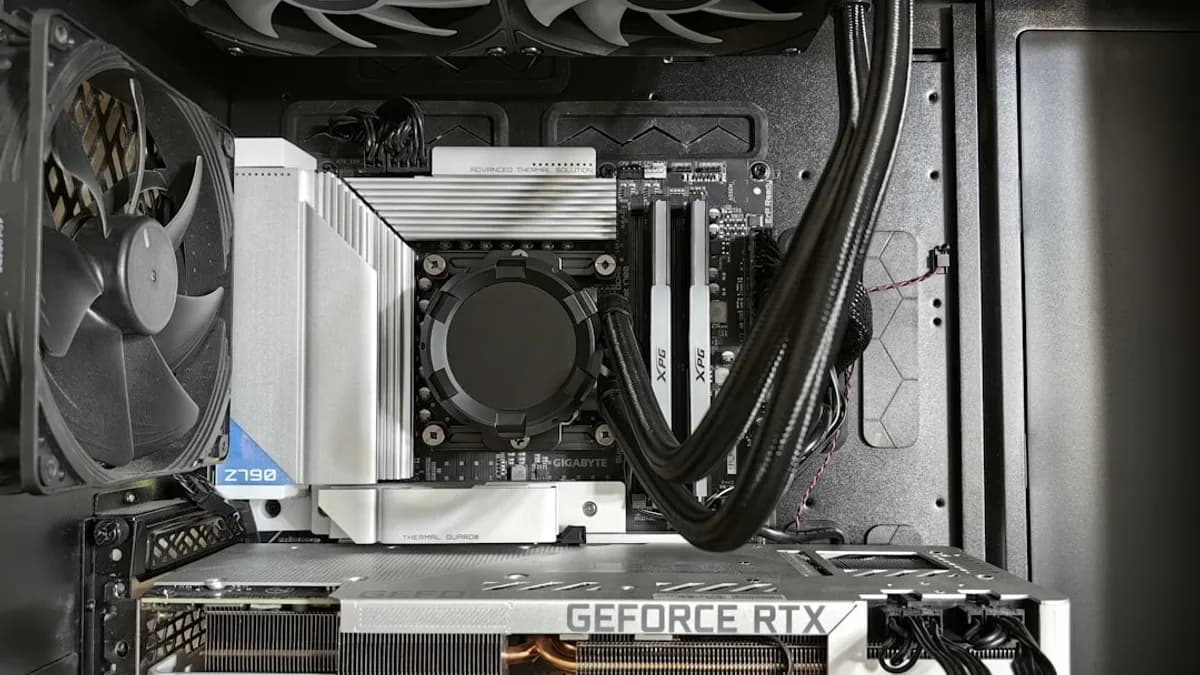
Computer components inside a black case with fans.
TechnologyMay 20, 2026· 4 min read· By Dev Kapoor

Steampunk PC Silences RTX 5080 With Zero Fans

Share

MLXIO Intelligence

Analysis Snapshot

60
Moderate
Confidence: LowTrend: 10Freshness: 98Source Trust: 100Factual Grounding: 92Signal Cluster: 20

Moderate MLXIO Impact based on trend velocity, freshness, source trust, and factual grounding.

Thesis

Medium Confidence

Billet Labs has demonstrated a fanless gaming PC using high-end AMD Ryzen 7 9800X3D and Nvidia GeForce RTX 5080 components, challenging conventional cooling norms.

Evidence

  • The build uses both AMD Ryzen 7 9800X3D and Nvidia GeForce RTX 5080, which are typically high-wattage parts.
  • Billet Labs claims the system operates without any fans, relying solely on passive cooling.
  • The exact cooling methods and materials used in the build are not disclosed in the source.
  • No temperature benchmarks, noise measurements, or performance data are provided by Notebookcheck.

Uncertainty

  • No hard data on sustained CPU/GPU temperatures or performance under load.
  • The engineering details of the passive cooling solution are undisclosed.
  • Long-term reliability and feasibility for mass adoption remain unproven.

What To Watch

  • Release of temperature and performance benchmarks for the fanless build.
  • Disclosure of the cooling technology and materials used by Billet Labs.
  • Industry and enthusiast reactions to the concept and its scalability.

Verified Claims

Billet Labs has built a gaming PC with an AMD Ryzen 7 9800X3D and Nvidia GeForce RTX 5080 cooled entirely without fans.
📎 A British PC cooling specialist has built a gaming PC with an AMD Ryzen 7 9800X3D and Nvidia GeForce RTX 5080—without a single fan.High
The exact passive cooling methods and materials used in Billet Labs' fanless gaming PC have not been disclosed.
📎 The exact methods and materials used remain undisclosed in the source.High
No temperature benchmarks, noise measurements, or performance comparisons are provided for the fanless build.
📎 Notebookcheck provides no temperature benchmarks, noise measurements, or side-by-side comparisons with traditional fan-based cooling.High
The fanless PC is intended as a proof of concept to demonstrate that passive cooling can be used with high-end gaming hardware.
📎 What is clear is the intent: demonstrate that passive cooling can scale to the highest end of consumer hardware.High
It is unclear whether the passive cooling solution is suitable for long-term or mass-market use due to lack of data.
📎 Whether this build relies on sheer mass, exotic materials, or some new design trick is left to speculation... the only concrete takeaway is that the system runs—at least at idle or unspecified workloads—without active airflow.Medium

Frequently Asked

Can a high-end gaming PC be cooled without any fans?

Billet Labs has demonstrated a gaming PC with an AMD Ryzen 7 9800X3D and Nvidia GeForce RTX 5080 running without any fans, using passive cooling.

Are there any performance or temperature benchmarks for Billet Labs' fanless gaming PC?

No, the source does not provide temperature benchmarks, noise measurements, or direct performance comparisons for the fanless build.

How does Billet Labs' fanless cooling system work?

The specific methods and materials used for passive cooling in Billet Labs' PC have not been disclosed.

Is passive cooling for high-end gaming PCs ready for mainstream use?

Based on the available information, it is unclear if the passive cooling solution is suitable for long-term or widespread adoption due to the lack of detailed data.

What makes Billet Labs' fanless PC unique compared to previous silent PCs?

Billet Labs' approach is notable for attempting to cool the latest high-performance gaming hardware passively, rather than relying on lower-power components or throttling.

Updated on May 20, 2026

Fanless Cooling for High-End Gaming: Turning Convention on Its Head

A British PC cooling specialist has built a gaming PC with an AMD Ryzen 7 9800X3D and Nvidia GeForce RTX 5080—without a single fan. The concept is as bold as it sounds, challenging decades of received wisdom that high-performance gaming hardware demands aggressive airflow. This is not a low-power, stripped-down build; it’s an unapologetic showcase of top-tier silicon running in total silence, wrapped in a steampunk shell. The move comes from Billet Labs, a name now tied to the claim that even today’s most power-hungry components can run cool using only passive cooling, according to Notebookcheck.

The industry standard has always been simple: more power means more heat, and more heat means more fans. Billet Labs’ experiment throws that relationship into question. If their approach holds up, it suggests a new frontier for custom PC design—one where aesthetics, silence, and raw performance aren’t at odds.

Technical Feasibility: Can Passive Cooling Handle the Heat?

The AMD Ryzen 7 9800X3D and Nvidia GeForce RTX 5080 are both high-wattage parts, typically demanding robust cooling solutions. The challenge here isn’t just moving heat away from individual chips, but dispersing it fast enough to keep thermals in check during real-world gaming loads. Billet Labs claims to have solved this puzzle without resorting to fans, but the exact methods and materials used remain undisclosed in the source.

What is clear is the intent: demonstrate that passive cooling can scale to the highest end of consumer hardware. The steampunk aesthetic isn’t just window dressing—it signals a commitment to reimagining the look and function of gaming rigs. But without specifics on the heat dissipation hardware or the physical construction, it’s impossible to dissect the engineering trade-offs. Whether this build relies on sheer mass, exotic materials, or some new design trick is left to speculation.

Hard Data: What We Know and What’s Missing

Notebookcheck provides no temperature benchmarks, noise measurements, or side-by-side comparisons with traditional fan-based cooling. There’s no data on sustained CPU/GPU temperatures, no figures on noise levels (except the implied zero from “no fan”), and no information on energy efficiency or possible performance throttling.

That absence of hard numbers is telling. Either the build’s creator wants to spark curiosity before releasing the details, or the solution works well enough for a proof of concept but not yet for mass adoption. For now, the only concrete takeaway is that the system runs—at least at idle or unspecified workloads—without active airflow.

Stakeholder Implications: What Enthusiasts and Engineers Might Think

For PC builders and engineers, Billet Labs’ fanless machine is a provocation. If the claim holds, it could inspire a wave of experimental builds that prioritize silence and visual flair. Gamers intrigued by zero-noise rigs will watch closely for follow-up data. Industry veterans may remain skeptical without evidence of long-term reliability or load benchmarks.

The environmental argument is less clear. Passive cooling can reduce noise pollution, but the energy savings (if any) are unproven here. Maintenance concerns—such as dust buildup, cleaning, or longevity—are also unexplored in the source.

Where This Fits in the History of Passive Cooling

Passive cooling isn’t new. Silent PCs have existed for years, but always with compromises: lower power envelopes, throttled performance, or exotic and expensive cases. What sets Billet Labs’ approach apart—if it works at scale—is the ambition to pair the very latest gaming hardware with a purely passive design. The steampunk styling doubles down on the “showpiece” angle, aiming to turn functional engineering into art.

Why This Matters—and What Remains Unclear

If Billet Labs can back their claim with data, it could push both hobbyists and boutique builders to reconsider what’s possible with high-end gaming PCs. Silence would no longer require a trade-off in performance or aesthetics. Manufacturers might even rethink case design, prioritizing heat dissipation and material science over fan count.

But right now, the technical details are missing. There’s no evidence yet that this approach works under sustained loads, or how it copes with real-world gaming sessions. The durability, cost, and scalability of such a solution are all unknowns.

What to Watch: Proof, Pushback, and the Next Chapter in Silent Performance

The next step is obvious: hard numbers. If Billet Labs or Notebookcheck publish detailed benchmarks—sustained temperatures, clock speeds, power draw—this project could shift from curiosity to credible threat for conventional cooling paradigms. On the other hand, if the build can’t handle sustained gaming loads or requires prohibitive materials, the experiment will remain a one-off.

Watch for follow-up coverage from Billet Labs, independent teardowns, or any disclosure of component choices and thermal performance. The real test is whether this proof of concept can spark a wave of silent, high-performance PCs—or whether the industry will decide that, for now, the fan still reigns.

Why It Matters

  • This PC challenges the long-standing belief that high-end gaming hardware must use loud, power-hungry fans for cooling.
  • A successful passive cooling design for flagship CPUs and GPUs could inspire quieter, more aesthetically unique gaming PCs.
  • If scalable, this innovation may influence the future of PC hardware design, merging performance, silence, and new visual styles.

DK

Written by

Dev Kapoor

Consumer Tech & Gadgets Reviewer

Dev reviews smartphones, laptops, wearables, smart home devices, and consumer electronics. He focuses on real-world performance, value-for-money analysis, and helping readers find the best tech for their needs and budget.

SmartphonesLaptopsWearablesSmart HomeConsumer Electronics

Related Articles

A close-up of an rtx 3090 graphics card.
TechnologyMay 20, 2026

Lenovo Unleashes RTX 5070 Laptop with 165Hz OLED Display

Lenovo launches Legion 5i with Nvidia RTX 5070 GPU and 165Hz OLED display, combining high-end gaming power with user-upgradeable features globally.

4 min read

A close-up of an rtx 3090 graphics card.
TechnologyMay 20, 2026

Lenovo Unleashes 15-Inch Legion 5 with RTX 5070 and 1,100-nit OLED

Lenovo’s Legion 5 15IAX11 gaming laptop packs a rare 1,100-nit OLED and Nvidia RTX 5070 GPU, raising the bar for visuals and performance in 15-inch gaming rigs.

3 min read

red and black f 1 race car on track during daytime
BusinessMay 19, 2026

Sky Blocks Apple’s F1 Expansion in UK and Italy with Early Deal

Sky’s early renewal of UK and Italy F1 rights halts Apple’s European streaming plans, raising stakes in the battle for global sports dominance.

5 min read

Bitcoin coins are displayed with a stock chart.
FinanceMay 20, 2026

Catena Labs Raises $30M to Build Banks for AI Agents

Catena Labs raised $30M to build regulated banks for AI agents, enabling autonomous financial operations with new infrastructure and compliance.

5 min read

Teacher guiding students on computer in classroom.
TechnologyMay 20, 2026

Kansas City Ditches 30,000 PCs for Apple in Bold School Tech Shift

Kansas City Public Schools will replace 30,000 Windows PCs and Chromebooks with Apple devices, aiming for a unified tech ecosystem across the district.

4 min read

brown spring note
TechnologyMay 20, 2026

Boox Bets on Monochrome with Note X6 Ahead of May Launch

Boox's Note X6 embraces monochrome ePaper and stylus input, aiming at users who value clarity and focus over color distractions.

4 min read

Young woman talking on a cell phone at home.
TechnologyMay 20, 2026

AT&T Sparks Backlash with New $2.63 Fee for Prepaid Users

AT&T adds a $2.63 monthly administrative fee to prepaid plans, ending prepaid customers' exemption from recurring surcharges and raising their bills.

4 min read

Close-up of an apple logo with colorful reflections
TechnologyMay 20, 2026

Apple Locks iPhones on iOS 26.5, Blocks Downgrades Forever

Apple permanently blocks iOS downgrades with version 26.5, forcing users to stay on the latest update regardless of issues.

4 min read

black smartphone on black laptop computer
TechnologyMay 20, 2026

Xreal Sparks Android XR Race with Display-Driven Project Aura

Xreal’s Project Aura targets a 2026 launch with integrated displays, setting a new standard against Google’s display-free Android XR glasses.

4 min read

Three samsung galaxy smartphones displayed on a white surface.
TechnologyMay 20, 2026

Samsung’s Galaxy S27 Pro Shrinks Flagship with No S Pen

Samsung’s Galaxy S27 Pro offers a compact 6.47-inch flagship experience, ditching the S Pen to target users wanting power without bulk.

5 min read

Stay ahead of the curve

Get a weekly digest of the most important tech, AI, and finance news — curated by AI, reviewed by humans.

No spam. Unsubscribe anytime.