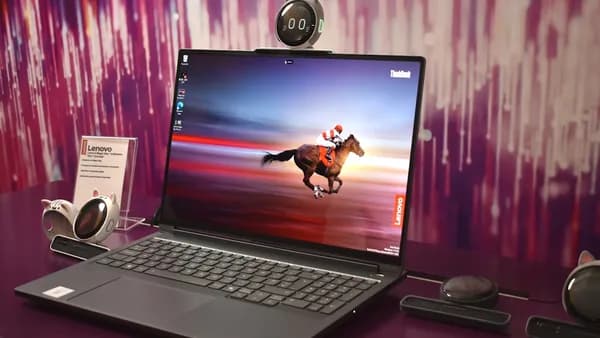
Lenovo is turning AMD’s Strix Halo into a real retail gaming laptop, not just an MWC demo: the 15.3-inch Legion 7a 15ASH11 is now on sale internationally with Radeon 8060S graphics and a configuration that can assign up to 48 GB of VRAM. The laptop is available in Australia, Hong Kong, Malaysia, Singapore and Thailand, while Europe and North America remain unavailable at the time of writing, according to Notebookcheck.
The launch matters because Lenovo Legion 7a 15ASH11 does not follow the usual gaming-laptop formula of a CPU paired with a discrete Nvidia or AMD mobile GPU. Instead, it uses AMD Ryzen AI Max+ processors with integrated Radeon 8060S graphics, making memory configuration a central part of the performance story.
Lenovo’s Strix Halo Legion is now a retail product, with Asia-Pacific pricing attached
The strongest signal here is not the OLED panel or even the 48 GB VRAM headline — it is that Lenovo has moved the machine from showcase hardware into regional sales channels. Notebookcheck reports the laptop appeared on several Lenovo regional sites earlier this month after being presented during MWC, and it can now be purchased in selected markets.
Starting prices vary sharply by country:
| Market | Starting price |
|---|---|
| Australia | AUD 4,199 (~$3,013) |
| Hong Kong | HKD 25,601 (~$3,268) |
| Malaysia | MYR 9,889 (~$2,502) |
| Singapore | SGD 3,462 (~$2,711) |
| Thailand | THB 81,593 (~$2,514) |
That spread makes regional configuration details important. Lenovo is selling the machine with a choice between Ryzen AI Max+ 388 and Ryzen AI Max+ 392 processors, and the headline memory allocation only applies to the higher-end setup.
The counterpoint is obvious: this is not yet a broad global release in the way North American and European buyers usually mean it. Notebookcheck says the model “remains unavailable in Europe and North America,” and pricing elsewhere has not been confirmed.
“Pricing for other markets remains unknown for now.”
That keeps the story narrower than a full worldwide rollout. Still, actual retail listings across Australia and multiple Asian markets make this more than a speculative product page.
The 48 GB VRAM figure comes from shared memory, not a conventional GPU
The Legion 7a 15ASH11’s most unusual spec is its configurable graphics memory ceiling. Lenovo pairs the Ryzen AI Max+ 388 with 32 GB of RAM, while the Ryzen AI Max+ 392 version gets 64 GB of RAM. Only that 64 GB configuration can assign up to 48 GB of VRAM to the Radeon 8060S iGPU.
That distinction matters. This is not a laptop with a discrete GPU carrying a fixed onboard VRAM pool. It is a Strix Halo-style design where system memory can be allocated to graphics, which gives Lenovo a way to advertise a much larger graphics-memory figure than many conventional gaming laptops.
| Legion 7a 15ASH11 option | CPU detail from source | RAM | Radeon graphics | Max assignable VRAM |
|---|---|---|---|---|
| Ryzen AI Max+ 388 | Lower CPU core/thread count | 32 GB | Radeon 8060S | Not listed as 48 GB |
| Ryzen AI Max+ 392 | 12 cores / 24 threads | 64 GB | Radeon 8060S | Up to 48 GB |
MLXIO analysis: a large shared VRAM pool could be useful for workloads that can actually address it, including graphics-heavy projects or local compute tasks that are memory constrained. But that is not the same as proving gaming dominance. Real performance will depend on Lenovo’s power limits, cooling, drivers and how the Radeon 8060S behaves in shipping units.
That is the key counterweight to the spec sheet. A big memory number can draw attention, but it does not replace benchmark data. Independent testing against RTX-equipped systems will matter more than the raw “48 GB” figure.
For readers tracking how laptop vendors are repositioning portable performance hardware, MLXIO has also covered very different angles in 6,144 CUDA Cores Turn Nvidia N1X Into Laptop Threat and HP ZBook 8 G2a Squeezes 64GB RAM Into 14 Inches.
The OLED panel is just as aggressive as the memory spec
Lenovo did not pair the Strix Halo platform with a budget display. Every Legion 7a 15ASH11 variant listed by Notebookcheck uses the same 15.3-inch OLED panel with a 2,560 x 1,600 resolution, 165 Hz refresh rate, 100% DCI-P3 coverage, 500 nits peak brightness in SDR and 1,100 nits when viewing HDR content.
That makes the display one of the clearest parts of the pitch. The machine is aimed at buyers who want a high-refresh OLED in a relatively compact chassis, not just maximum frame rates at any cost.
The rest of the hardware supports that portable-performance framing. Lenovo lists 1 TB of storage, a spare M.2 2242 slot, an 84 Wh battery and 180 W USB Type-C charging across models. Notebookcheck also reports the laptop weighs 1.55 kg and measures 345 x 244 x 15.5~15.9 mm.
The strongest caveat is that local Lenovo listings still matter. Port selection, exact SKUs, shipping timing and bundled configurations can vary by region, and buyers should check the country-specific store page before treating any single spec sheet as universal.
This is also a different kind of Lenovo gaming-laptop story than lower-cost positioning around models such as Lenovo LOQ 15 Bets on Loud Green, Not Faster Chips. Here, the selling point is not cosmetic differentiation. It is the combination of Strix Halo, high shared-memory allocation and a bright OLED panel in a 15-inch-class machine.
Benchmarks and wider availability will decide whether the Legion 7a is more than a spec-sheet standout
The next proof point is performance under load. The Legion 7a 15ASH11 has the ingredients for a distinctive AMD-powered gaming laptop, but the current data is still mostly configuration, pricing and availability.
The most important tests will be gaming benchmarks, sustained thermals, battery behavior and workloads that can actually use the large shared graphics-memory allocation. The Ryzen AI Max+ 392 version is the configuration to watch because it carries the 64 GB RAM setup needed for the 48 GB VRAM claim.
Pricing will also shape the reception. The listed starting prices range from roughly $2,502 in Malaysia to roughly $3,268 in Hong Kong based on Notebookcheck’s conversions, but there is no confirmed price yet for Europe or North America.
If Lenovo expands availability and independent reviews show the Radeon 8060S can hold up inside this thin chassis, the Legion 7a 15ASH11 could become one of the more unusual gaming laptops in AMD’s current mobile lineup. If thermals, drivers or pricing disappoint, the 48 GB VRAM headline may remain the most memorable part of the launch rather than the reason to buy it.
The Bottom Line
- Lenovo is turning AMD Strix Halo from a demo platform into a real retail gaming laptop.
- The integrated Radeon 8060S design challenges the usual CPU-plus-discrete-GPU gaming laptop formula.
- Regional pricing varies widely, with North America and Europe still missing from availability.