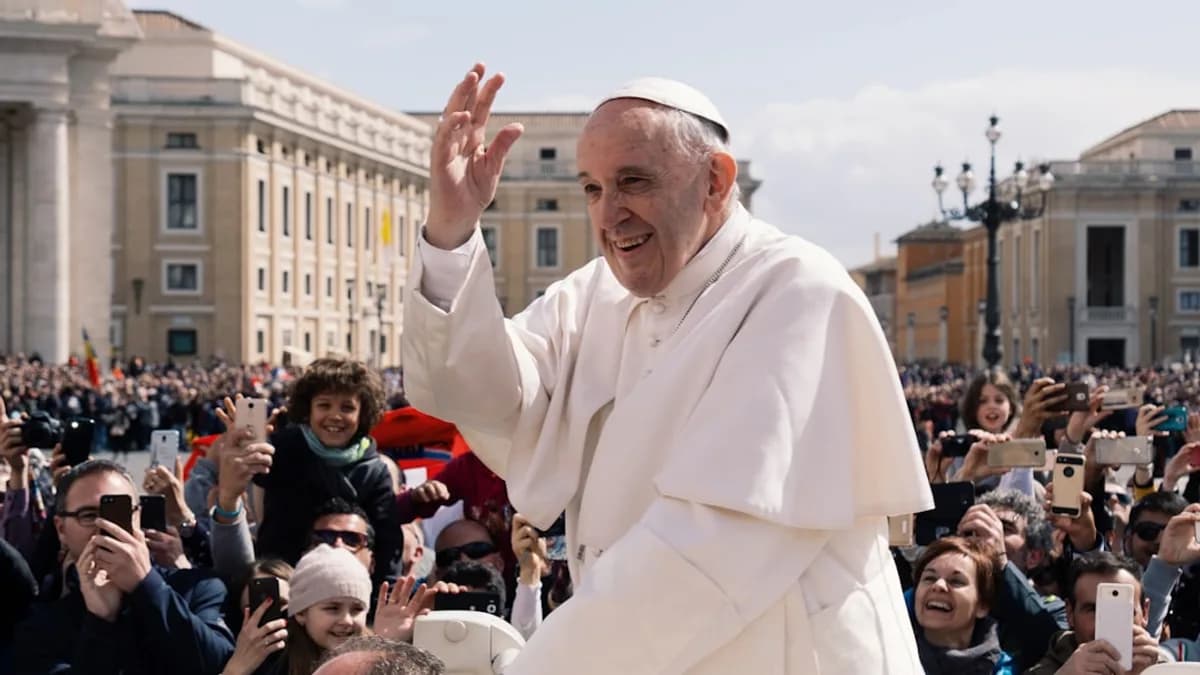
Pope Leo XIV’s AI encyclical targets Silicon Valley power, not software
Pope Leo XIV’s 200-page first encyclical, Magnifica Humanitas, is not really an AI document; it is an indictment of concentrated technological power. The pope published Magnifica Humanitas on Monday, framing it as a text on “safeguarding the human person in the time of artificial intelligence,” according to TechCrunch.
That framing matters. AI is the hook. The target is older: inequality, war, eroding democracy, and the transfer of social authority to a small class of people with money, data, compute, and political access.
Leo’s central claim is blunt. A technology built and governed by a narrow elite cannot credibly claim to serve the common good. That is not a software critique. It is a power critique.
“When such power is concentrated in the hands of a few, it tends to become opaque and evade public oversight, increasing the risk of distorted forms of development that give rise to new dependencies, exclusions, manipulations and inequalities,” Leo writes.
The encyclical should be read less as a Vatican white paper on algorithms and more as a moral challenge to the people who believe their technical capacity gives them governing authority.
AI gives the Vatican a modern language for older warnings about human dignity
The document sits in a Catholic social tradition that has long worried about labor, markets, inequality, and the dignity of the human person. The obvious reference point is Rerum Novarum, Pope Leo XIII’s 1891 encyclical on workers’ rights, capitalism, and the obligations of employers and states during the Industrial Revolution.
The current pope is not hiding that lineage. The source material says Leo XIV has already connected his namesake’s work to the AI revolution, arguing that today’s technology poses comparable questions about “human dignity, justice and labor.”
That is the key to understanding Magnifica Humanitas. The Vatican is not saying machine learning is uniquely evil. It is saying AI gives old forms of exploitation and alienation a new interface.
The technology can treat people as data sources, workers as replaceable inputs, and communities as test environments for systems they did not meaningfully approve. That is MLXIO’s analysis, but it follows directly from Leo’s concern that AI amplifies the power of those who already hold “economic resources, expertise and access to data.”
This is not anti-innovation. It is anti-dehumanization. There is a difference, and Silicon Valley often benefits when critics blur it.
The real AI risk is a ruling class that automates its own priorities
Leo’s sharpest line is not about sentient machines. It is about human institutions using machines to harden their own advantages.
The encyclical says AI tends to amplify existing power and can allow elites to “shape information and consumption patterns, influence democratic processes and steer economic dynamics to their own advantage.” That is the heart of the document.
Here is the tension in plain terms:
| The promise sold around AI | The danger Leo emphasizes |
|---|---|
| Efficiency: Faster systems, faster decisions, faster deployment | Opacity: Power can “evade public oversight” |
| Scale: Larger models and datasets | Concentration: Control sits with those who already have resources and data |
| Progress: More technical capability | Domination: Technical power gets mistaken for a right to govern |
| Personalization: Systems shape information and consumption | Manipulation: Democratic processes can be influenced by those who control the tools |
This is where the encyclical becomes uncomfortable for the tech industry. If AI systems reflect the incentives of the companies, investors, and governments that build them, then the question is not only whether the models work. It is who they work for.
Leo’s phrase “for ever more powerful algorithms and larger datasets” directly attacks the AI arms race logic. Companies and countries may see that race as a path to “geopolitical or commercial dominance.” The pope sees a moral trap.
“To disarm means discrediting the assumption that technical power automatically confers the right to govern,” he wrote.
That sentence is the encyclical’s thesis in miniature.
Democracy weakens when AI decisions move faster than public consent
The political timing is not subtle. TechCrunch reports that the encyclical came a few days after President Donald Trump delayed signing an executive order on AI that would have given the government oversight over new models before release, reportedly at the urging of David Sacks, a VC investor and former White House AI czar.
That does not prove causation. It does show the live conflict Leo is entering: whether AI development should move first and answer later, or face public rules before its systems shape public life.
Leo calls for “clear criteria and effective oversight” grounded in participation from the communities affected by AI. That phrase is doing real work. It rejects a governance model in which companies build, deploy, apologize, and then invite regulators into the room after the damage is done.
Notre Dame Law School professor Paolo Carozza, a member of the Pontifical Academy of Social Sciences and chair of the Meta Oversight Board, gives the democratic concern its clearest formulation. He told TechCrunch that AI-driven misinformation and deepfakes have “corroded our capacity to recognize what’s true and what’s not true, and that really has consequences for democratic politics.”
That is not a narrow content-moderation complaint. It is a warning about the conditions democracy needs to function: shared facts, accountable institutions, and citizens who can distinguish persuasion from synthetic manipulation.
Tech elites sell AI salvation while avoiding responsibility for its costs
The encyclical also challenges one of the tech industry’s favorite rhetorical moves: treating AI disruption as inevitable while insisting that only the people driving it are qualified to manage it.
That logic is convenient. It converts political choices into technical destiny. It turns social costs into transitional friction. It tells workers, educators, creators, and citizens that the future has already been decided.
Leo rejects that moral posture. His attack on the AI arms race is aimed at companies and countries that believe scale itself can justify the race for dominance. The encyclical’s argument is that power does not become legitimate because it is technically sophisticated.
The strongest evidence in the source material is not abstract. TechCrunch links Leo’s concerns to patterns such as Elon Musk’s acquisition of Twitter and use of the platform to help elect Trump, as well as “hundreds of millions” flowing from tech elites into super PACs to block AI regulation. Those examples matter because they show the overlap between platform power, political influence, and resistance to oversight.
Carozza’s second warning cuts even deeper. He said the tech industry’s practice of “harvesting and manipulating” human data poses “fundamental challenges to cognitive freedom.”
That phrase should stop every AI executive mid-pitch. If the raw material of AI is human behavior, human expression, and human attention, then the costs are not external to the product. They are inside it.
The strongest defense of AI is productivity, medicine, and human possibility
The serious counterargument is that AI can help people. The source material does not reduce the technology to harm. Related reporting says Leo has described AI as a tool that can serve human beings, and The Atlantic’s account of the encyclical says he calls it a “gift that can alleviate suffering and open up new possibilities” when ordered by humane values rather than monopolistic interests.
That matters. A blanket dismissal of AI would be lazy. It would also be impractical. The question is not whether technical capability can produce benefits. Of course it can.
The question is whether those benefits arrive under conditions the public can inspect, contest, and shape.
Leo’s critique is strongest because it separates the technology from the power structure around it. AI as a tool is one debate. AI as a private governing layer over work, media, education, truth, and political influence is another.
The encyclical’s challenge is to govern AI before it governs us
The practical takeaway is clear: AI governance cannot be treated as a compliance chore delegated to lawyers after launch. It has to become a democratic and moral obligation.
The priorities follow from the source material: effective oversight, public participation by affected communities, protection for workers facing automation, limits on autonomous lethal decisions, scrutiny of data extraction, and human accountability in high-stakes uses.
Leo does not provide a technical rulebook. Papal documents usually do not. But he gives policymakers, universities, companies, civil society, and religious institutions a sharper frame: stop asking only what AI can do, and start asking who gains power when it does it.
That is why Magnifica Humanitas is more important than another generic AI ethics statement. It names the central conflict. Not man versus machine. Not progress versus nostalgia.
The fight is between convenience and justice, speed and consent, concentrated power and human dignity. If AI is going to shape public life, the public has to shape AI first.
Impact Analysis
- The encyclical reframes AI as a question of power and public accountability, not just software safety.
- It challenges Silicon Valley’s claim that technical expertise alone justifies broad social authority.
- By linking AI to labor, inequality and democracy, the Vatican places modern technology inside a much older moral debate.