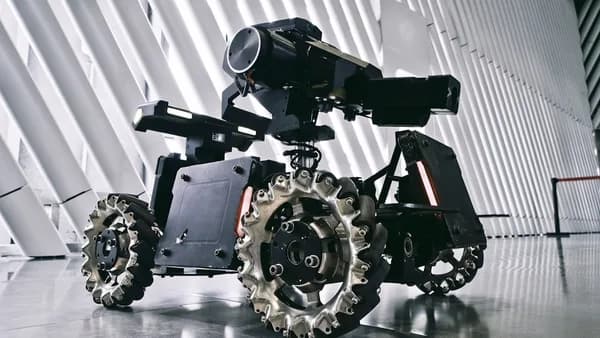
NVIDIA Cosmos 3 puts world generation, physical reasoning, and action generation into one open model family, aiming squarely at builders of robots, autonomous vehicles, and smart spaces that need AI to understand the physical world before acting in it.
The release, published June 1, 2026, is available on Hugging Face with Cosmos 3 Super and Cosmos 3 Nano, Diffusers integration, post-training scripts, and synthetic data generation datasets, according to the Hugging Face Blog. For teams trying to build physical AI, the promise is simple: fewer separate models, fewer custom inference paths, and a more direct route from perception to action.
“No more juggling between different models and inference pipelines - Cosmos 3 does it all.”
That is the core claim. The harder question is whether one open omni-model can make real-world systems cheaper to prototype without hiding new complexity in local AI compute, data, safety validation, and deployment.
Why could NVIDIA Cosmos 3 change the economics of building robots and autonomous machines?
Physical AI is expensive because it has to learn from the world, not just from text. A robot, autonomous vehicle, drone, or factory machine must interpret space, motion, objects, causal relationships, and task goals. It also has to act without breaking equipment, wasting inventory, or creating safety risk.
Cosmos 3 targets that bottleneck by combining capabilities that NVIDIA previously split across separate Cosmos models. The blog says earlier releases required developers to work with different models for world generation, controlled generation, scene understanding, and policy generation. Cosmos 3 brings those into a single Mixture-of-Transformers model.
The cost issue is integration, not just training
For builders, the expensive part is not only collecting real-world video or training multimodal models. It is stitching together perception, simulation, reasoning, and action planning in a way that survives messy environments.
Cosmos 3 could reduce that friction because it supports:
- World generation: creating realistic, physically plausible video worlds from text, images, videos, or action inputs.
- Physical reasoning: interpreting motion, causality, and spatial relationships.
- Future prediction: generating future video and action sequences from a current state.
That does not mean deployment becomes easy. Analysis: the economic upside depends on whether teams can fine-tune Cosmos 3 on their own environments faster than they can maintain older, narrower robotics pipelines.
What is NVIDIA Cosmos 3’s open omni-model for physical AI reasoning and action?
Cosmos 3 is best understood as a foundation model family for physical AI: systems that need to perceive the world, reason about what is happening, and generate actions or simulations tied to real-world constraints.
The “omni-model” label matters because Cosmos 3 works across multiple inputs and outputs inside one architecture. NVIDIA lists support for text, image, video, audio, and action modalities. The model can behave like a vision-language model, a video generator, a forward dynamics model, an inverse dynamics model, or a robot policy without changing architecture.
What does “open” actually include?
The release includes:
- Cosmos 3 Nano on Hugging Face at
nvidia/Cosmos3-Nano - Cosmos 3 Super on Hugging Face at
nvidia/Cosmos3-Super - Model cards and licensing
- Cosmos 3 Diffusers integration
- Post-training scripts on GitHub
- Open synthetic data generation datasets for physical AI
NVIDIA’s related Cosmos paper describes the broader platform as open-source and open-weight with permissive licenses available through NVIDIA Cosmos. Still, teams should read the actual Hugging Face model cards before assuming commercial permissions, redistribution rights, or deployment limits.
| Model | Size stated by NVIDIA | Intended use | Hardware noted in source |
|---|---|---|---|
| Cosmos 3 Nano | 8B parameter model with 8B reasoner and 8B generator | Efficient inference | Workstation-grade compute such as RTX PRO 6000 GPU |
| Cosmos 3 Super | 32B parameter model with 32B reasoner and 32B generator | Large-scale synthetic data generation and research | NVIDIA Hopper and Blackwell GPUs |
How does Cosmos 3 connect perception, world modeling, reasoning, and robot action?
Cosmos 3 uses a Mixture-of-Transformers backbone that processes different modalities through a shared architecture. NVIDIA says each modality is first encoded by a dedicated encoder: a ViT for visual understanding, a VAE for visual and audio generation, and domain-aware vectors for actions.
The model then splits input into two subsequences:
- Autoregressive subsequence: handles reasoning and understanding through next-token prediction.
- Diffusion subsequence: handles generation through iterative denoising.
These token streams use separate parameter sets in each transformer layer but interact through joint attention. That design is what lets Cosmos 3 move between reasoning, video generation, dynamics modeling, and policy-style outputs.
Why is physical AI different from a chatbot?
A chatbot can be wrong in text. A physical AI system can be wrong in motion.
The source frames Cosmos 3 around use cases such as training a robot to fold laundry, building autonomous driving simulation, and generating synthetic training data for warehouse safety scenarios. In each case, the model has to deal with geometry, physical cause and effect, and uncertainty over time.
Synthetic data is central here. NVIDIA released datasets for domains including robotics, physics, reasoning, human motion, driving, and warehouse safety. These datasets are meant to help train and evaluate world foundation models without forcing every risky or rare scenario to be reproduced in the physical world first.
How would Cosmos 3 help a warehouse robot pick, move, and recover from mistakes?
A useful way to read Cosmos 3 is as a potential bridge between “see the scene” and “generate the next plausible action.” NVIDIA does not claim a finished warehouse robot product in the Hugging Face post. It does show warehouse safety data generation as one target use case, and it lists Image | Text → Video & Action as a policy-model mode.
A constrained example, not a deployment claim
Suppose a warehouse team wants to test a robot instruction such as moving an object relative to another item. NVIDIA gives this action-generation prompt example:
“Put the pot to the left of the purple item. This video is captured from a first-person perspective looking at the scene.”
In a Cosmos 3-style workflow, the system could take image and text input, model the spatial relationship, and generate video and action outputs. If the goal is simulation or training data, that generated sequence could help developers evaluate whether the model understands the instruction and the scene layout.
Cosmos 3’s Diffusers integration also gives a concrete entry point. NVIDIA shows a single-frame generation example using Cosmos3OmniPipeline, with num_frames=1, height=720, and width=1280, producing a 720 x 1280 image from a detailed robotics lab prompt.
That is not the same as validated real-time robot control. Analysis: the practical value is likely strongest first in simulation, synthetic data, and post-training loops, where teams can test generated outcomes before trusting any action path on physical equipment.
Why does making Cosmos 3 open matter for developers, enterprises, and AI infrastructure buyers?
Open availability changes who can experiment. Developers can pull models from Hugging Face, inspect model cards, use Diffusers pipelines, and run post-training scripts from the Cosmos Framework. That is a different starting point than waiting for a closed API to support a specific robot, camera setup, or simulation loop.
The source also ties Cosmos 3 to NVIDIA NIM microservices, the Cosmos Cookbook, and the broader Cosmos Framework for training and serving world foundation models. That points to a stack where models, data tools, post-training, and deployment pieces are meant to fit together.
For adjacent context on NVIDIA’s broader role in AI compute, MLXIO has covered how Nvidia chips show up in cloud AI discussions in Apple Google AI Deal Sends Siri to Nvidia Cloud Chips, and how workstation-class hardware choices affect professional buyers in Dell Precision 16 Makes You Pick Nvidia Over Lightness.
Analysis: Cosmos 3 does not prove a new infrastructure demand cycle by itself. But the source’s hardware split is clear: Nano is aimed at workstation-grade inference, while Super targets larger NVIDIA GPU platforms for research and synthetic data generation.
What limits and risks should teams evaluate before building physical AI systems on Cosmos 3?
Cosmos 3 is a major technical packaging move, but teams should treat it as infrastructure for experimentation and post-training, not as proof that physical AI deployment is solved.
Before building on it, evaluate:
- Latency: Can the model support the timing constraints of the target machine?
- Hardware fit: Does the workload fit Cosmos 3 Nano, or does it require Cosmos 3 Super-class compute?
- Integration: Can existing perception, control, simulation, and safety systems connect cleanly?
- Data needs: Does post-training require domain-specific video, actions, or prompts the team does not yet have?
- Licensing: Do the model cards allow the intended commercial or research use?
- Validation: Are generated videos and actions physically reliable outside curated demos?
Safety is the harder layer. Physical AI systems need monitoring, fallback behavior, human oversight, and domain-specific compliance. A warehouse robot, autonomous vehicle simulation system, and medical robot would each face different validation burdens.
The practical watch item is whether developers can use Cosmos 3’s open models, Diffusers pipelines, SDG datasets, and post-training scripts to produce reliable task-specific world models. If they can, Cosmos 3 becomes more than a model release. It becomes a test of whether physical AI can move from custom pipelines toward reusable foundation-model infrastructure.
The Bottom Line
- Cosmos 3 could reduce integration complexity for teams building robots, autonomous vehicles, drones, and smart spaces.
- An open model family on Hugging Face may make advanced physical AI prototyping more accessible to developers.
- The real test will be whether unified reasoning and action generation lowers costs without adding new compute, safety, and deployment challenges.