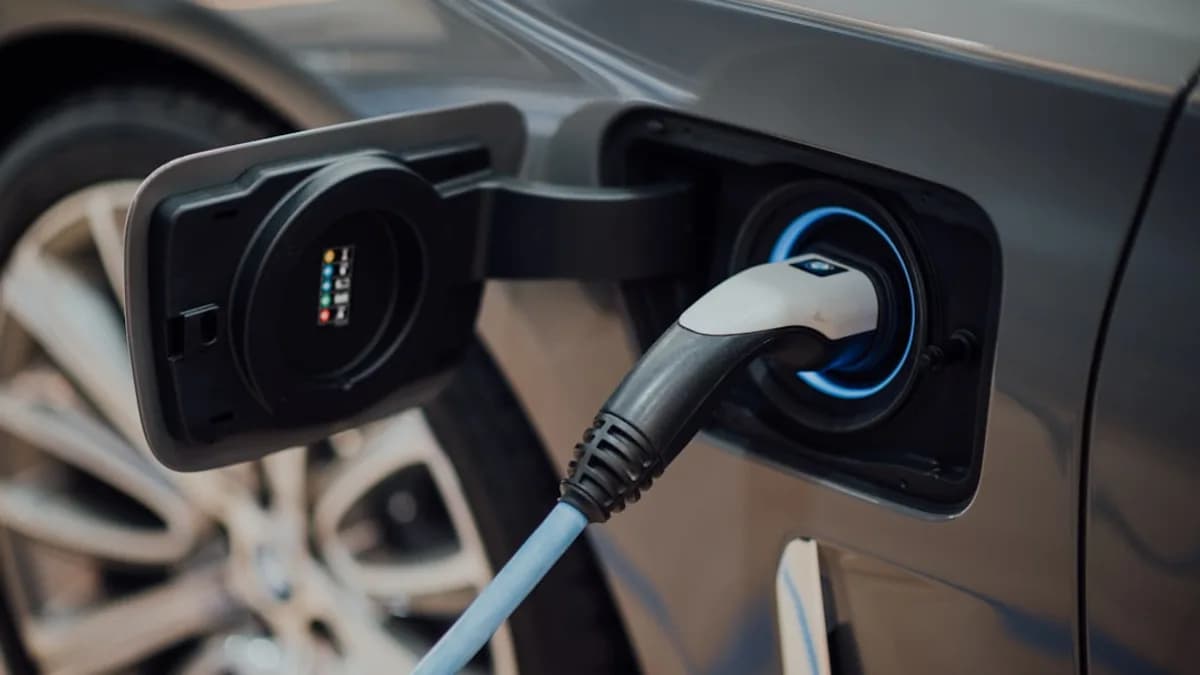
The auto industry’s problem is no longer whether drivers will switch to electric cars; it is whether the rest of the system can keep up with a market that has doubled from 10 million annual EV sales to roughly 21 million in just a few years.
That shift is the real story behind the latest EV sales data, according to Notebookcheck, which cites International Energy Agency figures showing that BEVs and plug-in hybrids now account for 25 percent of new cars sold globally. In 2018, that share was just 2 percent.
Electric cars have moved from challenger product to market default in key regions
The headline number is blunt: around 21 million electric cars were newly deployed globally last year, compared with the first crossing of the 10 million threshold in 2022. That means the EV market did not merely grow. It compressed a major adoption curve into a very short period.
The market signal is stronger than the volume figure alone. Notebookcheck’s data shows that every fourth new car sold worldwide now runs on electricity rather than fuel, when counting battery-electric vehicles and plug-in hybrids together. That does not mean combustion vehicles vanish overnight. It does mean they increasingly sit on the defensive side of the market in regions where policy, charging access, and model availability are pushing buyers toward plug-in options.
MLXIO analysis: The competitive question has changed. Automakers are no longer just asking how to convince consumers to try EVs. They are being forced to ask how quickly they can price, build, service, and distribute electric models in markets where EV share is already too large to treat as experimental.
The sales data shows a two-speed EV boom, led overwhelmingly by China
The global EV boom is not evenly distributed. China is the volume engine. Of the roughly 21 million EVs sold globally last year, 13 million were sold in China’s domestic market alone. That gives China about 60 percent of global new EV registrations.
Europe is moving fast as well, but for a different reason. Notebookcheck says EV sales in Europe rose nearly 30 percent in the first quarter of 2026, giving BEVs and plug-in hybrids 28 percent of new registrations. Experts cited in the source expect that by the end of 2026, one in three new cars across Europe will be a BEV or plug-in hybrid.
| Region | Source-supported signal | Market implication |
|---|---|---|
| China | 13 million EVs sold domestically; roughly 60 percent of global registrations | Scale, pricing, and charging density are reinforcing adoption |
| Europe | Q1 2026 EV sales up nearly 30 percent; 28 percent of new registrations | CO2 fleet rules are accelerating the transition |
| Latin America | EV registrations surged 75 percent | Smaller base, but adoption is spreading beyond core markets |
| Southeast Asia | Electric car sales doubled within 12 months | Fast regional growth is no longer limited to China, Europe, and the US |
| Global 2026 projection | More than 23 million EVs expected | The record cycle has not yet peaked, based on current forecasts |
A separate Electrek summary of the IEA’s Global EV Outlook says global EV sales are expected to hit 23 million in 2026, making up nearly 30 percent of new cars sold worldwide. It also cites the IEA’s view that battery prices remain a key force behind momentum.
“Looking ahead, the falls we have seen in battery prices and the potential policy responses to the current global energy crisis are set to provide further momentum in EV markets,” IEA Executive Director Fatih Birol said, according to Electrek.
One caution: sales volume is not the same as financial success. The supplied data shows adoption and market share. It does not show which automakers are earning strong margins, which models are profitable, or how price competition is affecting balance sheets.
China’s EV advantage is now a scale problem for everyone else
China’s lead is not just about consumer demand. Notebookcheck points to fiercely competitive prices from local automakers and an extremely dense charging infrastructure as reasons switching to an electric car has become easier for Chinese buyers.
Electrek’s IEA-based reporting adds more detail on the production side: Chinese automakers supplied 60 percent of EVs sold worldwide in 2025, and China produced nearly 75 percent of the world’s roughly 22 million EVs last year. Chinese EV exports doubled to more than 2.5 million vehicles. Outside China, Europe, and the US, 55 percent of EVs were imported from China, up from under 5 percent five years ago.
That matters because scale changes pricing power. If one market controls the largest domestic demand pool, the largest production base, and more than 80 percent of global battery cell production, rivals face a harder cost equation before the car even reaches the showroom.
MLXIO analysis: This is where the EV transition becomes an industrial strategy problem, not just a climate or consumer story. Countries and automakers that cannot match China’s cost structure may still compete, but they will need clearer advantages: local manufacturing, brand strength, software quality, regulation-driven demand, or specialized segments.
This adoption curve now looks less like a trial and more like a platform shift
The jump from 2 percent global EV share in 2018 to 25 percent now is the most important comparison in the data. It shows that EVs have passed the stage where adoption depends only on early buyers.
The source material points to several forces working together:
- Battery costs: The IEA cites falling battery prices as a source of further momentum.
- Policy pressure: Europe’s stricter fleet CO2 rules are pushing automakers faster.
- Charging access: China’s dense charging buildout is making the switch easier.
- Manufacturing scale: China’s production base is lowering the global cost bar.
- Model spread: EV sales are growing across China, Europe, Latin America, and Southeast Asia.
This resembles prior technology adoption curves only in one narrow way: once cost, infrastructure, and product quality move together, adoption stops depending on persuasion alone. MLXIO has tracked similar hardware adoption dynamics in adjacent sectors, including consumer energy products such as Mova’s solar system with a €300 discount and free smart meter, though the EV market is operating at a much larger industrial scale.
Different players face different risks from the same EV sales surge
For drivers, the immediate implication is wider EV availability and a faster-growing installed base. The supplied data does not provide total cost of ownership, resale values, insurance costs, or battery degradation figures, so those remain outside this analysis. What it does show is that EVs are becoming common enough in major markets that buyers are increasingly comparing plug-in models against each other, not only against combustion cars.
For automakers, the risk is more direct. High global EV growth does not guarantee that every brand wins. The data suggests a market being pulled toward scale, price competition, and regional manufacturing strength. China’s share of sales and production makes that pressure visible.
For governments and energy planners, the oil-market effect is already part of the IEA framing. Notebookcheck cites forecasts that by 2030, the influx of BEVs could save around 5 million barrels of crude oil every single day. That is not a marginal transportation footnote. It is a demand-side energy shift with measurable consequences.
EVs are also part of a broader move toward connected, updateable hardware. That creates opportunities, but also operational risk. MLXIO’s reporting on record IoT attacks tied to the Kimwolf botmaster case is not an EV story, but it is a reminder that connected infrastructure brings security obligations alongside convenience.
The next test is whether EV growth stays strong outside China’s gravity well
The records are clear: 21 million EVs last year, more than 23 million projected in 2026, and forecasts suggesting around 55 million electric vehicles could be sold by 2035. The direction of travel is not subtle.
The more useful question is where the next proof point comes from. If Europe reaches the expected one-in-three share by the end of 2026, if Southeast Asia continues scaling after doubling in twelve months, and if Latin America’s 75 percent registration growth persists, the EV boom will look less dependent on China alone.
Evidence that would weaken the thesis would be equally clear: slowing growth outside China, weaker charging rollout, stalled battery cost declines, or automakers pulling back because unit growth fails to translate into viable economics.
For now, the old auto model has lost negotiating power. EVs have already taken a quarter of global new-car sales. The next phase will decide who controls the profit pool behind that share.
The Bottom Line
- EVs have shifted from a niche category to one-quarter of global new car sales.
- Automakers now face pressure to scale pricing, production, service, and distribution for electric models.
- China’s dominance highlights that the EV boom is advancing unevenly across global markets.