Can a €899, wire-free robotic mower make boundary cables and RTK antennas feel unnecessary for small European lawns?
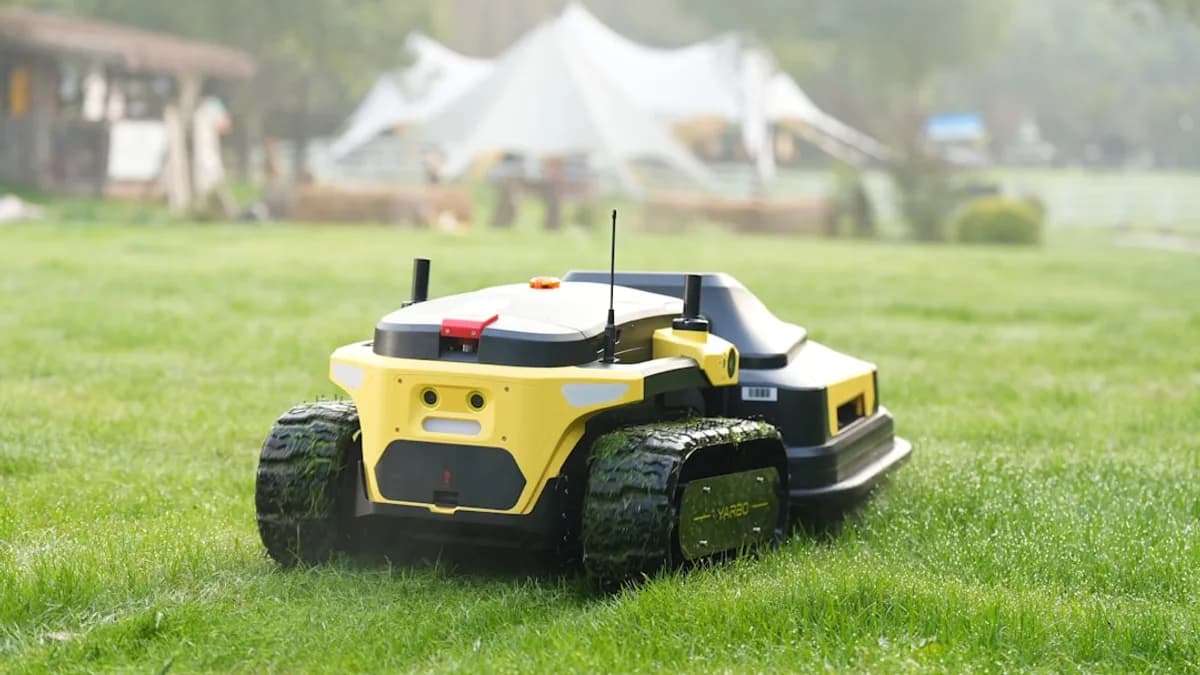
That is the real test behind Anker’s Eufy C15, which has now moved from pre-order to official rollout, according to Notebookcheck. The pitch is blunt: Anker’s cheapest robotic lawnmower to date maps a garden with front-mounted cameras, skips perimeter wires, skips RTK, and launches with a free shelter at the same €899 price as the base mower.
Does €899 turn Eufy’s robot mower from premium gadget into appliance?
The Eufy C15 is not trying to beat Anker’s higher-end mowers on raw coverage. It sits below the Eufy E15 and Eufy E18, and it is built for lawns up to 500 square meters.
That positioning matters. The C15 is framed less as a flagship and more as a low-friction entry point. The recommended retail price starts at €899, or €999 including the garage. During the launch promotion, Anker is selling the mower with the garage for €899, effectively bundling the shelter for free.
MLXIO analysis: that bundle is doing more than sweetening the deal. In a category where buyers may already worry about installation, mapping, blades, weather exposure, and reliability, including the shelter reduces one obvious add-on decision at checkout. It makes the package feel complete.
This follows Anker Day’s broader hardware push, which also included a flagship robot vacuum with a fragrance function; for related MLXIO coverage, see our look at Eufy’s HydroJet S2 fragrance bet.
Can camera-only navigation replace wires and RTK in a cheaper mower?
The C15’s most important feature is not the cutting disc. It is the navigation stack.
The mower uses a front-mounted camera system to map the lawn independently. That means no perimeter wire. It also means no RTK antenna. RTK, or real-time kinematic positioning, is a high-precision satellite correction method often used when a robot needs tighter location accuracy than standard GPS can provide. It can work well, but it adds hardware and setup complexity.
The C15 instead bets on camera-led autonomy. The same cameras used for mapping also handle obstacle detection.
Notebookcheck’s testing claim is notable:
The mower recognizes “objects like hedgehogs and other wildlife,” which “worked reliably in our testing.”
That is a meaningful claim, but not a complete verdict. Reliable obstacle detection in one review setting does not automatically prove reliable boundary behavior across every lawn shape, lighting condition, or seasonal change.
MLXIO analysis: the C15’s gamble is that enough small gardens are predictable enough for cameras to do the job without the cost and setup burden of wires or RTK. If that holds, the product’s spec sheet becomes less important than the owner’s first hour with the mower.
Do the numbers make the C15 meaningfully cheaper, or just simpler?
The headline figures are clear:
| Model / package | Price or capacity from source material |
|---|---|
| Eufy C15 | €899 starting RRP |
| Eufy C15 with garage | €999 RRP |
| Launch offer | €899 with garage included |
| C15 lawn capacity | Up to 500 m² |
| E15 lawn capacity | Up to 800 m² |
| E18 lawn capacity | Up to 1,200 m² |
| C15 cutting width | 180 mm |
| C15 cutting height | 20 to 60 mm, manually adjustable |
The C15 is not a hidden flagship. The 180 mm cutting width and 500 m² limit place it squarely in smaller-garden territory. Related launch coverage also lists support for slopes of up to 32%.
Total cost is where the wire-free claim matters. A mower that does not need a boundary cable may spare buyers the work of laying one. A mower that does not need RTK avoids the antenna setup. The source material does not quantify installation savings, so the financial case cannot be fully measured yet.
Still, the value proposition is visible: €899, no perimeter wire, no RTK antenna, and a launch-bundled garage.
For a separate example of how hardware makers use discounts and bundled extras to change buyer psychology, MLXIO recently covered Mova’s solar discount and free smart meter bundle.
How did robotic mowers get to a camera-first entry model?
Older robotic mowers often depended on boundary wires. That made sense: a buried or pinned wire gives the robot a clear operating zone. It also creates the worst part of ownership before mowing even starts.
Newer models increasingly use combinations of cameras, sensors, GPS, RTK, or hybrid navigation. The C15 strips that stack down to the part Anker thinks can carry the experience for smaller lawns: vision.
That is the smart-home playbook applied outdoors. Reduce setup. Hide complexity. Push control into an app. Bundle the accessory that buyers might otherwise postpone.
The C15 can be managed through Eufy’s app, where users can create schedules, manage saved maps, and adjust settings. It also has onboard controls for manual operation in the garden.
MLXIO analysis: this is Anker treating lawn care less like specialist garden machinery and more like consumer electronics. The risk is that lawns are messier than living rooms. Edges shift. Light changes. Wildlife appears. Grass grows unevenly. A cheaper autonomous mower still has to feel boringly dependable.
Who judges the C15 most harshly: homeowners, rivals, or retailers?
For homeowners, the scorecard is practical:
- Setup: Does mapping work quickly without wire or RTK?
- Coverage: Does it mow the whole 500 m² target area without awkward misses?
- Safety: Does obstacle detection reliably avoid pets, people, and wildlife?
- App control: Do schedules and saved maps behave predictably?
- Cut quality: Is the 20 to 60 mm manual height range enough for the lawn?
- Durability: Does the included garage help protect the mower over time?
For retailers, the confirmed fact is simpler: the C15 is available directly from Anker’s website, on Amazon, and through other retailers. The source does not provide sell-through data, retailer reaction, or margin details.
For competitors, there is also no sourced reaction. The cautious read is this: if a recognized smart-home brand can make wire-free mowing credible at €899, buyers may start expecting that feature set closer to entry level.
Does the C15 make smart garden hardware more accessible in Europe?
The confirmed launch is European-priced in euros, and regional availability beyond that remains unclear in the supplied material. Earlier related coverage said UK and US availability had not been confirmed.
For European buyers with smaller lawns, the C15 lowers three barriers at once: price, installation complexity, and accessory cost during the launch window. That does not make it cheap in an absolute sense. It makes it less intimidating than a mower that asks buyers to pay more, install infrastructure, and then hope the mapping works.
MLXIO analysis: the C15’s importance is not that it has the biggest lawn rating. It does not. Its importance is that it packages autonomy into a smaller, simpler, cheaper product. That is often how smart-home categories move from enthusiasts to ordinary households.
What would prove Anker’s low-cost mower strategy right?
The C15 will not be judged by launch pricing alone. It will be judged after weeks of ordinary mowing.
Evidence that would strengthen Anker’s thesis:
- Reliable mapping without wire or RTK across different lawn shapes.
- Consistent obstacle detection, especially around wildlife and pets.
- Clean coverage within the stated 500 m² limit.
- Low owner intervention after initial setup.
- Stable app behavior for schedules and saved maps.
Evidence that would weaken it is just as clear: boundary confusion, frequent remapping, missed patches, poor edge behavior, or obstacle detection that works in tests but falters in everyday gardens.
The C15 may not redefine robotic mowing through specifications. Its sharper play is expectation-setting. If €899 with a free garage buys credible wire-free mowing, the next entry-level robotic lawnmower will have to explain why it asks buyers to accept more hassle.
Key Takeaways
- Anker is lowering the entry price for wire-free robotic mowing in Europe.
- Camera-based navigation could simplify setup by removing perimeter wires and RTK hardware.
- The free shelter bundle makes the €899 launch offer feel more complete for first-time buyers.