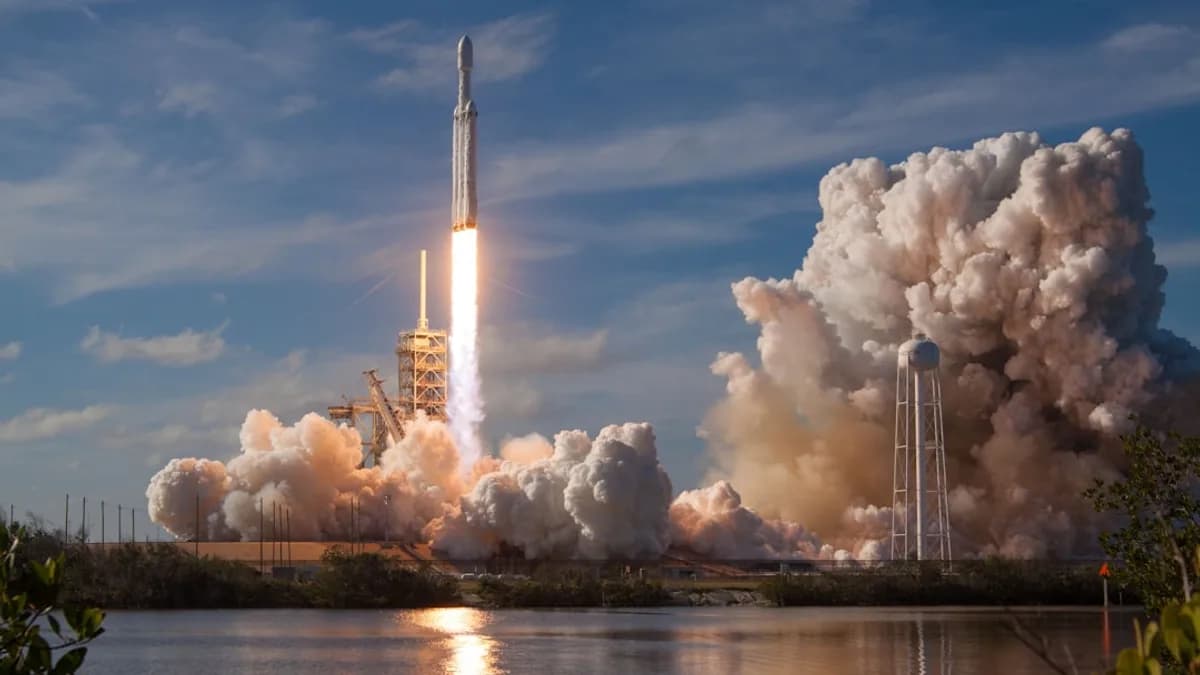
Blue Origin’s New Glenn is cleared to fly again after an April upper-stage problem destroyed an AST SpaceMobile satellite, putting Jeff Bezos’ rocket company back on the launch pad with unanswered questions about the failure.
The Federal Aviation Administration cleared New Glenn to resume flights after Blue Origin submitted a report and made “corrective measures,” according to TechCrunch. The company said the rocket’s upper stage “experienced an off-nominal thermal condition” that caused one of its three engines to deliver less thrust than expected.
Blue Origin gets its New Glenn schedule back, but not the missing satellite
The clearance ends a grounding that followed New Glenn’s third-ever flight, when the rocket failed to place an AST SpaceMobile satellite into the intended orbit. The payload later burned up in Earth’s atmosphere.
Blue Origin did not publish a detailed technical account of the failure. It did not say what component overheated, how the thermal condition developed, or what changes were made before the FAA allowed flights to resume.
New Glenn’s upper stage “experienced an off-nominal thermal condition” that caused one of the three rocket engines to produce lower-than-expected thrust, Blue Origin said.
The immediate question for Blue Origin: does the company treat this as a narrow upper-stage fix, or as a broader reliability signal for a rocket still early in its flight history?
The April launch was not a total failure for the company. The New Glenn booster was reused for the first time and landed again on an ocean drone ship. That matters because booster recovery is central to Blue Origin’s plan to fly New Glenn repeatedly, as other reusable-rocket tests like SpaceX’s Starship V3 booster loss show.
| Mission element | April result |
|---|---|
| Booster reuse | Successful first reuse of the New Glenn booster |
| Booster landing | Successful second landing on an ocean drone ship |
| Upper-stage payload delivery | Failed to deliver the AST SpaceMobile satellite to the target orbit |
| Customer payload outcome | Satellite burned up in Earth’s atmosphere |
That split result is why the FAA clearance is not a clean reset. New Glenn’s booster story improved. Its upper-stage story now has a gap Blue Origin has not fully explained.
AST SpaceMobile takes the direct hit from New Glenn’s upper-stage shortfall
The most immediate loser was AST SpaceMobile, whose satellite did not reach a usable orbit. Blue Origin was supposed to place the commercial payload into orbit, but the upper-stage thrust shortfall prevented that outcome.
AST SpaceMobile said it had insurance coverage for the cost of the lost satellite. The supplied sources do not detail the insured amount, replacement timing, or whether AST SpaceMobile will fly again with Blue Origin on a revised schedule.
What does the customer know that the public still does not? That is the open point. Blue Origin said it has taken corrective measures, but it has not disclosed whether those measures involved hardware, software, inspection procedures, mission planning, or operating limits.
Blue Origin CEO Dave Limp previously said the company was in contact with AST SpaceMobile after the launch. In a post cited by the Orlando Sentinel, Limp said:
“While we are pleased with the nominal booster recovery, we clearly didn’t deliver the mission our customer wanted, and our team expects.”
That sentence captures the tension around New Glenn. A reusable booster landing is valuable, but commercial launch customers buy orbit delivery. In this case, the payload result outweighed the booster milestone.
MLXIO analysis: for a rocket on only its third flight, the distinction matters. Early missions build the record that customers, regulators, and internal teams use to decide whether a launch system is maturing or still exposing basic flight-risk issues. The source material supports the existence of the failure and the FAA return-to-flight decision; it does not show how customers have reacted beyond AST SpaceMobile’s insurance disclosure and Blue Origin’s stated communication with the company.
Launch buyers and regulators now have one narrow question: was the engine issue isolated?
New Glenn’s return comes after an FAA process tied to public safety. The FAA had classified the April event as a mishap after the rocket failed during the second-stage flight sequence, according to the related Orlando Sentinel report.
The FAA’s clearance indicates Blue Origin’s report and corrective actions satisfied the agency enough for flights to resume. It does not mean the public has received a full failure investigation.
For launch buyers, the practical concern is narrower than public speculation: can Blue Origin show that the upper-stage engine underperformance has been contained before the next payload flies?
The company has said it plans to launch New Glenn as many as 12 times by the end of 2026, TechCrunch reported. The one-month grounding now sits directly against that ambition, though the effect on Blue Origin’s flight calendar remains unclear.
The April mission also came after earlier New Glenn milestones. The rocket debuted in January 2025, and a follow-up mission launched a pair of Mars-bound satellites in November, according to the related source material. The April flight was the third mission and the first to reuse the booster.
MLXIO has covered other technology execution stories outside space, including Trump Mobile T1 Phones Reach Media After Yearlong Delay and ₹5,000 Hike Hits OnePlus Nord 6 Weeks After Launch. New Glenn is a different category of risk: when launch execution fails, the result can be a lost spacecraft and a regulator-imposed pause.
New Glenn’s next flight will test Blue Origin’s fixes, not its booster comeback
Blue Origin can now move toward another New Glenn mission. The company has not said when that flight will happen, what payload it will carry, or whether the mission profile will change after the April failure.
The next useful disclosures would be specific: what caused the “off-nominal thermal condition,” what was changed, and whether Blue Origin added new limits or checks for the upper stage. Without that detail, outside observers can only separate the visible facts from the missing engineering record.
Could a successful return flight restore momentum quickly? Yes, but only if the upper stage performs as required and Blue Origin avoids another payload-delivery problem.
The broader signal is straightforward. New Glenn’s booster program just showed progress through reuse and another ocean landing. Its upper stage now has to prove that the April engine underperformance was a corrected incident, not a recurring weakness.
Impact Analysis
- FAA clearance lets Blue Origin resume New Glenn launches after the April upper-stage failure.
- The destroyed AST SpaceMobile satellite leaves unresolved questions about New Glenn’s early reliability.
- Successful booster reuse and landing remain important proof points for Blue Origin’s reusable launch strategy.