Updated: This article has been substantially revised to correct the identities of Uranus’ two outermost rings, remove unsupported composition and age claims, and reflect the current state of evidence from Hubble, Keck, JWST imaging, and planetary-ring research.
Why Uranus’ Outer Rings Challenge Our Understanding of Planetary Ring Formation
Uranus has handed planetary scientists a puzzle: its two outermost rings do not appear to be simple variations of the same structure. Instead, the faint μ (mu) and ν (nu) rings likely have different source histories, shaped by separate moons, dust-production processes, and dynamical environments.
That matters because ring systems are often described as if they formed from one broad event: a disrupted moon, a collision, or leftover debris trapped around a planet. Uranus complicates that picture. Its ring system is not one uniform disk like Saturn’s bright icy rings. It is a narrow, dark, dusty, highly structured collection of rings and ringlets, including the well-known dense epsilon ring and the much fainter outer μ and ν rings.
The emerging view is not that all ring-formation models must be discarded, but that they must be more flexible. A planet’s rings can be assembled and refreshed by multiple processes over time: micrometeoroid impacts on small moons, collisions between satellites, dust migration, resonances, and gravitational shepherding. Uranus’ outer rings make that complexity impossible to ignore.
Decoding the Data: How Webb, Hubble, and Keck Helped Reveal Uranus’ Ring Mysteries
The story of Uranus’ outer rings has unfolded across decades and across observatories. The Hubble Space Telescope played a central role in identifying the faint outer μ and ν rings in the early 2000s, while Keck Observatory observations helped study their colors, brightness, and relationship to nearby moons. More recently, the James Webb Space Telescope (JWST) has delivered some of the clearest infrared views yet of Uranus, its rings, and its moons.
The key distinction is observational rather than sensational: the μ and ν rings do not look or behave alike. The μ ring is associated with the tiny moon Mab and is unusually blue for a planetary ring, a trait it shares with Saturn’s E ring. The ν ring is redder and lies closer to a different population of inner moons, including members of Uranus’ tightly packed Portia group.
That color difference is important. In ring science, color can point to particle size, surface processing, contamination, and source material. A blue ring is often interpreted as being dominated by very small dust grains, while redder material may indicate different particle sizes, surface alteration, or composition. Current evidence does not justify precise claims such as “60% water ice” or “80% carbonaceous material” for these faint rings. The safer conclusion is that their colors, locations, and associated moons point to distinct dust sources.
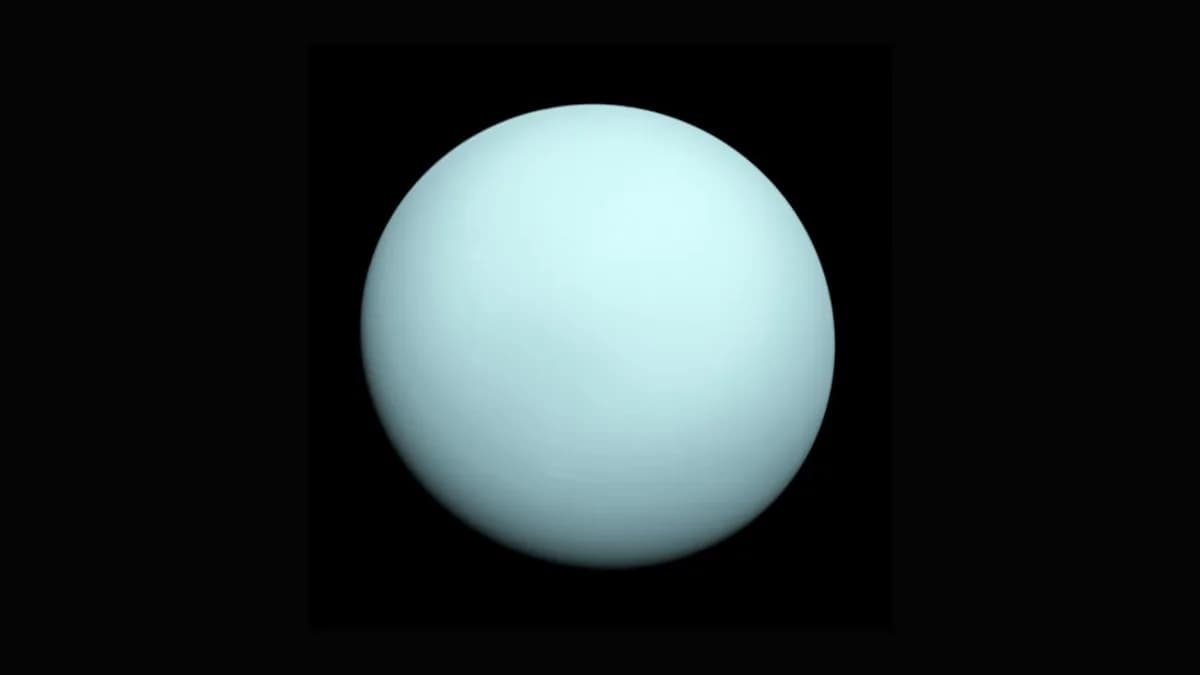
JWST adds another layer by imaging Uranus in infrared wavelengths, where its rings and atmosphere stand out in different ways than they do in visible light. But even Webb does not turn these rings into easy targets. Uranus is nearly 3 billion kilometers from Earth, and its faintest rings are thin, dark, and easily overwhelmed by the planet’s glare.
Numbers Behind the Rings: Structure, Color, and Dynamics of Uranus’ Outer Rings
Uranus has 13 known rings, most of them dark and narrow. The dense epsilon ring remains the brightest and best-known of the main rings, but the outermost pair are ν and μ, discovered long after the classical rings were found.
The ν ring orbits outside the main ring system but inside the μ ring. It is broad and diffuse compared with the narrow classical rings. Its redder color suggests a dust population different from that of μ, possibly tied to nearby small moons or a past collisional event in the inner satellite system.
The μ ring is farther out and is centered near the orbit of Mab. Its blue color is one of the strongest clues that it may be continuously replenished by dust knocked off Mab by micrometeoroid impacts. Small grains can remain spread through the ring while larger fragments may fall back to, or remain near, the source moon.
Unlike Saturn’s bright rings, which are dominated by reflective water ice, Uranus’ rings are generally dark. They reflect little sunlight and are difficult to measure in detail. That darkness is one reason scientists are cautious about making strong composition claims without direct spacecraft measurements.
Age estimates are also uncertain. Ring material can be young even if the ring’s orbital location is ancient, because dust is constantly created, altered, and removed. For the μ and ν rings, the most defensible statement is that they are likely maintained or refreshed by ongoing processes rather than being untouched relics from Uranus’ formation.
Diverse Origins Explored: Scientific Theories on How Uranus’ Outer Rings Formed
The leading explanation for the μ ring is that it is fed by Mab. Micrometeoroids striking the small moon can eject dust into orbit. Over time, that dust spreads into a broad ring. The ring’s alignment with Mab and its unusual blue color support this source-moon model.
The ν ring is less straightforward. It may be tied to a different group of inner moons or to debris produced by older collisions in Uranus’ crowded satellite system. Uranus’ inner moons occupy tightly spaced orbits, and long-term simulations suggest that some may be dynamically unstable over astronomical timescales. That environment makes collisions and dust production plausible.
A captured-asteroid explanation is possible in broad planetary-science terms, but it is not the leading interpretation for every Uranian ring. For μ and ν, local satellite sources remain the more grounded explanation. The central point is still striking: two rings in the same planetary system can be sustained by different source bodies and processes.
That makes Uranus a useful counterweight to Saturn. Saturn’s rings dominate public imagination, but they are not the template for all ring systems. Uranus shows how faint, dusty rings can act as tracers of moon impacts, satellite evolution, and gravitational sculpting.
What Uranus’ Ring Discovery Means for Planetary Science and Future Exploration
The evidence for distinct origins among Uranus’ outer rings strengthens a broader shift in planetary science: rings are not static ornaments. They are active systems that record impacts, moonlet evolution, particle transport, and gravitational interactions.
This has direct implications for future exploration. The U.S. planetary science decadal survey identified a Uranus Orbiter and Probe as the highest-priority new flagship mission for the coming decade. Such a mission has not yet launched or been fully approved, but if it proceeds, Uranus’ rings and moons would be major targets.
An orbiter could do what telescopes cannot: measure ring particles directly, map dust density, identify composition with close-range instruments, and track how material moves between moons and rings. It could also determine whether rings like μ and ν are being actively replenished today.
The exoplanet angle is important but should be handled carefully. No ring system around an exoplanet has been confirmed beyond dispute. Still, Uranus offers a warning for future exoring studies: if distant planets do have rings, those systems may not be Saturn-like. They may be faint, dusty, temporary, and shaped by local moons.
Stakeholders Weigh In: Perspectives from Researchers, Space Agencies, and the Scientific Community
Researchers who have studied Uranus’ rings, including teams associated with Hubble, Keck, and JWST observations, have long emphasized the value of comparing the outer planets rather than treating Saturn as the default model. Work by scientists such as Imke de Pater, Mark Showalter, and other planetary-ring specialists has helped establish Uranus as a complex ring-and-moon system worthy of renewed attention.
NASA has also increasingly highlighted Uranus in public releases tied to JWST imaging and in long-term mission planning. The planet was once visited only briefly, by Voyager 2 in 1986, which remains the only spacecraft to fly past it. Nearly everything known since then has come from Earth-based observatories and space telescopes.
The scientific community’s interest is growing because Uranus sits at the intersection of several open questions: how ice giants form, how rings evolve, how small moons survive, and how planetary systems respond to impacts over billions of years. Its outer rings are a small feature with outsized scientific value.
Looking Ahead: Predicting the Next Frontiers in Uranus Ring Research and Outer Planet Exploration
The next phase of Uranus ring research will depend on sharper imaging, longer monitoring, and eventually a dedicated spacecraft. JWST can continue tracking the rings in infrared light, while upgraded adaptive optics at observatories such as Keck and Gemini can improve ground-based views.
The biggest leap would come from a Uranus orbiter. Instruments capable of dust detection, high-resolution imaging, magnetospheric measurements, and near-infrared spectroscopy could finally test whether μ is actively fed by Mab, whether ν is tied to the Portia-group moons, and how quickly ring particles are created and lost.
Beyond Uranus, the lesson is clear: ring systems are dynamic records of planetary history. They can preserve evidence of collisions, moon erosion, and orbital instability. Uranus’ outer rings are not just faint lines around a distant planet; they are clues to how chaotic and changeable planetary systems can be.
Impact Analysis
- Uranus’ two outermost rings, μ and ν, likely have distinct source histories.
- The μ ring is strongly associated with the small moon Mab, while ν appears linked to a different dust environment.
- The finding supports a more complex view of ring formation, where multiple processes can shape one planet’s ring system.
- Future Uranus missions could directly measure ring particles and settle questions that telescopes cannot fully answer.