Introduction: The Cosmic Dance of Supermassive Black Holes
Astronomers have recently uncovered a remarkable cosmic event unfolding 800 million light-years from Earth: two supermassive black holes are spiraling toward each other, destined to collide within the next century—a blink of an eye on astronomical timescales [Source: Source]. This impending merger is not only a rare spectacle but also a scientific goldmine. Such events are among the most energetic and transformative occurrences in the universe, promising to generate powerful gravitational waves and reshape their host galaxy. The prospect of witnessing, or at least recording, a supermassive black hole collision in real-time has ignited excitement among both scientists and the public. In this article, we’ll break down what supermassive black holes are, how this collision was discovered, what happens when these cosmic titans merge, and what—if anything—Earth might experience as a result.
What Are Supermassive Black Holes?
At the heart of nearly every large galaxy lies a supermassive black hole—an object millions to billions of times more massive than our Sun. Unlike stellar-mass black holes, which are formed by the collapse of massive stars, supermassive black holes are thought to grow over billions of years through the accretion of gas, dust, and even stars, as well as by merging with other black holes [Source: Source]. These giants exert a profound influence on their surroundings, shaping the formation and evolution of their host galaxies.
Supermassive black holes are typically found at galactic centers, where their immense gravity governs the orbits of stars and the dynamics of galactic material. The Milky Way’s own central black hole, Sagittarius A*, has a mass equivalent to about four million Suns. Yet, some supermassive black holes can reach masses of tens of billions of solar masses, making them the most massive single objects in the known universe.
Their origins remain a subject of intense research. Scientists hypothesize that they begin as smaller “seed” black holes in the early universe, gradually growing through accretion and mergers. The energy they release—often visible as active galactic nuclei or quasars—can drive galactic winds, regulate star formation, and even determine the fate of their host galaxies. Understanding supermassive black holes is thus essential to unraveling the broader story of cosmic evolution.
The Discovery: Two Titans on a Collision Course
The identification of two supermassive black holes on a collision path marks a significant milestone in astronomical observation. Researchers detected this pair using advanced radio telescopes, which allowed them to observe distinctive particle jets emanating from the galaxy’s center. These jets—streams of charged particles moving at near-light speed—are a telltale sign of active black holes, particularly when two are spotted in close proximity.
The host galaxy, named SDSS J120136.02+015619.2, is located approximately 800 million light-years away from Earth [Source: Source]. Within its core, astronomers observed two separate jets, each corresponding to a black hole with masses estimated in the millions of solar masses. The black holes are separated by just a few light-years—a minuscule distance on a galactic scale—and their mutual gravitational pull is drawing them inexorably closer.
What makes this discovery particularly unique is the timescale. While most observed black hole mergers involve stellar-mass black holes and take place over thousands or millions of years, this supermassive pair is expected to collide in about 100 years. This proximity in time and space allows scientists to monitor the final stages of a merger that has been, until now, largely theoretical. The detection was made possible by the unprecedented sensitivity of modern radio telescopes, which can resolve the complex dance of these titanic objects. Observing such a merger will offer new insights into galactic dynamics, the life cycle of black holes, and the extreme physics at play where gravity reigns supreme.
What Happens When Supermassive Black Holes Collide?
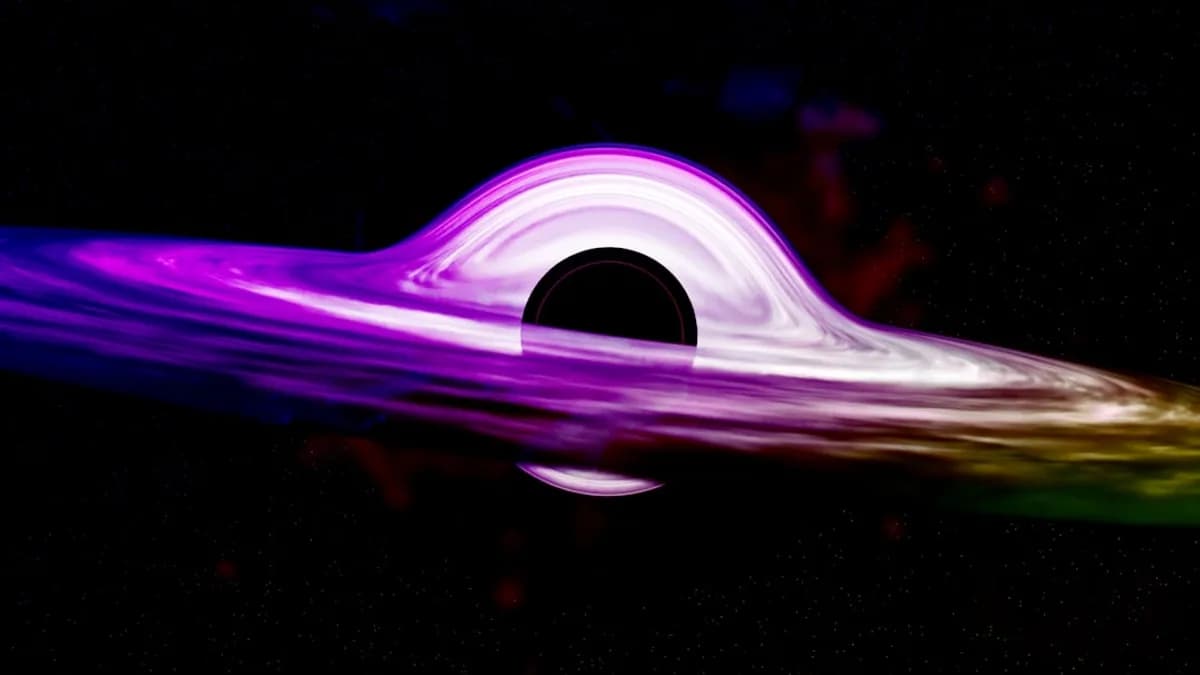
Supermassive black hole mergers are among the most dramatic events in the cosmos. As these giants spiral closer together, they lose energy through the emission of gravitational waves—ripples in the fabric of spacetime first predicted by Einstein and confirmed by recent observations of smaller black hole mergers. In the final moments, the black holes will accelerate, their event horizons stretching and distorting under immense gravitational forces. When they finally collide, they will form a single, even larger black hole, releasing an enormous burst of energy [Source: Source].
The merger process unfolds in several stages. First, the black holes orbit each other, gradually losing orbital energy. As they approach, tidal forces and relativistic effects intensify, culminating in a dramatic coalescence. During and after the collision, the newly formed black hole may emit powerful jets and outflows, reshaping the surrounding galaxy. The gravitational waves produced by a supermassive merger are far stronger than those from stellar-mass black holes, potentially detectable across the universe by next-generation observatories.
The “100 years from now” estimate is unusually short for such events. In cosmic terms, this is nearly instantaneous, as most galactic collisions and mergers unfold over millions or billions of years. Scientists will be able to monitor the approach, collision, and aftermath, using both gravitational wave detectors and electromagnetic telescopes. The data collected will help refine models of black hole growth, test theories of gravity under extreme conditions, and explore new frontiers in astrophysics.
Could Earth Feel the Effects of This Collision?
The headline-grabbing question is whether Earth, or humanity, will experience any direct effects from this distant cosmic collision. The answer is reassuring: the black holes are far too distant for their merger to threaten our solar system. However, the collision will send gravitational waves rippling across space. These waves distort spacetime itself, but by the time they reach Earth, their effect is minuscule—smaller than the width of an atom [Source: Source].
Gravitational waves from mergers of stellar-mass black holes have already been detected by observatories like LIGO and Virgo, confirming Einstein’s predictions and opening a new window onto the universe. A supermassive black hole merger will produce even stronger waves, offering an unprecedented opportunity for Earth-based detectors to record and study them. While we won’t feel these waves physically, scientists will gain invaluable information about the universe by analyzing their properties.
It’s important to dispel misconceptions: black hole collisions do not “suck in” material from across the cosmos or pose any direct danger to Earth. Instead, their effects are confined to their host galaxy. For us, the main impact will be scientific: a chance to observe one of the universe’s most extreme events and to advance our understanding of fundamental physics.
The Broader Implications for Astronomy and Physics
The impending collision of two supermassive black holes is much more than an astronomical curiosity—it’s a crucial opportunity for science. Gravitational waves from such mergers can test the limits of Einstein’s general relativity, explore the nature of spacetime, and shed light on the behavior of matter and energy under extreme gravitational conditions. Observing this event will deepen our understanding of how galaxies form and evolve, and how black holes grow over cosmic history.
Technologically, the event will push the boundaries of gravitational wave astronomy. Current detectors are optimized for smaller mergers, but a supermassive collision could inspire new, more sensitive instruments—both ground-based and space-based. Multi-messenger astronomy, which combines gravitational wave data with electromagnetic observations (like radio, optical, and X-ray), will allow scientists to piece together a more complete picture of the event.
In the grand scheme, this discovery fits into the ongoing narrative of cosmic evolution. Supermassive black hole mergers are rare, but they are key drivers of galactic change. They help form the most massive galaxies, trigger bursts of star formation, and redistribute cosmic material. By studying such collisions, scientists advance not only astrophysics but also our understanding of the universe’s structure and fate.
Conclusion: Awaiting a Universe-Shaking Event
As we look toward the future, the collision of two supermassive black holes stands out as a cosmic milestone. While the event is still about 100 years away, its discovery has already transformed our understanding of the universe’s most powerful forces [Source: Source]. Scientists are preparing to observe and analyze the merger, hoping to unlock new secrets about gravity, black holes, and the evolution of galaxies. For the public, this event is a reminder of the universe’s dynamic nature and our ability to peer into its deepest mysteries. Though Earth will not feel the collision directly, the signals it produces will enrich our scientific knowledge for generations to come. As humanity watches and waits, we are reminded of our place in the vast, ever-changing cosmos—and the wonders it continues to reveal.